How Century Happened: A Story of Confluences

Some thirteen years ago I had some correspondence with a fellow Centurion (someone from Century, Florida), Jerry Simmons, of the Alger-Sullivan Historical Society (ASHS) about the unique personalities and circumstances that combined to eventuate the town of Century, Florida, and the extraordinary Alger-Sullivan sawmilling operation – reputed in its day to be the largest anywhere East of the Mississippi River – that both built and sustained it for two-thirds of a century, but, for a variety of reasons, we never published our findings. Then, just yesterday, Neal Collier, currently a leading light in the ongoing efforts to preserve and acknowledge the fascinating history of the place, posted a note about one of those founders, W. D. Mann, which reminded me that I had already done much research on both him and his associates that I had not shared, so I sent this info to Neal who requested that I find a way to make it public, and as I realized that’s what this blog is for – to share information and interests with all of you – I decided to post it here.

If you find the history of the Florida panhandle, or early American forestry, or even the  story of how the Civil War both skewered and served those it affected long into the next century, you might find this of interest. And, if you’re a Centurion, yourself, or simply interested in the history of southern sawmilling, I’m sure you will. Posted with a great affection for this little place where I grew up and the people at its heart. 10/24/2025
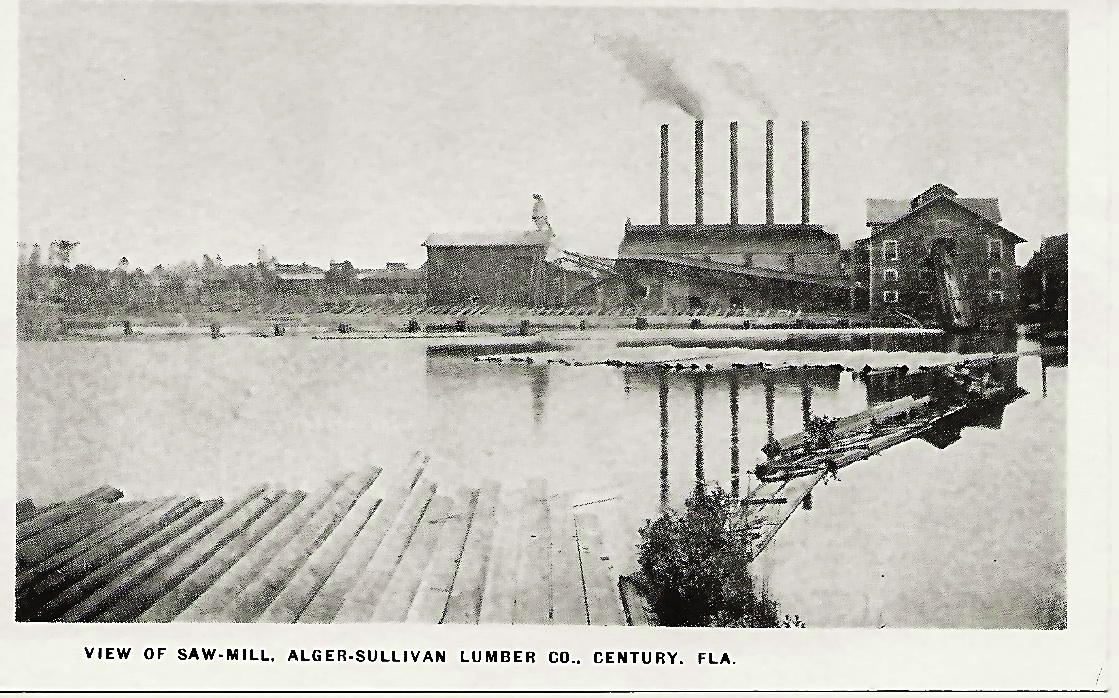
Postcard showing Alger-Sullivan Sawmill Company about 1939


Dear Jerry,

When you mentioned you might want to publish my higgledy-piggledy notes sent to you on Facebook about the founders of Century, I was inspired to keep digging till I got to the bottom of the story on every possible front. As you know, when last I wrote you, I was still trying to figure out the Daniel Sullivan part, and now I believe I have the whole thing. It’s an unbelievable tale that really belongs in a novel, but since I don’t have enough time to do that, I’m just going to send you what I have uncovered, as best I can, in narrative form, without references, though I did find strong evidence in every case here presented.

In putting this together, I found Ancestry.com to be especially useful, and I created family trees for the Sullivan brothers, the Hausses, the Heckers and the Henry Glover families, and these were instrumental in taking me to places I could never have imagined. The story turns out to be much more intertwined than I had ever suspected. If you like, I can get you the link to these family trees to look for yourself and for the benefit of the Historical Society.

We all know the main players: General Russell Alger, Daniel and Martin Sullivan, Colonel Frank Hecker and W. D. Mann. To this, I would now add two additional names: Kate Grant Sullivan (Mrs. Martin) and Emily Cropp Sullivan (Mrs. Daniel). Since E. A. Hauss and Henry Glover were both recruited to run things by the founders, they are secondary to the story, but no less important, of course, to the history of our town.

I have always been curious about how Alger-Sullivan happened, and even made an appointment with Mr. Hauss when I was in Mrs. Coleman’s fourth grade class studying Florida history to interview him on the early years. Of course, when I was 10, I didn’t know what questions to ask, and even if I had, I’m not sure he would have answered them.

Unfortunately, it’s not a short story because to really understand it all, you have to start at the very beginning, and it also has to be broken into its two halves: the Alger story and the Sullivan story, which both, ultimately, come together when W. D. Mann shows up in Mobile in 1866 and brings them together.

THE SULLIVAN SIDE OF THE STORY

There were carpetbaggers, and then there were benevolent opportunists who descended on the South after the war. The scalawag types saw a wounded country and swooped in to take advantage, but there were also others who, while certainly looking to do well for themselves, were also motivated by some larger calling, a greater good. W. D. Mann was the ultimate rapscallion, but the Sullivan brothers, who came to this country as children only eight years before the Civil War and had no true allegiances except those which were the inevitable result of their having been drafted into the Union Army, were looking for a place where they could practice their devout Catholic faith and put their considerable energies and penchant for prosperity to good use. That said, they got very little credit for their good works from the natives, who would not readily forget that they had both served in the Union Army, but I’m getting ahead of my story.


KATE GRANT of Stella Plantation

There are so many great stories to tell, that it’s hard to know where to start, but I could hardly do better than the tale of Kate Grant, who dropped her pretentious given name, Catherine Clemence Grant in her youth, and as far as I could find, never used any other name but Kate for the rest of her life. The threads of her story really begin when Mademoiselle Genevieve Dulat was wed to the noble Don Antonio de Gras in the Cathedral of Our Lady of Sorrows, now the Cathedral of St. Joseph, in Baton Rouge on January 15, 1773. Don Antonio, from Majorca, was one of the earliest settlers in the Baton Rouge area, which, unlike New Orleans, was ruled by the Spanish king since the westernmost part of Florida reached all the way to the Mississippi River until 1810. Don Antonio helped design and lay out the city of Baton Rouge and personally donated the land for the Cathedral. His wedding to Genevieve was the very first to be celebrated in the newly consecrated building and he built their home just north of the present church where the State Capitol Annex now stands.

The marriage was a clever one for the Spaniard, who, as a recent immigrant, needed “old-money” connections if he was to be accepted in the highest levels of New Orleans society and his new bride could not have been more well-placed. She was the perfect combination of early Louisiana influences including both German and French. Her mother was a third-generation full-blooded German immigrant whose forebears had arrived in the Colonies in the mid-1600s, and her father – a true Acadian – was a fourth-generation full-blooded Frenchman (except for 12.5% Native American that resulted from his Huguenot grandfather’s scandalous marriage to a Mic-mac princess in Nova Scotia before emigrating with the most of the “Cajun” population from Canada to the New Orleans vicinity in the early 1700s.)

As far as I could determine, Don Antonio and Genevieve only had one child, Joseph Grass, who also married well, choosing Clemence Arthemise Broussard, also a fifth-generation American on both sides of her family (her mother’s family name was Molaison). And, in 1827, their daughter, Olympe Clementine Grass was born.

Only a few years earlier, in 1820, another immigrant, this one from Scotland, had arrived in New Orleans. His name was Alexander Grant, and he is listed as a “merchant” on many documents, but it seems clear that he was a major player in the slave trade. The circumstantial evidence is strong that he was descended from the proprietor of Alexander Grant & Company of Glasgow, which was one of England’s primary slave trading corporations until 1807, when it went bankrupt as a result of the abolition of slavery in that country. The infamous slave fort off of the Ivory Coast was built by Alexander Grant & Company of Glasgow (where our Alexander Grant also hailed from) and there was a different Capt. Alexander Grant, a generation older than ours, who died at sea en route from Barbados to Scotland in 1797 aboard a slave-trading ship. To add to the inference, there was an actual 690-ton slave-trading sloop named the SS Alexander Grant, and, finally, after much searching, I even found an old newspaper ad from around 1830 listing our Alexander Grant as the agent for a slave “estate sale” to be held in New Orleans.

Whatever he did, Alexander Grant made lots of money, because, in 1845, he purchased the immense Stella Plantation just south of New Orleans on the Eastern bank of the river. (You can type “Stella Plantation” into Google Earth and it will take you right there since it is still being operated, these days as a weddings and event venue that takes advantage of the elegant, enormous plantation house and expansive Mississippi River frontage.) It was a massive sugar plantation with scores of slaves and since sugar cane was primarily exported to trade for slaves, his purchase makes perfect economic sense. It is also possible that he saw it as a way to hedge his bets, as the abolitionists were gaining ground by the time he bought the plantation and he may have decided to have a sweet insurance policy, just in case. Slaves or no slaves, sugar would always be in demand.

Alexander Grant married a woman named Julia (last initial D) from Virginia, but that is as much as I have been able to dig up on her background. In 1820, she bore him a son, whom they named Alexander Grant, Jr.  He grew up in his father’s footsteps – at least the maritime part – and became a river boat Captain on the Mississippi, his last vessel being the SS Captain Quitman, which was still in service during the first year of the war, but was burned in 1862 to prevent Admiral Farragut of the Union Navy from capturing it when he overran New Orleans. (Alexander Grant, Jr. then enlisted in the newly-formed CSA Navy as a Lt. and served aboard the CS Missouri, a Confederate Ironclad, until it was decommissioned at the end of the War.)

Several years before the war, in spite of his “newcomer” status and the somewhat off-putting business of his father (slave traders were never considered a very reputable bunch, in spite of the strength of their business), Alexander Grant, Jr. had made an outstanding match for himself when he managed to persuade none other than Olympe Grass – veritable New Orleans royalty – to become his bride. Of course, as a river boat captain, he was away from home most of the time, so Olympe and her growing brood of children – ultimately they had four – lived during the 1850s and 1860s on the Stella Plantation with her in-laws, and who wouldn’t. It was about as good as Southern plantation life could get. It is hard to say upon whom Margaret Mitchell may have based her depiction of Katie Scarlet O’Hara, but the life lived by Katie Grant was as charmed, if not more so, at least, until the Yankees came.

In 1851, Olympe and Alexander Grant, Jr. had their first child, our heroine, Catherine Clemence Grant, or, simply, Kate. In 1873, she would change her name once more, for the last time, to Mrs. Martin H. Sullivan.


EMILY S. CROPP of Barbour County

The story of Emily Cropp also begins in the middle of the 18th Century, since it was about 1750 when her great-grandparents, Mordecai and Esther Cohen Myers, and his brothers-in-law, Abraham and Solomon Cohen, became the first Jewish Settlers to set up shop in George Town, SC. George Town, now Georgetown, was just up the coast from Charlestown, but boasted an economy based upon indigo and rice plantations, rather than the slave/cotton/privateer economy of her larger southern neighbor. Mordecai and Esther had eleven children in all, seven boys and four girls, and they all did well for themselves. Moses Myers was the first Jewish attorney in SC, being admitted to the bar in 1793 at the age of 21. He also served as Clerk of Court of the Common Pleas for 10 years. Jacob, his brother, was a blacksmith, postmaster, and captain of the local artillery company. Abraham Myers was also a lawyer, being admitted to the bar three years after his brother and was elected Mayor of George Town for two terms, and Levi Myers, his younger brother, received his medical degree from the University of Glasgow in 1797 and was the first Jewish doctor to belong to the Medical Society of SC. He enjoyed a distinguished career as a doctor in the low country, mostly in Charleston, until a hurricane in 1822 swept his house out to sea, drowning his entire family.  The other three boys were Solomon, Isaac and Cohen Myers, and it is either Solomon or Cohen Myers who concerns us here.

In 1875, one Capt. Abram Huguenin of the CSA, took the time to write down all his recollections of his family history, which is good for us, because the only thread that links our story to that of the Myers family is this passage: Anne [Huguenin, his first cousin] married Myers (Col.) of Savannah, Ga. I have heard my father say that he heard from his father, that he (Myers) was a very fine fellow, of great humor, he died young, leaving two daughters, one of which married Longworth and was drowned in the “Pulaski” (steamer), the other married Benjamin Cropp and has a large family in Alabama.” Now, by process of elimination, I have been able to determine that the only possible candidates for this “Myers (Col.) of Savannah, Ga” are Solomon and Cohen Myers. Also, since none of the Myers sons was ever a Colonel in any army (they were too young for the Revolutionary War and just right for the War of 1812, but no Colonels), I believe the “(Col.)” was mis-transcribed from the originally handwritten history and he was either writing “Sol.” or “Coh.” It could be either one. Isaac lived a long life, so it couldn’t have been him, and the other four mentioned above are all accounted for with families of record.

So, Anne Huguenin married one of the Myers boys, and they had two daughters. One of them drowned with her husband when the SS Pulaski sank, and the other, Louisa Caroline Myers, born in 1796, married a Georgia preacher named Benjamin Cropp, who then moved with her to Barbour County, AL sometime in the early 1800s.

But that is not all there is to this story, because there was another claim to fame in the Myers clan. Abraham Myers, who had been mayor of Charles Town, and his wife, Belle Nathans, had a son in 1811 whose name was Abraham Charles Myers, who put his talents to work for the young United States by serving in the Quartermaster Corps. His grandfather Mordicai in George Town had supplied the Continental Army throughout the Revolutionary War, including Francis Marion, the Swamp Fox, as he raided the British in and around the low country, so supplying military operations was something long instilled in his blood. By the time the War Between the States began, young A. C. Myers had been graduated from West Point (1833) and was already a senior officer in the U.S. Army Quartermaster Corps, so Jefferson Davis wasted no time in appointing him as the first Quartermaster-General of the Confederacy. A. C. had already set up housekeeping in New Orleans, his adopted city, and he continued to operate from there until Admiral Farragut took over the city, at which time he moved to Montgomery, and from there to Richmond as the War progressed.

One can only conjecture whether or not Louisa Cropp visited her cousin in New Orleans, but it would seem entirely likely. And, if she did, she would surely have taken her grown daughters, including our second heroine, Emily S. Cropp, with her. In other words, even long before they each married a Sullivan brother, they might well have been acquainted through their New Orleans connections. But, either way, marrying into such a well-structured commercial network as that of Quartermaster-General Myers was a real coup for the Sullivans. (For what it’s worth, Fort Myers, FL is named after Daniel Sullivan’s mother-in-law’s first cousin, A. C. – not bad.)


DANIEL FRANKLIN SULLIVAN and MARTIN HENRY SULLIVAN

On March 7th, 1853, the SS DeWitt Clinton steamed into New York harbor. On board were Patrick Sullivan, listed as a farmer on his immigration papers, his wife Bridget, and their six children Catherine, 19; Daniel, 16; Bridget, 11; Martin, 9; John, 7; and Ann, still in diapers. I have not been able to find where, exactly, they settled, but it seems to have been in or near the city since, once the War was joined, Daniel and Martin were drafted into the Union Army in New York City. Both signed on with the 88th New York Volunteers, called the “Irish Brigade” because it was almost exclusively made up of Irish immigrants. Daniel was mustered in on the 19th of September, 1861 and when Martin turned 18 on February 1st of 1862, he joined the same brigade, though in a different company.

Most of the Irish Brigade was sent to Washington to join the Army of the Potomac and the list of battles it fought paints a long, slow, deadly trail from the early days of the war right through to the surrender at Appomattox Courthouse, and Daniel was among this group of soldiers. He served for his full term before being mustered out in good condition exactly three years, to the day, from when he had begun.

Martin, on the other hand, was fortunate to be in one of the two Companies of the 88th who were assigned to guard Fort Washington in the Bronx, so he was still in New York when he was placed on the disabled list in late November, only 10 months after he started, with an unspecified bowel ailment. He must have improved, however, because in June of ’63, while working in the city as a bartender (now age 20), he re-registered for enlistment with the Army, but I could find no record of his having served a second tour of duty.

Daniel’s final action as a soldier was at Reams Station, VA, a few miles south of Richmond, in August of 1864. The only hard information, such as it is, that I have found about his movements and actions from September 19 until he marries Emily in 1868, can be found on the Pensapedia website, where it says that he supplied the Union Army by rounding up free range cattle. However, we know enough about him to connect some dots and fill in the blanks.

We can begin by assuming his first priority would be to get home to his family, who were still, as far as we know, in New York City where his strapping brother was bartending, passing through Washington before taking a train north. With three years under his belt as an ambitious soldier in and around D.C. to make contacts and explore possibilities for making his way after the war, he most likely already had a plan in mind and he wasted no time putting it into motion.

It is not a well-known fact that Florida, in those years, was grazed from one end to the other by hundreds of thousands of freely-roaming head of cattle, and they were especially thick in the panhandle, having grown and multiplied ever since 1540 when “Don Diego Maldonado brought a large herd of Spanish cattle and horses to the Pensacola Bay area to supply the expedition of Hernando De Soto. Don Diego was unable to make contact with the conquistadors and it was reported that many of the cattle were lost to run wild in the timber of north Florida” (from Florida-Agriculture.com).

During the War between the States, it was well known that the great “wild” herds in central Florida were one of the Confederacy’s most valuable food resources – indeed, it was famously a thorn in the side of the Union – with most of that beef flowing out of Tampa Bay or being driven by sympathizers north to the Georgia and Alabama borders for distribution to the forces. And, since we can assume there were similar herds of roaming cattle on the Union-held timberlands in and around Pensacola at the time, no doubt the Union was eager to get in on the free food at its feet and looked for a way to round up as much of this untapped resource as possible.

“What?” I can just hear Daniel, whose first 16 years had been spent enduring the Irish Potato Famine, saying when he heard about this. “Are you telling me there are free cows just roaming around down there for the taking? You mean I can serve my country and make a fortune just by grabbing my brother and heading for Pensacola? What are we waiting for?!”

Now, the difficulty, and reason these cattle had not already been confiscated, lay in the fact that the only possible way to get them from isolated Pensacola (the Confederates having completely taken up and removed the rail lines as they left) was by ship, and the loading docks and facilities had been ransacked just like the railroads when the town was abandoned by the Confederates. But where others saw obstacles, Daniel and Martin saw opportunity, and they set out to make it possible to load the cattle and sail it to New Orleans, the nearest Union-held port that could get it to the inland armies. The enterprise would also have required their setting up business on the receiving end, so it seems clear that both cities would have seen a lot of the Sullivan brothers once they began.

In other words, as best I have it figured, Daniel and Martin left New York City by the end of 1864 and sailed south, around the Union-held fortifications at Key West, and most likely landed in Pensacola just in time to begin work around the first of 1865. The very nature of the job they had to do would have taken them deep into the unspoiled timberlands at least as far north as they could go before running into Johnnie Reb, introducing them to the extraordinary value in the towering trees that grew all around, untouched and under-appreciated. With government gold to spend, they would have had all the resources they needed to corral their cattle, and since the freight docks had to be rebuilt and outfitted – another opportunity! – Sullivan’s Wharf, which would be the foundation for all their later successes, was soon under construction. Perhaps, while Daniel stayed in Pensacola to run things, Martin accompanied the shipments back and forth to New Orleans to make sure they were properly recompensed for their troubles (which would also have given him ample opportunity to get to know and love the woman he would marry eight years later).

And what a place they would have found when they arrived in Pensacola! It would be hard to imagine a more desolate or unwelcoming sight. It was deserted, destroyed, dilapidated and dirty; home to squatters, ne’er-do-wells and reprobates who, for whatever reason, were not serving either side in the war – the human flotsam and jetsam of its tides.

It was deserted because, when the Union forces took over the city in May of 1862, the retreating Confederate soldiers burned every government building they could, destroyed anything that might be of value to the Union, and all of the locals who were Confederacy sympathizers headed north into Alabama, leaving only the Union loyalists in place when the U.S. Navy moved in. For a few months, the better homes and gardens of Pensacola provided luxurious barracks for the Union officers, but then they were ordered to desert what was left of the burned out city and reposition themselves behind the rebuilt fortifications at the navy base, taking all the locals who were Union sympathizers with them for their protection. This made for cramped and uncomfortable living on the base and left the city open to “feral” invaders and, astonishingly, the result was that by early May of 1863 there was one – one! – permanent resident left in all of Pensacola, and that was the Spanish Consel, Francisco Moreno, who, as it turned out, was a Confederate spy, which may explain his willingness to remain there all by himself.

And, it was onto this wasteland that Daniel and Martin Sullivan disembarked. It must have taken their breath away when they saw the daunting challenges they faced, but they were full of energy, drive and determination, and, finally released from the bonds of poverty and war, they must surely have been chomping at the bit to make their mark on the world. Where others saw disaster, they only saw possibilities, and they intended to make the most of them.

Of course, their enterprise for the Union armies could have only lasted for a few months, since the War was over that spring, but if there were still free cattle to be rounded up among the pines trees (free-range cattle in Florida went extinct around the turn of the 20th Century), I’m sure they worked it till the supply was exhausted. By then, of course, they had their wharf, their New Orleans connections, and enough of a nest egg to parlay into a remarkable series of successes. And, while the details are lost to history, somewhere along the way Daniel, supplier of the Union Armies, met and, in 1868, married – ironically enough – the beautiful and accomplished cousin of the Quartermaster-General of the Confederacy and great-granddaughter of the man who had supplied the Carolina Revolutionaries. By all accounts she was a remarkable wife and mother and a great asset to Daniel. In an obituary published in the New Orleans Times-Democrat following his death, it says he was “Blessed with a wife whose angelic goodness and truth surrounded her with a halo and placed her on a pinnacle far above ordinary women.” Even allowing for the hyperbole of the Victorian era, that’s quite a compliment.

Emily Cropp Sullivan bore Daniel two daughters. Mary L. was born in 1869 and Kate in 1871. This latter name and date are instructive, since it was two years before Martin married Kate Grant in 1873, leading one to postulate that she and Emily may well have been good friends and it was that connection which led to Kate’s courtship with Martin in those years.

Quickly, the brothers began to make the most of the opportunities that surrounded them on every side. They had the wharf and needed something new to export, and since the only local, exportable resource of any size was held in the vast pinelands that lay to the north in Escambia and Santa Rosa Counties as well as for miles into the southern counties of Alabama, they set about, in a determined and systematic way, to bring that resource to market. They bought up every bit of the forest that became available, bought or built the saw mills required to process them, and laid new railroads into the interior to bring those logs to market.

As more and more money, almost all of it generated by the timber industry, flowed into the area, the brothers launched the First National Bank of Pensacola to keep it safe, and, as the general prosperity of the area grew even further, they capitalized upon the dearth of cultural diversion in the area by constructing the Pensacola Opera House, which was played by all of the great international touring artists of the latter quarter of the 19th Century from Caruso to Sarah Bernhardt, all of whom, presumably, were personally feted by their hosts.

By 1873, Martin had convinced Kate Grant to be his bride, and finally the equation was complete. Through Emily Myers Cropp, Daniel had family connections that spread throughout the whole of the Eastern Seaboard, and through Kate, Martin’s family reach extended into the pockets of the entire Western half of the United States, beginning with New Orleans, itself. The boys were set, and what a remarkable ten years they must have enjoyed as each of their enterprises seemed to only grow into more and better enterprises. They had their forests – a seemingly inexhaustible resource in those days – to harvest, their wharf to ship their product to market, their bank to keep their earnings safe and gaining interest of their own accord, and their opera house to keep them diverted and provide free entertainment for themselves and all their distinguished visitors from the ends of the earth.

In ’74, Martin and Kate welcomed Marie, the first of their seven children. Julie was born in ’75, Daniel Francis Sullivan, II, in the Centennial Year, and Martin H. Sullivan, Jr., in 1879. Their fifth child, Charles, came along in December of 1884, but he would be the first never to know his Uncle Daniel, because he had died six months earlier, in June. It was sudden, and I have not been able to find a cause of death, but Yellow Fever epidemics spread by mosquitos were an annual affair in those days, and since he died in the summer, that is one possibility. In any event, he went out in a burst of productivity. In only the last three years of his life, he executed more than 300 contracts for tracts of forestland – from 120 to 1200 acres each – in Alabama alone. There may have been more in Florida, as well, as evidenced by the mills and railroads the Sullivans built throughout the Western Panhandle, but by the time he died, he had increased his land holdings to as much as a quarter of a million acres. Aside from a few specific bequests, the administration of his estate was entirely vested by his will in the care of Emily and Martin, to do with as they saw fit, and, overnight, Martin’s reach and economic wherewithal went from considerable to commanding.

There seems to have been a peculiar conspiracy of silence surrounding the Sullivan brothers in those early years. If you go through the extraordinarily detailed timeline of Pensacola history on the PNJ website, the most remarkable thing is that nothing whatsoever is listed there between the day the city was surrendered to the Union in May of 1862 and when the war ended in April of 1865. Nothing. Not anything at all is considered to have happened during those years. I further found it curious that in a Master’s thesis I read that tells the Pensacola story during those and the reconstruction years in great detail – including many pages on the timber resources and marketing – the name Sullivan is nowhere mentioned. Only those who were native to the area are included as having been instrumental in these matters in those times. Since I don’t believe the writer of the thesis would have had any intent to “smear by omission” by leaving them out of a scholarly paper written fully 150 years after the fact, I can only presume that, in all the considerable research he did, there just wasn’t much mention of the Sullivan brothers in the local historical records. Yes, they may have come in from the north, and yes, they may have profited by taking advantage of the ripe opportunities they found in Pensacola, but they did it by the sweat of their brows and the clarity of their business acumen, not by conniving and subterfuge, so while the locals of the time may have seen them as carpetbaggers, I don’t count them as such. They did not immigrate to Pensacola to pillage, they came to apply themselves and make a living by filling a perceived need and working hard, and in so doing they created much of the infrastructure upon which the new Pensacola was built; the very foundation for whatever prosperity the area enjoyed in the years that followed.

It is also telling, I think, that the only obituary of Daniel that I have been able to find, though it was published in the Pensacola Commercial, was a reprint of one written and published the day before in New Orleans. No one in Pensacola seems to have been interested in extolling the virtues of a man who had done more than anyone to resurrect prosperity in his adopted city. I think he really loved Pensacola, and he seems to have put his money where his heart was in many ways. Of course, I’m sure he always made a profit so it’s hard to feel sorry for him. I’m convinced it was because of the cold shoulders they must have endured that he (or maybe it was Martin’s doing) made sure he would not be forgotten for generations to come by purchasing a huge plot in St. Michael’s Cemetery and erecting the tallest, most impressive monument there. Even today, it strives to say: this was great man.

The obituary, signed by “R. M. K., New Orleans Times-Democrat” and published in Pensacola on June, 18, 1884, reads:

“The sad intelligence of the death of Daniel F. Sullivan at his home in Pensacola, Florida, has by this time been telegraphed to all the principal cities of Europe and America and in each of them warm and true hearts are today mourning this sudden ending of a life so noble, so pure, so [unclear], with work well done and character wisely and generously bestowed.

“A typical Irish gentleman, Mr. Sullivan possessed those qualities of mind and heart which commanded the respect and won the esteem and regard of all who knew him.

“His wonderful business talent was known all through this country and is vouched for by the success of his numerous and varied enterprises. By his untiring energy he soon amassed a large fortune and in an incredibly short space of time was justly numbered among the merchant princes of the South.

“Generous and just, he was ever willing to aid the poor and deserving. No young man anxious to work and struggling to gain an honest livelihood ever applied to Mr. Sullivan in vain, and the different branches of his life work gave employment to hundreds who feel that thy have lost their best friend.

“Gifted with a genius for acquiring wealth, he gave with untiring hand to the poor and needy. The blessing of the widow and the orphan sounded daily in his ears. Churches and charitable institutions of all creeds appealed to him, confident of his willingness to aid them. Philanthropy in the best sense of the word. He never wearied of improving and beautifying the city of his adoption.

“It was this writer’s proud privilege to claim him as a friend and to study the simplicity, beauty and worth of his character in that most trying of all crucibles, his home. No truer, tenderer heart ever beat in the breast of man, and no man ever did more for the comfort and happiness of his family.

“Blessed with a wife whose angelic goodness and truth surrounded her like a halo and placed her on a pinnacle far above ordinary women, his home life was indeed enviable and beautiful. To her and to his loving children it is difficult to suggest anything in mitigation of a grief so unequaled. To God, whom they have ever faithfully looked and feared, we commend them, confident that He will help them bear this affliction with which he has seen fit to visit them.”

Two years after Daniel died, Martin’s sixth child, Russell, was born. It was January of 1886, and I also find this instructive since Russell was not a family name and uncommon enough that I suspect General Russell Alger, who had been elected Governor of Michigan in 1884, had already come into the picture, one way or another. This was most likely through their mutual acquaintance, W. D. Mann, who, like the Sullivans, had seen the virtue of investing his considerable fortune in Alabama timberlands, beginning with his arrival in Mobile in 1866, but unlike them, was a true scoundrel.

The last of Martin’s children, John J. Sullivan, would be born in 1887, even as his father’s vast expanse of lands, network of local railroads, bank, opera house and export/import operations continued to thrive. The demand for Southern Longleaf Yellow Pine grew exponentially in the 1880s and ‘90s due to its expanding reputation as a strong, durable wood capable of supporting the vast factories spawned by the industrial revolution across Europe and the Americas. The trees of the virgin forest were enormous – up to 350 years old, 180 feet tall and four feet in diameter – and considered the best to be found this side of Michigan. By the mid-1890s, millions of board-feet of lumber were shipping out of Pensacola every month to supply the needs of governments and business interests around the globe, and all of it from Sullivan’s Wharf.

Indeed, the need was so great, and the ability of the little local sawmills so puny, that something big needed to be done. It was time to build the biggest, most productive sawmill that the best engineers of the time could produce, and to do that, Martin needed a level of world-class expertise that was not to be found nearby. At the time, Michigan was the center of the forest products universe, with the biggest mills and best distribution route, via Lake Michigan, and the lumber industry there was booming as strongly as it was in Pensacola, but on a much grander scale. What Martin needed was an industrialist lumber baron from the North to help him build his dream mill, and who better than the friend for whom he had (apparently) named his fourth son, General Russell A. Alger of Grand Rapids.


THE ALGER SIDE OF THE STORY

Most likely because of his titles and fame, General Alger has always impressed me as being the brightest star in the Alger-Sullivan constellation, but I find that of all the players in the story, he turns out to be the least involved.  Nevertheless, he provided exactly the expertise in large-scale lumber milling that was needed, and the people he sent down from Michigan to put it all together – Hecker, Glover and Hauss – proved to be fundamental and were, in the end, the three people who, along with Martin, Kate and Emily, were most responsible for everything that happened in the design, construction and operation of Century and the Alger-Sullivan sawmill for nearly sixty years.


Brevet Major-General RUSSELL ALEXANDER ALGER

40th U. S. Secretary of War, 20th Governor of Michigan, U. S. Senator,

and 23rd Commander-in-Chief of the Grand Army of the Republic


Orphaned at thirteen in Ohio, Russell Alger worked on a farm to support himself and his two younger siblings before teaching for two years, getting his law degree and moving to Grand Rapids in 1860 to engage in the lumber business. He married and had six children and as his fortune grew, so did the prominence of his family.  He enlisted as a private at the start of the Civil War and was soon elevated to Captain and then Major in the 2nd Michigan Cavalry Regiment. After several successful battles, in July of 1862 he was named Lieutenant Colonel in command of the 6th Michigan Cavalry. Coincidentally, a year later, a gentleman named W. D. Mann was given the same rank and placed in command of the 7th Michigan Cavalry, both serving under the command of General George Armstrong Custer. They would serve in close quarters for the remainder of the war and were particularly instrumental at the battle of Gettysburg, meriting strong mentions in General Custer’s report on the battle.

Over three years, Alger commanded his cavalry in sixty-six different skirmishes and battles and was, quite coincidentally, mustered out of the army only one day after Daniel Sullivan, on September 20, 1864, and in the same general area. It is quite possible they met for the first time on that occasion, but that is pure speculation.

After the War, Alger settled in Detroit as head of both the Alger, Smith & Company and the Manistique Lumbering Company and personally owned a great pine forest on Lake Huron that covered more than 64,000 acres. (Given that, the 250,000+ acres of the Sullivans must have astonished him.) As Alger prospered and his family grew, he branched out into politics and, in 1884, he was elected Governor of Michigan and served a two-year term through the end of 1887, when he refused to be re-nominated.

In 1897, President McKinley asked Alger to serve as his Secretary of War, and he was in charge for most of the Spanish-American War, which began the next year. He was asked to resign in August of 1899 because the war wasn’t going very well.

Alger was appointed by the Michigan Governor in 1902 to fill out the remaining months of a U. S. Senate term following the death of the sitting Senator, and was elected to his own term beginning in 1903. He served until his death in 1907.


Colonel FRANK J. HECKER

Like Alger and the Sullivans, Frank Hecker had also started with nothing and built an empire by the seat of his pants. The son of Prussian immigrants, he was born in Freedom, Michigan in 1846. In August 1864, at the age of 18, he enlisted in Company K of the 41st Missouri Infantry, but since the war was nearly over by the time he was old enough to join, he worked until 1866 as a clerk in headquarters of the Missouri forces. After the army, he joined the Union Pacific Railroad for two years, worked on several railroad construction projects until 1876, and then took his last job before launching out on his own as superintendent of the Detroit, Eel River, & Illinois Railroad, where he remained until 1879.

In December 1879, he and a partner named T. D. Buhl founded the Peninsular Car Works to make railroad freight cars. Buhl must have been the larger investor since he was President and Hecker was VP/Treasurer. One of their founding Directors was his fellow Michigan industrialist, General Alger. The combination of lumber and rail made a great deal of sense in those days because, until trucks grew large enough for the task, railroads were the only available means of extricating large saw logs from landlocked forests. Indeed, in its heyday, as you know, Alger-Sullivan was running over 100 miles of track in Escambia County, Alabama. In 1884 or 1885, Hecker and another railroad car magnate, Charles L. Freer (of the Freer Gallery of Art which is part of the Smithsonian) bought out Buhl and changed the name to the Peninsular Car Company. Following a merger in 1892, The Peninsular Car Company became the Michigan-Peninsular Car Company and Frank Hecker remained president until 1899.

However, in June of 1898, the US forces in Cuba fighting under Teddy Roosevelt were in trouble and there were not enough ships in the US Navy to supply their needs, so, General Alger, then serving as Secretary of War, enlisted his fellow Michigander and gave him the authority to purchase and charter ships for the transportation of troops and supplies. On July 18, 1898, William McKinley commissioned Hecker as a Colonel of Volunteers, Chief of the Division of Transportation, Quartermaster’s Department. And, until May of 1899, he continued his purchasing and hiring duties, outfitted transports for conveying troops to and from Cuba and Manila, arranged for the transportation of troops by rail, contracting for the movement of Spanish prisoners from Santiago to Spain, and conducting inspections.

Now, while I’m jumping ahead of the story a little here, it sheds a fascinating light on all of this to learn of something that happened in 1904. Theodore Roosevelt had appointed Hecker to the second Isthmian Canal Commission to supervise the construction of the Panama Canal and establish the Canal Zone government in March of that year. “However, in October, newspaper allegations claimed that the Commission purchased construction and other supplies without public advertisement and suggested that Col. Hecker may have mishandled lumber contracts to suit the business interests of his friend, Senator Russell A. Alger, and himself. Col. Hecker resigned the next month, citing illness related to the Canal Zone climate (despite encouragement from President Roosevelt to remain in his position).” [taken from the University of Michigan website] Clearly, it’s a lot easier to ship lumber from Pensacola to Panama than from Michigan, so this undoubtedly must refer to Alger-Sullivan production.

It is also worth mentioning that, in 1898, Col. Hecker’s daughter, Louise May, married Count Julius von Szilassy of the Austro-Hungarian Empire. He would later be made a Baron and died in 1935, but only seven years after their marriage, in 1905, Louise filed for divorce, citing “non-support” as the reason for her decision. They had one son, George Charles Frances Szilassy. An article printed in the June 2, 1905 edition of the New York Times reads:

“COUNTESS ASKS DIVORCE. Former Miss Hecker of Detroit Brings Suit Against Diplomat.

“DETROIT, June 1 – Countess Louise May Hecker de Szilassy, daughter of Frank J. Hecker of Detroit, ex-member of the Panama Canal Commission, has begun a suit for divorce from Count Guyla Hope Joseph de Szilassy of Vienna, who was for many years Secretary of the Austro-Hungarian Legation at Washington. They were married Dec. 23, 1898. The countess charges non-support in her bill. She has one child.”

From May 1905 to December 1906, Col. Hecker and a group of three Michigan friends owned a controlling share of the Detroit Free Press and he was on the original Board of Directors of the Union Trust Company of Detroit, Detroit Lumber Company, and, of course, Alger-Sullivan Lumber Company. He was also a Director on the Boards of the Detroit Copper and Brass Rolling Mills, LaSalle County Carbon Cola Company, and State Savings Bank (later the Peoples State Bank). He also lived longer than any of his fellow “first-generation” founders, and died at home in Michigan in 1927.

HENRY GLOVER

The details of Henry Glover’s life are sketchy, at best, but we do know that he was born in Vermont in 1851 and by the age of nine had moved to a 450 acre farm in Saginaw County, Michigan, rich timber country. When he was 32 he married Elizabeth A. Wilson in Bay City, not far from where his family had first set up their farm. In 1879, their first child, George Ezra, was born, and in 1887, their second, Irene Elizabeth. Since Henry Glover was too young to have served in the War, his youth was most likely devoted to learning the lumber trade which surrounded him on every side. In a Canadian census from Algona, Ontario – literally right across the line from Michigan – in 1891, he is listed as a lumberman.

Sometime after that, but before 1900, he moved his family to Mobile, and there, in 1900, he is listed in the census as the manager of a lumber company. So, while Alger and Hecker must have known of him, at least by reputation if not professional association, his move south must have occurred earlier than the inauguration of Alger-Sullivan and I detect, once again, the fine hand of our old friend W. D. Mann, long removed to New York City by then, but still very active in the region, and still holding some Alabama timberland of his own in the Mobile area.

In any event, there is little doubt that the new Alger-Sullivan Syndicate (the legal name of the holding company formed to own Alger-Sullivan Lumber Company and the associated lands) was well acquainted with Glover and his worth as a lumberman, since they chose him to oversee the construction of the mill and the town that we all know so well.

Unfortunately, Glover died early, in 1911, at the age of 59, so we will never know what contributions he might have made as the company matured. We can all thank him, however, for his greatest contribution to Century, his darling daughter, who was still darling sixty years later, our own Miss Irene.


WILLIAM D’ALTON MANN: WHERE THE TWO SIDES MEET

W. D. Mann was the Rupert Murdock of his age, though he didn’t start out that way. Like all of the other players in this story, he was a self-made man and, at least in the beginning, thrived on his ingenuity and resourcefulness.

Ready to join the war effort but unimpressed with his chances in Sandusky, Ohio, where he was born, he moved into Michigan where he had learned he would be given an officer’s commission if he could round up 1000 soldiers to fight under him. With charm, guile and exemplary salesmanship, he rounded up the quota in no time at all, but was dashed to find that the Michigan commanders felt his recruits were needed elsewhere and gave them to another commander. However, the Michigan Governor was impressed with his industriousness, so he challenged him to do it all over again in Saginaw, where the supply of available men was much smaller, with the promise to give him the command if he succeeded. He did, and on February 9, 1963 was named commanding Colonel of the 7th Michigan Cavalry, serving beside the commander of the 6th Cavalry, Russell Alger.

He also had invented a novel leather ammunition pouch for soldiers to use in the field, and it became very popular because it was configured to hang in the front, thus counterbalancing the weight of the backpacks and making it easier to endure long marches. He sold thousands of his pouches, which is most likely where he got his seed money, and he had amassed quite a bit of it by the time, in 1865, he was named an Internal Revenue Assessor by Washington and sent to Mobile.

Once in Mobile, arriving with a fortune of about $225,000, Mann quickly began investing in local industry, and especially in local timberlands and sawmills. By the 1870 census he was listed as owning $150,000 worth of land and having a personal net worth of $75,000 to boot. That is an enormous amount for someone so young (he was only 25 at the time of his arrival in Mobile) in such difficult times.

By 1870, he purchased a controlling interest in a small Mobile newspaper, and shortly thereafter, when approached by the foundering Mobile Register to invest enough money to keep it afloat, he took control of that paper as well.

In all, he remained in Mobile for about ten years before moving back north. His departure was no doubt occasioned by his involvement in a corruption scheme whereby the newspaper promoted a referendum to agree to the city purchasing a new paving system made basically of treated wooden railroad ties laid like bricks on the ground. It turned out that the timber to be treated for this use was to come from his own lumber interests in the city, and once this was exposed, he felt the time was right to move to New York, where his brother Eugene, who, with similar enterprise, had purchased a failing New York gossip sheet, renamed it Town Topics, and made it the talk of the town. Once he arrived, W. D. took over as editor of the rag while his brother ran the financial end of the company. That arrangement lasted until 1901, when his brothers failing health caused him to move to Arizona and leave the operation of the paper entirely in the hands of his brother.

In 1891, Mann also invented the “Mann Boudoir Car,” a railroad sleeping car, giving us yet another connection between Mann and Hecker. They just keep piling one on top of the other, until it all just seems to have been inevitable.

Perhaps Mann’s biggest claim to fame came in the late 1800s when he famously worked out a deal with the Robber Barons – Rockefellers, Carnegies and the like – not to print juicy gossip about them if they would only pay him a tidy fee for the discretion. Once word of this arrangement got out, Collier’s Magazine ran a big expose, tarnished the image of Town Topics to such a degree that the paper never really regained its former footing.

It is hard to know exactly when, or how, the connections all fell into place between the Sullivans, W. D. Mann, Alger and Hecker, but there were so many overlaps and joint interests in all of their lives, that it would have been more surprising if they had not resulted in some great common enterprise.


EDWARD ADOLPHE HAUSS

Once the Alger-Sullivan syndicate had been formed, and the work was underway to set up what we have all come to know as Century, there were still a few empty slots to fill. Martin Sullivan would continue to play an active role as Chief Executive until his death in 1911, and both Glover and Frank C. Hecker (the Colonel’s son) were also in place to oversee the operations, but there was still the need for a clerk/bookkeeper, and the elder Frank Hecker knew just the man. He was a young, eager and incredibly precise second-generation German who was already making an impression on his superiors at the Michigan-Peninsula Car Company, and he seemed, to Hecker, the perfect choice.

Better yet, he knew before he even asked that he wouldn’t, couldn’t, refuse because the gentleman in question was none other than his sister Anna’s son, little Eddie Hauss.

Once I re-discovered the relationship, that Hecker was Mr. Hauss’s uncle, I seemed to detect a glimmer of a memory that I already knew that from somewhere, but I surely had forgotten it long ago if I did. Of course, when they asked him to come down, they couldn’t have known that by 1911 both Sullivans and General Alger would have died, and the elder Hecker would only arrive from time to time to visit his son in the vast mansion named Tannenheim, leaving only the first cousins – younger Frank C. Hecker and Hauss – to run the place. One has to say they did themselves proud. And, in the end, when the younger Hecker died in 1939, the little clerk from the railroad car company found himself in charge of the whole kit and caboodle. And, there he remained, keeping it as true to its origins as the 20th Century would allow, until it was sold in 1957.

In 1900, just before heading south, Hauss married his Michigan sweetheart, Ethel, and they had two daughters, Anna, in 1904 and Ethel in 1907. Unfortunately, his wife died in the 1930s, and, in 1945, he journeyed to Europe to be married once more, and here, Jerry, is where this story took the most bizarre turn of all, because it turns out that the woman he married and that we both knew as Katalin, was, in fact, the sister of that Count Szilassy who had married, and been divorced by, Hauss’s first cousin, Louise May Hecker, nearly fifty years earlier.

By the way, I looked everywhere for an obituary of Martin Sullivan, who left his interest in the mill operations to Kate when he died in November of 1911, but could find only one short article, in the St. Lucie County Tribune, of all places, and it reads:

“After providing handsomely for all of his relatives in the United States and Ireland, Martin H. Sullivan, the millionaire Pensacola lumberman and banker, who died in Baltimore on October 15 last, by the terms of his will, directs the executors to increase the capital stock of the Sullivan Bank and Trust Company, of Montgomery, Alabama to $250,000. After this is done, he bequeaths his entire holdings in the Montgomery bank to his son, Russell Sullivan.”

Clearly, there is still much to the story, but, at least, I now know to my full satisfaction just how Century came to be, and how it managed to stay that way for so very long.

Hope you are well. Sorry this is so long, but it’s a long story.

Best to you and warm regards,

Tommy Wilson

4/2/2012

© 2025 by George Thomas Wilson


Posted in Angels | Leave a comment

Revisiting 2015 Cedar House Garden, Part II Midsummer

[Having posted the first of my three 2015 garden tours a couple of months back, it’s seems only right to give you the mid-summer walk-through, as well. And, in a couple of months I’ll round it out with a repost of the late summer edition from that year. I’m largely doing this for those of you who weren’t around to see God’s Kaleidoscope seven years ago, and also, to be honest, because, well, I love these posts and relish the resharing. I hope you enjoy.]

Since there are very definitely three phases to our beach house garden, I’ve decided to share this journey in three photo essays: The first one, of course, showcased the bright greens and pinks of spring; this second, midsummer, edition is lit with the brilliance of summer finery; and finally, the waning, wisened garden, chastened by a couple of strong storms but still erect like a proud dowager Empress, will conclude the series in a week or so to give you at least a little time between.

Also, as those of you who follow this blog already know, I posted a separate essay on our day lilies this summer which were so magical they demanded their own separate showing. (you can find it here: https://inpraiseofangels.wordpress.com/2015/09/04/day-lilies/) So, ultimately, there was enough beauty to fill four long slide shows for, I hope, your viewing pleasure. I do try to edit them down, and most shots are left behind on the cutting room floor, so I hope this doesn’t go on too long. It is organized just as the first one was, with the deck plantings, followed by the Shady Side and finally, just a couple from the Sunny Side. (Also, if you click on a photo, it will open up in a separate window which may help you see the whole thing at once, depending on what device you may be using.) Enjoy!

THE DECKS

IMAG1956IMAG2031IMAG1859IMAG1983IMAG1982IMAG2020IMAG2044IMAG2049IMAG2026IMAG2018IMAG2045(1)IMAG2048(1)IMAG2061IMAG1963

THE SHADY SIDE

IMAG2063IMAG2010IMAG1896If I have a favorite surprise from this year’s garden, it has to be the hydrangea bush shown below. I’ve always heard that you could change the color of a hydrangea by changing the acidity of the soil, but it never occurred to me that you might be able to grow a multi-colored one. The secret is in the rusty old barrel hoop that you can see sticking out of the ground just to the right of the little red caladium leaves. Left over and imbedded in roots, it is the remains of a half-barrel planter that used to sit where it is, but long ago rotted away. My assumption is that some of the roots of the hydrangea have managed to wrap themselves around the iron, and some of them haven’t, which accounts for the unique and beautiful array of flowers. I have dozens of photos of this one bush. It was impossible to resist.

IMAG1863 - CopyIMAG1965IMAG2064IMAG1903IMAG2015IMAG2070IMAG1881IMAG1880IMAG1972IMAG2006IMAG2005

THE SUNNY SIDE

IMAG1852IMAG1875IMAG1915This last calla lily is another angel gift for which there is no accounting. I planted it along

Long after all the other day lilies were done and gone, this one, last one appeared, bright as a new penny, on Labor Day. It was as if it was saying, "Thanks for the memories and a great, beautiful summer!"

Long after all the other day lilies were done and gone, this single last bloom appeared, bright as a new penny, on Labor Day. It was as if it was saying, “Thanks for the memories and a great, beautiful summer!”

with a whole collection the first year we moved into the house, but callas are summerbulbs, and unless you dig them up to overwinter them in a  cool, dry, dark place (which I did not choose to do since that would have involved transporting them to the city and keeping them in a closet), the freeze of winter will kill them. Except for this one. Blooming for the 20th consecutive year just beside our front door, it has never failed to grow and bloom, and every year – especially after particularly harsh winters (or salt-water flooding a la Sandy) – we wonder if we shall see it again. To date, she has never disappointed us, and this year, she not only grew and flowered, she even generated three additional offshoots. It is possible, of course, that it has something to do with its proximity to the septic tank, but I prefer to give the credit to my angels.

Finally, since I’m always talking about the beach house but never showing the ocean, here’s a view I took a couple of weeks ago just a few steps from our front gate. This really is a beach garden and we are truly, truly blessed, in spite of the occasional salt spray showers and crazy storms.

IMAG2174Wishing each and everyone of you a blessed day, thanks for allowing me into your life, and I hope you enjoyed the angel gifts, for what else could such astonishments be?

© 2015 by George Thomas Wilson. all rights reserved.

Posted in Angels, belief, biology, faith, God the Father, Holy Spirit, miracles, Uncategorized | Tagged , , , , , , , , , , , , , , , , , , , , | Leave a comment

A Photo Essay: Revisiting The 2015 Cedar House Garden

IMAG1781

[NOTE: I first posted this garden tour eight years ago, two years before the fire, so there’s nothing new here, but the truth is, it was beautiful, and while the art, like a Cristo installation, may be long gone, the beauty remains in these images, and I just felt like it was time to revisit them. I do miss my garden.]

If you happened to read my second foundational essay, “The Flow of God: Living Water and All that Missing Matter” (link easily found on the “About” page of this blog), you already know that my daily prayer includes three requests for spiritual tools I can use: first, I ask for metaphorical mirrors – mirrors of every shape and sort – to reflect out our constantly arriving Divine gifts of light, life, and love; Secondly, I ask for metaphorical lenses to gather the light and either shine it into the dark places where evil lurks, fears form and ignorance has a field day, or use it to spotlight the beauty, goodness and truth when we can find it; and thirdly, metaphorical prisms to help me unfold God’s light to reveal all the rainbows within.

And, for me, one of the most delightful aspects of knowing and cooperating with my angels – the very inspiration for this blog – is the creative work we do together to turn my prayer requests into reality, whether it is in growing a beautiful flower or baking a perfect cake, and while it may be true that I am the recipient, by and large, of the compliments that come when such efforts are successful, I am perfectly and completely aware that without their help – and the help of our mutual Creator – I would be completely lost; a compost heap without a cause.

And so, in that spirit, herewith follows my first “photo essay” in this  blog format as we take a tour of what may loosely be called our beach house gardens in their early phase. As you will see, many of these flowers are still in bud, so I look forward to updating you as things develop throughout the summer. A garden is nothing if not kinetic, and I hope to share that marvelous dance with you.

That said, it is also enormously important that I credit my helpmate and partner, Richard, for his huge contributions – both practical and artistic – to all this. On the practical side, well, just look at this year’s shipment of dirt, now long mixed into the garden it serves, and on the artistic side, many years ago we decided to divide the yard into two parts, with his garden growing on the sunny side, and mine on the shady side. This has proved an excellent arrangement over the years, as our creative approaches have proven to be very different, but I think you’ll agree that both have been successful.

This year's supply of dirt, now mostly put to work.

This year’s supply of dirt, now mostly put to work.

People often ask how we grow so much on what is essentially nothing but a sand bar, and the answer is that we import lots of dirt. The first year – 1996 – it was eight tons (in 40 lb. bags), and it exceeded twenty tons some time ago. [Before the fire when all this was destroyed in June of ’17, two years after these photos were first posted, we were up to over thirty-three tons of imported dirt and many more tons of peat moss and manure.]

Finally, note that this little tour is organized in three parts: I: The Decks (a series of tableaux combining tropical and temperate annuals – which we replace every year – with pots of perennials that only grow bigger and better as they age); II: The Shady Side (largely my doing) and III: The Sunny Side (where Richard reigns).

I: THE DECKS

We are blessed with two primary deck spaces, one in the front that steps down to a granite patio with a table and chairs (flanked by a fountain on one side and the gate to Richard’s garden on the other), and a second one that – once through the center hall that connects the two sides of the house – surrounds the pool and leads down to the hot tub and gardens in the back yard.

I'm starting with this photo to help you get oriented. Our entry starts with a bridge a few feet off the ground that leads from the wooden walk outside (all Fire Island houses are located along wooden walks; no cars are allowed here) to the gate leading into our front deck.

I’m starting with this photo to help you get oriented. Our entry starts with a bridge a few feet off the ground that leads from the wooden walk outside (all Fire Island houses are located along wooden walks; no cars are allowed here) to the gate leading into our front deck.

Just to the left, inside the gate, is this first tableau, which grows out of some built-in planters that were added with we redesigned the front deck some years ago. Roses, mandevilla, oriental lilies, petunias, geraniums, one chartreuse sweet potato vine just getting started good, and some rudbeckia that won't be blooming for a few weeks yet.

Just to the left, inside the gate, is this first tableau, which grows out of some built-in planters that were added when we redesigned the front deck some years ago. Roses, mandevilla, oriental lilies, petunias, geraniums, one chartreuse sweet potato vine just getting started, and some rudbeckia that won’t be blooming for a few weeks yet.

This is, of course, the same tableau, but seen from the other side. The oriental lilies complained they weren't being seen well enough!

This is, of course, the same tableau, but seen from the other side. The oriental lilies complained they weren’t being seen well enough in that first shot!

Turn to the right as you enter the deck, and this is what you'll see. Hibiscus and annuals are new this year, but the daylilies - some of my favorites - have lived in their pot though all seasons and many years.

Turn to the right as you enter the deck, and this is what you’ll see. Hibiscus and annuals are new every year, but the daylilies – some of my favorites – have lived in their pot though all seasons and many years.

Even my mother, who was a great daylily fancier, would be impressed with the size of these!

Even my mother, who was a great daylily fancier, would be impressed with the size of these!

Another shot for perspective, looking across the entry deck to the patio area.

Another shot for perspective, looking across the entry deck to the patio area. The wheels to the left are on our big wagon for hauling goods from the ferry dock – a necessity in a land without cars!

The cistern fountain was a birthday gift to Richard our first year in the house, and originally sat in the back yard, but has found a happy home on the patio, flanked by another huge pot of perennial Stella Doro daylilies, another hibiscus tree and lots of yet-to-bloom lilies.

The cistern fountain was a birthday gift to Richard our first year in the house, and originally sat in the back yard, but has found a happy home on the patio, flanked by another huge pot of perennial Stella Doro daylilies, another hibiscus tree and lots of yet-to-bloom lilies.

We'll be back to the front when we head out to Richard's garden, but for now, moving through the entry hall to the pool deck, just to the right is one of my favorite growing spots, because it seems to be perfect for growing begonias and coleus. It's early going yet for this grouping, so the first begonia is just showing a little orange bud, but there will be many more to come. I also put a surprise in this grouping, our first black-stemmed elephant ear that you can see just coming up in the large pot to the left. Be prepared, because this grouping will be huge by the end of the season.

We’ll come back to the front deck when we head out to Richard’s garden, but for now, moving through the entry hall to the pool deck, just to the left of the pool is one of my favorite growing spots, because begonias and coleus just love it. I grow the begonias from bulbs, so it’s early days yet for this grouping and the first begonia bud is just showing a little orange, but there will be many more to come. I also put a surprise in this grouping, our first black-stemmed elephant ear that you can see just coming up in the large pot to the left. Be prepared, because this tableau will be huge by the end of the season, and maybe by then I’ll have straightened out the handle on that light gray pot!

Just beyond the begonias, in the back left corner of the deck, is this built-in planter that actually goes down for six feet to the "bedsand" so works well for the Japanese maple tree in the center. Unfortunately, this is also the corner of the deck closest to the ocean, and the salt spray is deadly to the leaves of the maple, so keeping it going is a constant challenge. We lost more of it over the past winter than ever before, but it's still hanging in there. We also use this for herbs, and there is parsely, rosemary and basil growing alongside the little impatiens (and chives in the two boxes on the outside, where we're also growing basil and cilantro seedlings for later transplanting.)

Just beyond the begonias, in the back left corner of the deck, is this built-in planter that actually goes down for six feet to the “bedsand,” so it works well for the Japanese maple tree in the center. Unfortunately, this is also the corner of the deck closest to the ocean, and the salt spray is deadly to the leaves of the maple, so keeping it going is a constant challenge. We lost more of it over the past winter than ever before, but it’s still hanging in there. We also use this bed for herbs, and there is parsley, rosemary and basil growing alongside the little impatiens (and chives in the two boxes on the outside, where we’re also growing basil and cilantro seeds for later transplanting.) The hostas and daylilies are permanent, but the annuals are a yearly buy.

Another view for perspective looking to the right, across from the maple tree, where another hibiscus centers the grouping around our poolside dining table.

Another view for perspective looking to the right, across from the maple tree, where another hibiscus anchors the grouping of three tableaux around our poolside dining table.

The first grouping, against the wall, also includes a great pot full of day lilies that will bloom deep, deep read in a month or so. The yellow hibiscus was a gift, and if you look closely behind the pink cleome on the left, you'll see the beginnings of a pot full of canna lilies that will brighten up our August and September.

The first grouping, against the wall, also includes a great pot full of day lilies that will bloom deep, deep red in a month or so. The yellow hibiscus to the left was a gift, and if you look closely behind the pink cleome on the far left, you’ll see the beginnings of a group of youthful canna lilies for August and September.

On the other side of the table is this little group, one of my favorites, with a mandevilla that will, by season's end, have climbed all the way up the post and along the balcony rail above it.

On the other side of the table is this little group, one of my favorites, with a mandevilla that will, by season’s end, have climbed all the way up the post and along the balcony rail above it.

And, in the center of the grouping resides this wonderful pot, which boasts a "collector" daylily in the center that was a gift of our great friends KB and Hunter, who celebrated their marriage here last September. I asked KB what the wonderful plant with the heartshaped leaves (that stowed away with the daylily when she brought it from her Virginia yard) and after looking at it for a very long time, she began to laugh. "It's a violet!" she said. It was just so big and healthy that neither one of us recognized it. I do love the contrast of the daylily swords and the violet hearts.

And, in the center of the grouping resides this wonderful pot, which boasts a “collector” daylily in the center that was a gift of our great friends KB and Hunter, who celebrated their marriage here last September. I asked KB the name of the wonderful plant with the heart-shaped leaves (that stowed away with the daylily when she brought it from her Virginia yard) and after looking at it for a very long time, she began to laugh. “It’s a violet!” she said. It was just so big and healthy that neither one of us recognized it. I do love the contrast of the daylily swords and the violet hearts.

And look! There! Is that a stair? Where does it go, I wonder?

And look! There! Is that a stair? Where does it go, I wonder?

The biggest book in the Century Elementary School library was "The Secret Garden," and I was always jealous that my friend, Patsy Sparks, read it first, but ever since I did read it I've been in love with the idea of little hidden gardens that delight and surprise, and while some people might see this walk as the route to our hot tub (which it is), I rather think of it as that hidden pathway to floral fantasies...

The biggest book in the Century Elementary School library was “The Secret Garden,” and I was always jealous that my friend, Patsy Sparks, read it first, but ever since I gulped it down I’ve been in love with the idea of little hidden gardens that delight and surprise, and while some people might see this walk as the route to our hot tub (which it is), I rather think of it as our own hidden pathway to a floral fantasy where angels delight, the birds sing their brightest songs and even woodsprites dance in the dew…


II: THE SHADY SIDE

I actually climbed a little ladder to get this shot and Richard and I agree that these are the most astonishing astilbes (tall red spikes) we've ever seen, and the fact that they are still developing and yet to fully bloom, even this late in the year, is amazing. We are now into that part of our garden that was utterly destroyed only three years ago by Superstorm Sandy, and this specific bed - at the lowest point of all - was under 6' of seawater for at least a day. Almost all of this has been replaced and moved around in the meantime, but that big green hosta right in the center is a survivor, as is the hydrangea at the top of the photo.

I actually climbed a little ladder to get this shot and Richard and I agree that these are the most astonishing astilbes (tall red spikes) we’ve ever seen, and the fact that they are still developing and yet to fully bloom, even this late in the year, is amazing. We are now into the yard, or, put otherwise, that part of our garden that was utterly destroyed only three years ago by Superstorm Sandy, and this specific bed – at the lowest point of all – was under 6′ of seawater for at least a day. Almost all of this has been replaced and moved around in the meantime, but that big green hosta right in the center is a survivor, as is the hydrangea at the top of the photo.

The same garden, seem from another angle. We left the right portion of the wall open on purpose for light and air, which has improved even more since Sandy also killed several of the 50-year old cedar trees in that part of the yard.

The same garden, seem from another angle. We left the right portion of the wall open on purpose for light and air, which has improved even more since Sandy also killed several 50-year old cedar trees.

And, one more, this one showing our street light that Richard picked up at an auction in Evanston, IL when he was a teen and stored at his parents place for decades. The original 13' foot pole was too large, so we found a second-hand street light pole at the St. George's thrift shop in the city just as we were planning all this in 1995/6. Angels in action.

And, one more, this one showing our street light that Richard picked up at an auction in Evanston, IL when he was a teen and stored at his parents place for years. The original 13′ foot pole was too long, but against all odds, we found this pole at the St. George’s thrift shop in the city just as we were planning all this in 1995/6. Angels in action.

Rounding the corner into the back yard, the walk continues to the hot tub patio, passing another one of my favorite little beds along the way.

Rounding the corner into the back yard, the walk continues to the hot tub patio, passing another one of my favorite little beds along the way.

All new since the flood and very much in the shade with astilbes, hydrangeas, hostas, coleuses, and you can see the start of three begonias coming along at the front.

All new since the flood and very much in the shade with astilbes, hydrangeas, hostas, coleuses, and you can see the start of three begonias coming along at the front.

I've used this one before, but its the best view from the bottom of the garden looking up the hill toward the great overspreading holly tree that was already huge when we moved in.

I’ve used this one before, but its the best view from the bottom of the garden looking up the hill toward the great overspreading holly tree that was already huge when we moved in.

The first of several views from the lower garden.

The first of several views from the lower garden.


These weeping astilbes are also survivors and descended from some plants I bought from Atlee Burpee Seed company in 1996.

These weeping astilbes are also survivors and descended from some plants I bought from Atlee Burpee Seed company in 1996.

There are, of course, no rocks on Fire Island except those that have been imported. But both of us made sure to put in a rock garden twenty years ago. Every now and then, though, you have to dig the rocks out of the sand they've sunk into and reposition them. Here's mine.

There are, of course, no rocks on Fire Island except those that have been imported. But both of us made sure to put in a rock garden twenty years ago. Every now and then, though, you have to dig the rocks out of the sand they’ve sunk into and reposition them. Here’s mine.

The walk meanders up the hill. I measured it out once, and in our yard, which is about 70' by 120' - 35% of which is covered by structures - we have over 370 feet of garden paths!

The walk meanders up the hill. I measured it out once, and in our yard, which is about 70′ by 120′ – 35% of which is covered by structures – we have over 370 feet of garden paths!

Detail of my self-designed and homemade sea horse. We are at the beach, after all!

Detail of my self-designed and homemade sea horse. We are at the beach, after all!

A close-up of the rock garden with varigated grasses behind and slate steps leading up from the hot tub patio.

A close-up of the rock garden with varigated grasses behind and slate steps leading up from the hot tub patio.

I've always loved pitcher plants, but they are hard to grow here. Nevertheless, this umbrella-leafed specimen has been a steady contributor for many years. The long string hanging off its "lid" is to entice insects to land and then climb up and in... at their peril.

I’ve always loved pitcher plants, but they are hard to grow here. Nevertheless, this umbrella-leafed specimen has been a steady contributor to our garden and our delight for many years. The long string hanging off its “lid” is to entice insects to land and then climb up and in… at their peril.

Finally at the top of the hill, just before the entry bridge, is the rose garden. The enormous hydrangea behind it is another survivor. The first year after the flood, it didn't come back at all. The second year - last year - it was one tiny stem with only one flower. Clearly, it was ready to reclaim it's previous spot when this spring rolled around!

Finally at the top of the hill, just before finding ourselves back at the entry bridge, is the rose garden. The enormous hydrangea behind it is another survivor. The first year after the flood, it didn’t come back at all. The second year – last year – it was one tiny stem with only one flower. Clearly, it was ready to reclaim it’s previous spot when this spring rolled around. Really astonishing and absolutely a surprise!


III: THE SUNNY SIDE

Returning to the front patio, across from fountain is the entrance to Richard's garden. It is much more visible to passers-by and drenched in sunlight, but even here, unless you take the meandering paths and walk through it, you can't get the full effect.

Returning to the front patio, across from fountain is the entrance to Richard’s garden. It is much more visible to passers-by and drenched in sunlight, but even here, unless you take the meandering paths and walk through it, you can’t get the full effect. Here you can just see Cedar Walk (within the white lines) on the outside of our deer fence (which, though regrettable, is an absolute necessity here. The deer are everywhere.)

For perspective, as you pass through the gate to the sunny side, you can see the entry bridge and across to the big hydrangea to the left.

For perspective, if you look to the left as you pass through the gate to the sunny side, you can see the entry bridge and across it to the big hydrangea.

Following the path to the right, a veritable smorgasbord of ground covers, succulents, mosses and herbs play together in beautiful ways.

Following the path to the right, a veritable smorgasbord of ground covers, succulents, mosses and herbs play together in beautiful ways.

We call it the bonzai tree, but it's unique shape is the result of years of growth while constricted by massive poison ivy vines. Richard actually dug out the walk to be able to go underneath it without hitting your head.

We call it the bonzai tree, but it’s unique shape is the result of years of growth while constricted by massive poison ivy vines. Richard actually dug out the walk to be able to go underneath it without hitting your head.

Another view of the bonzai tree looking back toward the bridge.

Another view of the bonzai tree looking back toward the bridge.

Hens and Chicks are flowering!

Hens and Chicks are flowering!

Soon to be a field of liatris.

Soon to be a field of liatris.

A young, aspiring sequoia with a glimpse of the neighbor's house beyond the walk.

A young, aspiring sequoia with a glimpse of the neighbor’s house beyond the walk.

Wildflowers in white

Wildflowers in white

...or in yellow and fuscia.

…or in yellow and fuscia.

Sorry, you'll have to ask Richard what all this stuff is, but I think it's beautiful.

Sorry, you’ll have to ask Richard what all this stuff is, but I think it’s beautiful.

And though they are gone now, it wouldn't be right to close this out without a shot of the extraordinary field of buttercups that greeted us for several weeks this spring. Such happy flowers!

And though they are gone now, it wouldn’t be right to close this out without a shot of the extraordinary field of buttercups that greeted us for several weeks this spring. Such happy flowers! (The house in the back of this photo is the only thing between us and the Atlantic Ocean, and we both credit the concrete pool on the other side of it with helping us avoid even more Sandy damage than was done.)

And, so, my friends and readers, there you have it. Perhaps this is more than you wanted to see or look at, but I did promise a few friends to give you the tour. Thank you all for coming along with me, and may you also be granted the gifts of the Holy Spirit to reflect, to focus and to unfold the magnificent, generous gifts of our Heavenly Father!


Posted in Angels, belief, biology, faith, God the Father, Higgs Boson, Holy Spirit, Living Water, Love | 1 Comment

PART III: The Love of God: Uncut Diamonds (Seventh and Final)

Life imitates art? I found this photo on a European site promoting the conversion of human ashes into diamonds through a patented pressurization process. Who knew? (royalty-free photo)

Life imitates art? I found this photo on a European site promoting the conversion of human ashes into diamonds through a patented pressurization process. Who knew? (royalty-free photo)

“We have nothing, if not belief.” – Sir Reepicheep, Chief Mouse of Narnia, Voyage of the Dawn Treader (C.S. Lewis)

“Do the arithmetic or be doomed to talk nonsense.” – John McCarthy, A.I. trailblazer [1]

We are the uncut diamonds of God. Thus I begin this third and final installment of my unintended series of observations arising from my daily prayers, which has been as much a journey of discovery for me as for anyone, since it is surely true that however much you may believe something in your heart, until you actually codify it – until you put it into words – it remains a benign knowing untouched by the light of discernment; a happy faith in something suggested or implied or impossible to avoid as other known truths come together, but otherwise unexcised, unexamined and unexplained even to oneself. And so, as I have drilled, as best I could, to the bottom of my faith to share it with you, these first three essays have turned out to be real exercises in self-clarification. And, while doing it has been much more challenging than expected, the marvelous bonus has been the process itself. Like an old prospector whose faith in his next gold strike will never wane, even in my childhood I was panning and sieving and finding nuggets of truth for my thimble that ultimately led me to golden veins of what I perceive to be understanding; rich veins that, once discovered, I have done my best to follow wherever they led. Truth must make sense, or it isn’t True, and this is the standard to which I have, at least to my own internal satisfaction, held my religious beliefs, as well. So these three essays are really my sincere effort to forge a chain of plausibility from link to link and first to last that is solid. true, and aglow with love for the God I know and Whom I believe loves me – loves all of us – even to a much greater degree than we can possibly conceive, and it is, finally, to His love – love beyond all reckoning – that I turn in this third essay despite my inability to truly illustrate such a multidimensional largess as His in mere two-dimensional words. Of course, there is still much, very much, that remains outside my understanding of what really is, but if you, like me, believe in a personal God, surely it all has to begin with an acceptance that there is nothing incompatible in the two ideas that 1) We are the children of God: we are the beloved, known, embraced children of the personal and infallible Source of the Course of the Universe and are therefore just exactly the family of material children He intended us to become when He first conceived of the human race and put into motion the processes that made us, and 2) We are the children of evolution: that the earth and everything it holds has eventuated along a scientifically delineable path of growth and evolution that began with the sun’s release some four billion years ago of the very matter from which you and I and everything we touch are composed, continued with the arrival of life some one billion years ago, life which then progressed over eons into the astonishingly diverse array of wondrous creatures whose bones populate our museums, and that – step by agonizing step – took their place in the great parade from the single-celled, self-replicating amoebae of that “Original Life Moment” to the birth of human beings about one million years ago.[2] Yet, astonishingly to me, this view – that God initiated what science discovers, and science confirms the wonder of His inventions – is roundly criticized from both sides. To the atheistically leaning scientist, it is anathema. To the literalist Christian, it is blasphemy. I suppose you might say I’m swimming upstream here to embrace a confluence of ideas so easily rejected by everyone, yet I persist, because, to me, these realities are the ultimate proof of our Loving Father, and the necessary foundation of any plausible explanation for our lives on earth. Of course, To believe in both science and God begs all sorts of questions that, in the end, must be dealt with, not the least of which is the one I just alluded to: is evolution a real, living process? Well, forgive me, but really? Of course it’s real, and I seem silly even writing such an obvious point, but if love is blind, denial is blinder, since it owes its very existence to sightlessness, and it is a tragic loss to both houses as they sail right past each other – and Truth in the doing – with science insisting upon material provability of spiritual realities – a non-sequitur if ever there was one – and a great swath of believing Christians refusing to even consider facts uncovered time and again by scientists because they run counter to a poetic telling of our creation story as put to parchment by exiled Hebrew scribes nearly three millennia ago.

The Ark Encounter theme park in Williamstown, KY, where little boys can say hello to model dinosaurs said to have escaped the great flood aboard Noah’s ark. John Minchillo/AP

Yes, I suppose it is possible that God, being God, waved a magic wand and fabricated everything in six days – from the big dipper to duck-billed platypuses to Adam and Eve – and then filled His beautiful work with practical jokes in the form of dinosaur bones and ancient ruins for some whimsy of His own, but I don’t believe that makes any sense at all. As I have said before, the God I know and love is not wasteful, and neither is He a jester who would steer His beloved children down some false maze of anthropological ephemera.

And, anyway, how much more elegant, astonishing and worthy of His magnificent creative abilities is the other option: that He graced our planet with the beginnings of Life – the first single-celled organisms capable of dancing to His energies – a billion years ago, or so, with everything required even in those microscopic creations – the full recipe – for eventuating a succession of living beings, step by tiny step, that we might ultimately, at long, long last, evolve organically, stably, fully, into persons: distinctly individualistic personalities capable of independent thought, creative insight, social engagement, analytical perspective, and, most importantly, active faith – a proclivity to worship. Physical beings crafted from nothing but the elements all around us, yet miraculously endowed with the capacity to love and be loved, to know and be known, even by Him who so long ago planted those little seeds expressly, I believe, for the purpose of coaxing into being US: a family of earthly children He might love and be loved by in return, and to do so in such a way that we would inevitably emerge as marvelously diversely as is possible, but every one of us exactly as He has projected us, in His image, in His imagination. “Red and yellow, black and white, [we] are precious in His sight….” Life’s Miraculous Little Dynamo Now here’s something to think on: the largest self-contained unit of life ever found is invisible to the naked eye. It is much too small to see. Every living thing we do see, from a blade of grass to a blue whale, is but a gathering together of millions, billions, even trillions-upon-trillions, of teensy cells like so many microscopic Lego blocks, but unlike those static, plastic pieces, these little dynamos are anything but empty, and everything but still. In 1665, when a Fellow named Robert Hooke (of the Royal Society of Fellows), first looked at a leaf through the newly invented microscope – each part surrounded by a stiff cuticle – it reminded him of a monastery laid out with rows of spare, tiny rooms, so he called those little segments “cells.”[3] But surely in all the annals of science nothing has ever been so inaptly named, for, while it may have been beyond the power of his lens to see, within each one of those “walls” was everything required – the complete book of instructions and a full set of potentialities – to assemble the entire tree from which his analogous leaf had sprung. And that’s just a tree! What about people? The wonder of our making is almost beyond words. Two little cells do a waltz in the womb and that is all it takes to start the music. Only two tiny cells, yet everything required to make an entire person is included and, in a very short time, their offspring diversify to become bone cells gathering calcium, or liver cells cleaning toxins, or blood cells delivering oxygen harvested only seconds before by lung cells. We are so used to these things that the wonder of it all is taken for granted, but it happens 24/7: trillions of cells working together in perfect harmony, without hitch or hiccup, generating heartbeat after heartbeat, breath upon breath, and even thoughts that grow into more thoughts that sometimes even become actions: the creature’s creative response to being alive. I came to truly appreciate the importance of our little living building blocks when I was struggling to quit smoking after decades of addiction. I’m sure I’m not the only one who has ever prayed for help in quitting, and, over time, that simple prayer expanded as I tried to imagine the damage I was surely doing to my body. I found myself asking God to heal, if He would, those parts of my physical self that were most afflicted by my bad habit, and as my focus sharpened over time and I realized that the real seat of the harm I was doing was on the cellular level, I began praying for forgiveness not only from the Father I was surely offending, but as well from the lung cells I was physically assaulting on an hourly basis. Of course, I doubt they are the least bit sentient but I tried, nevertheless, to truly understand their suffering, the harm I was doing to each of them, and this proved to be a useful tactic as the more I inclined my heart to such admirable workers and gained in my appreciation of their dedication and indefatigable efforts to keep me alive, the more absurd my abuse of them became, and I was finally able to stamp out my last cigarette over a decade ago. Inevitably, after paying them so much attention, I gained an affinity for my dedicated little cells. In spite of how little credit we may give them for the hard work they do, or how poorly we may provide for them with our deficient diets and sedentary habits, they work like microscopic Oompa-Loompas, never stopping, even for a second, from birth until the moment of their last secretions, and some of them live as long as we do![4] Physically speaking, we are nothing more than the sum total of the absolute commitment of these indomitable self-replicating, self-diverging, self-organizing, self-monitoring and self-regulating beings. Their “constancy to purpose” is staggering and their rate of success is nearly perfect – far more perfect than any of us could ever hope for – as almost all of the one-hundred trillion of them in each of our bodies are born, live and die without error, just as I believe they were designed to do. And, so, when I pray these days, after first asking for God’s help in aligning my mind and heart with His, but before moving on to my prayers for you and all of our Earthly cousins, I ask Him to fill each and every one of my little cells[5] to overflowing with His Light, Life and Love energies. Then I ask our Father (for whom all things are possible, after all) to give each individual cell my thanks for the astonishing work it does solely for my benefit, whether that be giving me eyes to see or ears to hear, feet to walk, or hands capable of typing this sentence. I have no way of knowing if they truly get the messages, but I like to think so. And it never fails when I reach this point in my prayer – and you may believe this or not, as you like – but that I can physically feel the rush of realignments passing through me. Over a Billion Years in the Making, and So Expensive! Of course, thanks to science, we now know that what those two little cells in the womb do – progressing into a fully developed infant in only nine months – is but a rapid reflection of the process that began a billion years ago when those initial single-celled living beings inaugurated the great parade of Earthly life. The simplest known living cell – and presumed first living thing on earth – is called a prokaryote, and many scientists would have us believe that it simply sprang into life all by itself thanks to a fortuitous bolt of lightning, or some such, hitting exactly the right chemical compounds in exactly the right place and exactly the right way at exactly the right time.

Are you kidding me? Look at this drawing which illustrates that first living cell. They propose that these compounds somehow gathered themselves together unaided, then decided to come to life. From the source of this illustration: “The first cell is thought to have arisen by the enclosure of self-replicating RNA and associated molecules in a membrane composed of phospholipids. Each phospholipid molecule has two long hydrophobic tails attached to a hydrophilic head group. The hydrophobic tails are buried in the lipid bilayer; the hydrophilic heads are exposed to water on both sides of the membrane.” From: The Cell: A Molecular Approach. 2nd edition. Cooper GM. Sunderland (MA): Sinauer Associates; 2000.

But truth be known, there is nothing even the least bit simple about a prokaryote, and for any such “spark” to truly work, a whole host of very specific and diverse elements would have had to assemble themselves, unaided, into outrageously complex structures – including RNA and some very complicated structural elements (see figure at right). And, even if, by some stroke of outrageous fortune, all those little atoms did somehow line up in all the right sequences of sequences, what naturally occurring electrochemical phenomenon could possibly have happened to transform static chemicals into living, moving, eating, reproducing life capable of evolving into us? Does it not torture logic beyond reason to believe that such a spontaneous chain of events could ever have happened? I submit that, absent the hand of God, it could not have, and of all the arguments for believing in a living, loving Creator, this one, it seems to me, is the most compelling. Rather, I see no other choice but to believe those little prokaryotes, or something very much like them, were purposely placed by some, if you will, divine agency into primordial wetlands over a billion years ago, were lovingly nurtured as they grew from single cells to chains of cells to multi-celled creations that, in turn, became larger and larger life forms, each new strain more complex, more startling, more capable than the last, until, in the end, one-hundred trillion cells strong, the first true humans walked upon the earth. In other words, for a billion years and more, I believe, our Father and His angels have nudged and cajoled us forward, ever looking toward the day when we might, ultimately, become that beautiful, worshipful, beloved family of man that was His original intention and of which we are all members. (Now here, for all of you ‘Ancient Aliens’ fans, I would also say this: IF it were possible for  representatives of some superlative, advanced civilization to travel lightyears in some sort of mechanical conveyance, perhaps through worm holes IF such things actually exist, and even IF these beings were advanced enough to have created a microscopic, self-contained life-plasm that could evolve itself from germ to human over a billion years, the larger question – Is there a God – still remains because something – some Source and Center, some Creative Consciousness – must still be ‘in the beginning,’ else from whence did this marvelously advanced and creative alien civilization come? No matter how you frame it, there still must be an intentional impetus, an Original Mind, for life to be.) Of course, the minute you accept all this as fact – once you embrace the idea that God really did ordain and create the universe, including us – you begin to realize just how dearly we must have cost him. To say we are enormously expensive in energy, time, and space is such an understatement it strains the mind when you begin to add it all up. Our Father must truly love us deeply to have expended so much wherewithal on our making. The old hymn prays, “Thou art the potter, I am the clay,” but what an ambitious and strikingly daunting task our potting would seem to be. How deeply He must care to have taken so much trouble that you and I might live and breathe. Life yearns for Love, Love requires Life, and God, as they say, is Love, and thus we are. Even the casual weekend gardener knows how precious the life of each tiny emerging bud, every new leaf, becomes as it is watched impatiently for even the least little signs of growth. Despite knowing that, to quote Psalm 90, “In the evening it is cut down and withereth,” we nonetheless cannot help but love the life we nourish, anything that comes from the seeds of our own planting. It is irresistible. And how much dearer is every child to every parent as it grows from infant to toddler to, eventually, a fully formed adult through which the generations reaching back into the mists of time can continue to flourish and grow, honoring all who came before. Well, I contend that, however fulsome, the love of our earthly parents is but a reflection of the embrace given to every one of us from our Father in Heaven Who has with astonishing patience tended His earthly garden over eons of eons, ever encouraging, ever sponsoring our progress from those single-celled swimmers of that original miry bog into the fully developed human children that we are. Through His grace and, it seems to me, according to His purposes, we have been formed, step-by-step, from brackish mud into exactly those beings He yearned to form: daughters and sons of time, space, and experience capable of returning even His very own emotions through the love in our hearts and light of our eyes, and not just during this short mortal earthly adventure, but through millions of adventures to come across the vast ranges of His creation, and to do so for eternity. In other words, making people from scratch takes time and effort and, I would posit, lots of coordination by many celestial forces to accomplish. And, of course, this is just what is required for one planetary population: one garden of material beings. As I have said before, it seems clear enough to me that God, not being wasteful, did not make all these billions of galaxies just to beautify the night sky. If you truly want to calculate the almost unimaginable costs of making a peopled universe, our mere billion years of growth on earth is but the last and least of the expenses our loving Father must have undertaken when He decided to spread abroad His great expanse and populate it. Consider: ►The first expense would be matter, itself, which is extraordinarily expensive. To explain simplistically, when you split atoms and get an atomic explosion great enough to flatten a city, you have only released the energy that had been holding those few plutonium atoms together in the first place. And that’s just the energy contained in a few atoms! How much more force, then, is required just to bind the atoms in a sheet of paper, much less to make a person. One approximation I found on PhysicsForum suggested there are 100,000,000,000,000,000 (one-hundred quintillion) atoms in a single human cheek cell. That, multiplied by the 100 trillion cells estimated to exist in the body would come to 10-to-the-25th-power atoms just to build you, give or take a few. Now, if even you could multiply that up to the billions of beings on billions of planets filling the far reaches of space, not to mention the planets, themselves, the total energy required for such a creation is beyond mind-boggling and surely incalculable, yet you, and I, and this computer and all the rest of creation really do exist because God has chosen to spend all the energy necessary to hold it all together. Unimaginable doesn’t even begin to describe it. ►In addition to these “strong and weak atomic forces,” the next expense on the ledger would be all those additional energies that must be brought to bear for our universe to work, both those recognized by physics like gravity, and electromagnetic forces, as well as those which, from my perspective, are the radiant energy gifts of God – Life and Love – as explained in my previous essay (the Flow of God) – that also require a constant outpouring across all of His great creation. ► Thirdly, if you believe, as I do, that He has also created the hosts of angels who are ever and always watching, recording, urging, and guiding us to find the light and grow into our best possible selves; to help us be both more aware of God’s love and more loving of Him in return, then those costs in spirit, time, space, education and supervision must also be considered. Of course, I can’t prove my angels – or yours – are truly there, but I believe they are, even as I believe they are yet another gift from our loving Father assuring that every last one of us is sponsored and supported in every moment of every day by a cast of remarkable spiritual influences, a further indication of just how valuable and important every last one of us is to Him and His yet-to-be-revealed plans for us on higher planes. ►Finally, as if all that wasn’t enough largess for Him to expend on our creation and care, my path has led me to believe the most astonishing claim of all: that our Father even sent the ultimate gift – in spite of the enormous risk – when He allowed His Creator Son, Spirit of His Spirit, to be incarnated as one of us to tread the sands of His own creation, learning to know His created children from the inside-out, all the while giving to us – and to the millions of worlds of His watching Universe – the example of a material Life Perfected. And how great is our good fortune that He chose this planet, our very own earth, to set His example for the creatures of His own design, for as he lived here in the flesh, the Son of Man might even, over time and through the interplay of sixty generations, have become our very own Uncle Jesus. Yet, despite all this Divine generosity, we are such ingrates! Given all the time, effort and cost required of our Father to make us who we are, and beyond that, to give us such a marvelous, beautiful world to populate, it is hard not to conclude that we are vastly under-appreciative and astonishingly cavalier in our utilization of the marvelous gifts He so constantly lays at our feet. You may not believe that everything the Father, Son and Mother Spirit have done, all They have accomplished since that first Big Bang (we can call it that, however it all truly began) has been designed specifically and expressly for the eventual emergence of material children like you and me, but I do. Once you have accepted the idea that God is a Loving Father who makes no mistakes, then it must, perforce, follow that we, as we are, are truly His intended result. Nothing else fits. But why? Of course, this begs the obvious question: What makes us so special? If there really is a Father God and Mother Spirit, and if they really did create worlds for people to populate over billions of years, really did eventuate hosts of unseen angels out of this thing called ‘spirit’ just to care for us, and ultimately, as I contend, even went so far as to risk even His own Creator Son whom we call Jesus, allowing Him to be born as a defenseless infant in a backwater town on a backwater planet just to show us how to live a light and love-filled life, why? Why would He do all that? What makes us so incredibly valuable? What could we possibly bring to the table that is so worthwhile? How could it be that the Heavenly accounting book truly balances? Well, first, as I have already mentioned, we are but seedlings in this material life, so short and fragile, but if the Creator is aiming to bring forth the most diverse family of potentialized personalities possible, then the plan of pairing two random parents together over and over again is surely the best way to ensure that diversity. We see very much the same phenomenon, writ small, when we plant seeds from uncontrolled pollination. The new flower may come from a red parent but turn out to be yellow and orange striped, or to display a 12-petaled blossom from a parent with only six. But here the similarity ends because while that newly hybridized flower may yet be moved to a bed where it might live out its life in glorious color, we, the hybridized children of God are not known for a season only, but for eternity. The Father loves us not only as he comes to know us in the flesh, but also for the endless millennia ahead during which He anticipates with joy our joint ascension of Jacob’s Ladder, rung by rung and goal by goal toward that day when we may finally, fully be prepared to stand in the Presence of our Creator Him/Herself, long ago freed of the last vestige of any materialness and ready to be sent out into His universe upon assignment, taking with us our vast and what promises to be our unimaginable experience when only seen from where you and I are looking today. You see, I believe that God’s devotion to us is not only about Love, though it is surely that, it is also about experience, our mutual experience as Father and child, because when He started out on this great epic, “The Universe”, in the role of Him-Who-Is-The-Sum-of-All-There-Is-Occupying-Nothing, what He apparently could not do was subdivide himself to become linear, to experience what we call “time” and “place.” It is simply not possible when you are Everywhere to be somewhere, or when you are Eternity to be a moment in time. But IF you can eventuate energy fields that can slow down the substance of space to make atoms, and if, over vast periods of time, those atoms can be coaxed into beings that will have the capacity to experience time and space, and if you can implant each of those beings with a fragment of Your Own Self that can go along for the ride, in this way God, the Father, His Very Self, can ride the roller-coaster, eat the sublime pudding, and bask in the aromas of a garden of roses, and I truly believe that He does all these things as we do them because nothing pleases Him more, I believe, than to join with each of us – every one of His material personalities – one at a time and one by one. After all, if God is God, He can do that. Of course, He hopes that we will lead productive lives in preparation for an eternity of loving association with Him, but even when our actions may disappoint, or our choices reject His path, our experience is still His experience, and every life lived still adds another chain of doings to that which God the Supreme has done, to the sum of His own Substance. God, I believe, wants to do every righteous thing there is to do, to be every beautiful, good, and true thing there is to be, to join with each and every one of us as we live out our material, fractured, imperfect, even occasionally iniquitous, lives. He is, all the while, speaking to our inner ears with His still, small voice, hoping for the best, filling our dreams with beauty and goodness, and rejoicing with us when we occasionally succeed in realizing them for ourselves. Even the angels, who were created whole and nearly perfect – who lovingly descend to assist us even as we ascend, with their help and in the fullness of time, to the Father – cannot help Him experience anything new, anything unexpected, since He created them out of His own cloth. No, it takes a random, happenstance, higgledy-piggledy sort of evolution implanted across billions of worlds within billions of galaxies to truly cover the possibilities, to ever be generating something never before seen or done or even conceived. That is why, I believe, no two personalities are ever alike. We were made to be unique and creative, to deliver a life distinctly ours in every moment of every day, and that is what we unquestionably do. Whether for good or ill, for better or worse, we inevitably deliver upon the promise of our creation, just as He has designed us. And that, dear reader, is why He loves us so much, and why, even at such great expense, I believe that He would say the scales of our mutual gifts to each other ultimately balance. Uncut Diamonds Did it ever strike you as strange-bordering-on-bizarre that the most iconic and beautiful material found in nature, the diamond, is also the hardest? I remember being astonished when I was taught that in elementary school. It was hard to believe that something so seemingly delicate as the glimmering ring on my mother’s tiny finger was basically indestructible. But the secret to both the beauty and the strength of diamonds is found in their origin: the slow, intense burn under which they are born. That any diamond was ever formed, given the difficult and rare conditions required, is something of a miracle. Structurally, each one is a latticework grown from a simple square of four carbon atoms that, first, must be bonded at depths of a hundred miles underground within a narrow range of very intense pressures (45-60 kilobars), and a narrow range of temperatures that are uncharacteristically low for that depth (900°-1300° C.). And, once all those conditions are met, it must stay put, unmoving, to slow-cook for at least a billion years. Finally, after growing for all that time, if it just happens by some stroke of extraordinary fortune to be in the right place at the right time to be thrust up to the surface by a volcanic eruption at the right speed (at least 30 to 40 mph or it can turn to graphite),[6] it may beat the odds to one day become anything from the sharp end of a drill to the Hope Diamond. But, of course, you’d most likely not even notice one if it was lying at your feet since, when they emerge, they are just common pebbles of no particular interest to any but the well-trained eye. They come out uneven, knobby, occluded, dirty, and most of the time without any hint whatever of their astonishing qualities; of the beauty, clarity, and light they carry within. Well, while I well recognized the dissimilarities between us, like diamonds, it has taken a billion years or more to make human beings, and like diamonds, no two of us are ever alike, in spite of our common origins. And I would submit, like diamonds, we are course around the edges and often filled with imperfections, but that is only natural given the rough and tumble way we are born, live and die on planet earth. However, even as the eagle-eyed rock-hound sees the potential within the stone that becomes the fancy pink diamond, our Father also sees the light residing within us, the beautiful soul that, over the years of our life, we have nurtured together with Him knowing that possibly, one day our rough edges may become polished, our occlusions cut away, and we might, facet by facet, become perfected into the radiant realization of our Father’s original idea. How can it be that we suffer both for taking ourselves too seriously, and, yet, not seriously enough? On the one hand, at best and as I have said, this earth, this material plane, is naught but a seed bed, a place where our original two cells might join and grow into fully-developed beings, where each of our personalities may take root and gather understanding, gain definition and strength for the eternal life to come. It is a place where we can find our way to walking and talking, smiling, even loving, but even the most wizened centenarian is still just a baby in time, a mere infant in the universal scheme of things. No one – especially a loving father – would punish his newborn for wetting a diaper, yet, even though we are no more than infants on the cosmic level, we are terrible at forgiving each other, and even worse at forgiving ourselves. Yes, we take ourselves, and especially our perceived transgressions, entirely too seriously. On the other hand, we don’t even begin to take ourselves seriously enough. I’m not talking now about our earthly selves, but about our real selves, our child-of-God selves, for we truly are His diamonds in the rough, each a treasure-trove of eternal potentialities long nurtured and greatly beloved. We, you and I and all of our earthly cousins across seven continents, are the result of an extraordinary billion-year effort, a process of eventuating that began on the muddy shores of Pangea to evolve us into exactly who we are! And, however rough and unformed we may judge ourselves to be, however dirty and flawed we may feel, I truly believe it is ever and only the one-of-a-kind precious gem, the eternal soul growing within each of us, that Our Father sees as He waits and watches, longing for us to answer His knock and respond to His love; waiting for us to finally emerge, in accordance with His divine design, as the beautiful ascending jewels of earth we truly are. —– And, so, my cousin, with this third essay, I conclude my three-part examination of my fundamental beliefs. I began posting these nine year ago, and have continued to refine them over the years until now, at least for now, I am satisfied they are useful and clear. In the first, “The Family of God: Uncle Jesus” I have done my best to illustrate the almost lead-pipe cinch that we are all cousins – literal cousins – and even, quite possibly, blood relations of the Son of Man, Himself (https://inpraiseofangels.com/2023/04/09/the-family-of-god-uncle-jesus-seventh-and-final/). In the second, “The Flow of God: Living Water and All That Missing Matter,” I undertake a wild but sensible (to me) analysis of the recently proven-to-exist universal Higgs Field and how a redefinition of it as an ever-flowing stream of energies rather than a static universal blanket could align both science and spirit into a unified theoretical whole that both reveals our Creator’s unbounded generosity as well as the hiding place of the ‘dark matter’ that is said to make up 85% of our universe (https://inpraiseofangels.com/2023/04/09/the-flow-of-god-living-water-and-all-that-missing-matter-seventh-and-final/). And in this third essay, “The Love of God, Uncut Diamonds” I do my best to realistically appraise the mind-boggling investment required of our Creator just to eventuate you and me. Taken together, these three theses are more than enough, it seems to me, to justify a lifelong devotion to the Father I love and ‘His only begotten Son,’ and I hope they speak to you and your faith, as well. Thank you so very much for coming along on this journey of belief. It is a cooperative adventure that constantly fills me with joy, and I can only pray that you are as moved as I am by the astonishing gifts of our loving God. I love you each and every one, my cousins, each and every one. © 2014 by George Thomas Wilson. All rights reserved. [Seventh Revision 2023]

——— [1]“He remained an independent thinker throughout his life. Some years ago, one of his daughters presented him with a license plate bearing one of his favorite aphorisms: ‘Do the arithmetic or be doomed to talk nonsense.’” — from the Oct. 25, 2011 New York Times obituary of John McCarthy, coiner of the term ‘Artificial Intelligence,’ (or “AI”) and one of the pioneers in its pursuit, who died on October 24, 2011 at the age of 84. [2]There are widely varying theories on when the first humans appeared. Here’s one article: http://www.sciencemuseum.org.uk/whoami/findoutmore/yourgenes/wheredidwecomefrom/whowerethefirsthumans.aspx [3] http://en.wikipedia.org/wiki/Robert_Hooke [4] 2 Sep 2005, uncredited article in Times Higher Education, http://www.timeshighereducation.co.uk/198208.article “Each kind of tissue has its own turnover time, related at least partially to the workload endured by its cells. Epidermic cells, forming the easily damaged skin of the body, are recycled every two weeks or so. Red blood cells, in constant motion on their journey through the circulatory system, last only 4 months. As for the liver, the human body’s detoxifier, its cells’ lives are quite short – an adult human liver cell has a turnover time of 300 to 500 days. Cells lining the surface of the gut, known by other methods to last for only five days, are among the shortest-lived in the whole body. Ignoring them, the average age of intestinal cells is 15.9 years, Dr Frisén found. Skeletal cells are a bit older than a decade and cells from the muscles of the ribs have an average age of 15.1 years. When looking into the brain cells, all of the samples taken from the visual cortex, the region responsible for processing sight, were as old as the subjects themselves, supporting the idea that these cells do not regenerate. ‘The reason these cells live so long is probably that they need to be wired in a very stable way,’ Frisén speculates. Other braincells are more short-lived. Dr Frisén found that the heart, as a whole, does generate new cells, but he has not yet measured the turnover rate of the heart’s muscle cells. And the average age of all the cells in an adult’s body may turn out to be as young as 7 to 10 years, according to him.” [5] http://en.wikipedia.org/wiki/Cell_%28biology%29 [6] http://en.wikipedia.org/wiki/Diamond

 
Posted in Angels, belief, biology, cells, diamonds, faith, God the Father, Higgs Boson, Higgs Field, Holy Spirit, Living Water, Love, prayer, quitting, quitting smoking, religion, smoking, Uncategorized | Tagged , , , | Leave a comment

PART II: The Flow of God: Living Water and All That Missing Matter (Seventh and Final)

Image of the galaxy M101 from NASA's Spitzer and Hubble Space Telescopes, NASA's Chandra X-ray Observatory, and NASA's Galaxy Evolution Explorer Photo: NASA

Image of the galaxy M101 from NASA’s Spitzer and Hubble Space Telescopes, NASA’s Chandra X-ray Observatory, and NASA’s Galaxy Evolution Explorer Photo: NASA

Let me begin with two fundamental tenets of my belief system: First, I utterly and without question believe the Universe we inhabit was made by a singular, living, creative, brilliant, loving God (Whom I happen to call “Father” but you may prefer to call “Mother” or any other of the many possible appellations for our Source and Center), a Creator who got it in His mind a very long time ago, as we measure such things, to set up all this vastness for His own purposes, perhaps many purposes, but at least one of them was to eventuate, after massive expenditures of energy and time, His material daughters and sons: you and me. I cannot say that He did this “the better to know and love us” since I have no idea what His initial motivation may have been, but I do know that once we had been made as He imagined us – “in His image” – He most assuredly came to love and care for each of us, one-by-one, as deeply as any parent ever has. I know this because I have lived it, witnessed it, and observed it in my own personal experience for a lifetime, but I also know that it is, alas, impossible to prove.

And my second belief follows from the first: we earthlings are surely not alone. How can anyone even begin to believe that the earth is the only place with intelligent life in all the Grand Universe? I have always felt in my bones that there must be millions of inhabited planets strewn across the substance of space, each one boasting millions of diverse material creatures who, like we, are doing their best to get the most they can out of the lives they lead. I’m not sure how I first subscribed to this notion, but perhaps I simply came to believe the velvet of the midnight sky teems with life because it is the inescapably logical extension of a larger idea: that our nurturing God, while loving and generous, is never, ever wasteful (after all, He recycles everything) and would not have expended such a wealth of matter and energy for countless eons across billions of light-years just to give us fumbling humans – His loveable but meager earthlings so very recently arrived and rarely deserving – a starry, starry night.

Of course, I am aware that your own conclusions – the grains of truth in your own collecting thimble – may be the polar opposite of mine, but I persist because, if a truth can yearn for the light, these are joyful possibilities that hunger to be shared, and I relish the sharing.

Now, the thing is (and for the sake of discussion, regardless of your own beliefs) if God is God, then the physical logic – the science – of the material universe He created must, perforce, flow from Him just as surely as the joy to be found in a moving hymn or the inspiration from a stunning sunset. In other words, the operating, actual rules of physics must also, by definition, be the actual rules of God, Himself. And if this is true, then those like me who profess belief in Him do our fellow seekers – and Truth – a profound disservice when we dismiss proven science because it upends some long-held religious dogma or doctrine, however venerated that teaching may be. Likewise, I would ask the scientist – empiricists of all stripes, really – to be equally open-minded enough to at least allow for the possibility of a living spiritual dimension even if it has not (so far at least) been proved. There have always been uncountable trillions of microbes permeating us and the space around us, not to put too fine a point on it, but we only discovered them in the last century. “Though science courses from the Source//Who spawned, as well, the spirit//The Source cannot be proven//So, they socialize over coffee//And miss the point.”

Rudi Giuliani famously remarked not so long ago, “Truth isn’t truth,” and in the topsy-turvy world we currently inhabit a huge swath of folks apparently accept this view (perhaps because it provides anyone an excuse for intellectual laziness), but of course he is wrong. Truth, by definition and whether he likes it or not, is singular. There can ever and only be ONE Truth. That which IS, is. Hydrogen is lighter than helium because it IS, and always will be and no matter how brilliantly you may argue otherwise, this truth will not change. This is science, the realm of matter, but it is not all that matters to me. And when you have been inspired as I was by my transformative preschool visits with Christ (see previous essay “Uncle Jesus”) to spend your entire life looking for new ways to introduce Him to others that they, too, might come to love Him as you do, you take as many paths as you are able, and when you are looking for Truth without fear or favor wherever you can find it, sometimes you stumble upon things you had no idea you were even looking for; sometimes the pieces of a material puzzle you didn’t even know you were solving can simply fall into place like a gentle embrace as the new realization enfolds you. When Truth is singular, sometimes in your personal seeking you might turn over a spiritual rock only to find a physical reality underneath, and that is exactly what happened to me.

This essay surely represents my most audacious reach into the limits of possibility, but I persist, because I think these ideas are thrilling and fundamental. They lay out a constant, loving connection a tangible connection ever streaming from our Father at the center of all things to each one of us. But, as it directly contravenes accepted cosmological belief, it requires a slight adjustment from the current conjectural understanding of the Universe and how it works. You see, current science says that nothing is ever added to the universe; that the Big Bang was all there is, but I say my loving Father nurtures His family! The universe He made must breathe, must grow as He continues, ever and always, to send out his sum and substance from the center of His creation to the edge of the edge.

“But,” I can hear someone say, “don’t you think somebody would have noticed by now if the sum total of matter was constantly being increased, however that may happen?” Well, yes, I would answer. In fact, they already have, they just haven’t yet realized what they are seeing, and this is true in two distinct ways. First, the dark matter. What if the reason we can’t see it through our telescopes is simply because it hasn’t moved into view yet? Our nearest star is over 4 light-years away, and if it exploded today in the spring of 2023 we wouldn’t have a clue until the summer of 2027, and that’s our closest neighbor. Conversely, 99.999% of creation by my estimation is thousands, millions, even billions of light-years away, so if there has been growth to the corpus of creation in those places, best case, we might at long last notice something in a thousand years of Webb observations, and, well, that’s a millennium from now. Perhaps, I posit, that missing matter isn’t really missing at all. It is just not yet observable from Earth.

Secondly, the Higgs Field. Though it is visualized by a scientific community in thrall to a static Universe as a “field” or blanket spread out across the face of all space, I am firmly convinced that it is something much more dynamic and interesting. It is the Flow of God, itself. But, let me begin with my dark matter conjecture.

The loving Father God in Whom I believe would never create a static universe any more than a loving parent would procreate a child only to leave it to starve without any support whatever. If God is the God I love Who is ever within and beside me, He didn’t just fling you and me and a gazillion stars out into the sky like a giant Frisbee and leave us to fend for ourselves! Rather, He made a living, breathing, dynamic universe, a fertile environment where His material children might be eventuated, a place perfectly designed for us to thrive and grow and, in the fullness of time, come to love Him in return for His generosity and astonishing skills. Ours is a creation made to reflect His very nature – His Beauty, Goodness and Truth – into which He might ever pour His love-in-action: tangible support in substance and energy to sustain His vast family. And the more I have thought about it, the more clarity I have gained.

You might say that I have come to these realizations by the back door, since one would expect scientific insight to come from scientific study rather than spiritual seeking, but if God’s truth and science’s truth are one and the same, then it shouldn’t matter which door one uses to get inside. And, wonder of wonders, once you accept the possibility of a “flow of God” emanating from the center and moving outward across all space to the outer edges of creation, the solution to the ‘missing matter’ conundrum seems obvious.

Pause with me, for a moment, and ask yourself about all those stories we have read for decades about ever-more-distant galaxies we are finding billions of light years away thanks to increasingly powerful telescopes. Have you never wondered if it was not possible that the actual reality of those fifteen-billion-year-old sights we see through such a distance darkly as they were all those ages ago could not have completely changed into something quite different by now? We are told these observations as if they have never changed a whit in aeons of aeons, yet, as we have surely learned from life on earth, NOTHING made of matter stays the same. Even mountains of granite are eventually turned to sand. It is the nature of nature to erode, to change, to morph, yet we are expected to believe that these distant galaxies have not changed in fifteen billion years?

Conversely, however, if as current science suggests, no substance – matter – is ever added to the Universe – if all that IS or ever shall be, every speck of dust in the entirety of all creation, was released by that teensy-tiny corpuscle of density that became the universe in one split second, one big bang – then there is perhaps some sense in assuming that not much has changed over billions of  years. In such a scheme, things would inevitably settle into some sort of equilibrium of mutual gravity and stay that way, even if they drifted apart over time. But consider, please, that if a central source has been adding energy/matter to the Universe for all time, as I propose (and bearing in mind that our measly few decades of observation is not even enough to get a whiff of what universal processes, movements, additions, or subtractions might really be happening over billions of years) then guess what? Not only would the amount of change in the distant starry regions be completely beyond our ability to know, blinded as we are by time and distance, but the ongoing addition of that unseen mass, day in and day out, would surely have, by now, increased the overall substance of Creation enough to account for the missing matter that has so stumped observers for a generation. The gravity pull creating the conundrum, I propose, is simply that generated by matter yet too young for us to see.

Telescopes are nothing less than time machines and the farther they look, the more ancient is the truth they reveal, but God’s love is “an ever-present help in time of need” and I believe He never stops delivering His gifts of light, life and love to His creation, and consequently that our universe never stops growing, eventuating, evolving according to His vision. Even so, my adventures in astrophysical conjecture might never have begun had they not been inspired by the worldwide scientific search for “The God Particle,” or, more properly denominated, the Higgs Boson, the recent discovery/confirmation of which required the construction of the largest machine in the world, the Large Hadron Collider [LHC], placed within an underground tunnel 17 miles in circumference beneath the French/Swiss Border that took 10 years to build “in collaboration with over 10,000 scientists and hundreds of universities and laboratories, as well as more than 100 countries.” [Wikipedia]

That’s a passel of resources – billions and billions of dollars and more than a few thousand scientific lifetimes– just to observe particles that only last for a nanosecond before dissipating into nothingness, for Higgs Bosons are literal flash-in-the-pan impossibly small particles that, in and of themselves, are not all that important, but the fact that these flashes happen, as was recently proven in the LHC, does matter (no pun intended) – even matters enough to actually go to such extraordinary lengths to find them – because they confirm the existence of something infinitely greater: the “Higgs Field,” which as currently understood is the absolute condition-precedent for any matter, at all, to occur.

Now, I promise not to get too far into the weeds, but the Higgs Field is described as a sort of vast circular skirt covering the whole of the known universe. The Simple English Wikipedia definition says:

“The Higgs field is a field of energy that is thought to exist in every region of the universe. The field is accompanied by a fundamental particle known as the Higgs boson, which is used by the field to continuously interact with other particles, such as the electron. Particles that interact with the field are “given” mass and, in a similar fashion to an object passing through molasses, will become slower as they pass through it. The result of a particle “gaining” mass from the field is the prevention of its ability to travel at the speed of light.

“Mass itself is not generated by the Higgs field; the act of creating matter or energy from nothing would violate the “laws of conservation” [please note]. Mass is, however, gained by particles via their Higgs field interactions with the Higgs Boson. Higgs bosons contain the relative mass in the form of energy and once the field has endowed a formerly massless particle, the particle in question will slow down as it has now become “heavy”.

“If the Higgs field did not exist, particles would not have the mass required to attract one another and would float around freely at light speed. Also, gravity would not exist because mass would not be there to attract other mass [emphasis mine].”

In other words, if there were no Higgs Field, then there wouldn’t be anything at all. Neither you, nor me, nor the stars in the sky.

Now, one more point. In the definition above, it mentions the “Laws of Conservation” which say, simplistically speaking, that “matter is neither created nor destroyed.” Ever. Likewise there is a Law of Energy Conservation, but neither of these “laws” take the possibility of change counted in light-years rather than moments into account. Epicurus, in 350 BC, said “the sum total of things was always as it is now, and such it will ever remain.” And, the pivotal experiment to confirm the constancy of mass was conducted in 1785 by Antoine Lavoisier who placed a lit candle in a sealed glass jar and observed that when the candle had burned down and melted, the contents of the jar weighed precisely the same as it had before burning – including gasses as well as melted wax and ashen wick. Thus, mass never increases or decreases. That seems a powerfully meager experiment to base a universal constant upon, but it has gone unquestioned, apparently, for over two centuries because the increase in total Universal mass I’m suggesting happens over centuries and millennia, not hours or minutes.

Likewise, like matter, “new” energy is also a non-sequitur in this cosmological construct relied upon by our scientists for centuries, but I here, as well, I rise to question this ‘truth,’ and to encourage science to develop an experiment that would either confirm or defeat their idea that our Father adds neither mass nor energy to the firmament of His creation, because I don’t believe either of these assumptions is true, and in the fullness of time, both will be reversed. Though it may do so exceedingly, imperceptibly slowly to our eyes, creation breathes and grows as it is fed, ever and always, from the generous font of Energies at its center. And I propose that it is the Higgs Flow – the Father’s own pouring out of everything required by His creation – that is the sustaining basis of all matter. Even we.

But that is not, I believe, all there is to it. Once you get your head around the idea that there is a flow ever and always making its way through all of creation – even right through the center of each one of us 24/7 like countless neutrinos – sent by our loving Creator, you begin to realize something else. Theoretical physicists may tell us that without the Higgs Field there would be no material reality at all; that the Higgs Field blanket of “molasses” is the foundational warp without which every star, every planet, everything down to the last atom of hydrogen would simply cease to be, but as I see it, their theory, while correct as far as it goes, has stopped two stations short of the destination. They have discovered the warp but missed the weft, perceived the ocean of creation, the Higgs Field, but have yet to capture its current. And, even more importantly, they have completely overlooked the cargo it carries to the outer edges of creation because they only see it as a static field. Once you realize it is a flow, suddenly it explains so much more: the energies and discernments given to us by our loving, generous Father Who continues to perfect His growing, learning, loving Universe of material children in every moment of every day.

Now, allow me to shift the focus from science to spirit for a moment and consider something that might, at first, seem entirely unrelated: the oft-repeated idea of “living water,” or the “water of life,” which is surely one of the most cryptic concepts in the Bible. According to the site Openbible.info, there are twenty-nine scripture verses about “living water” and exactly one-hundred about the “water of life.”¹ Isaiah², Jeremiah³, and Zechariah⁴ all mention “living waters” in some form or another, the book of Revelation is overflowing with citations⁵, and perhaps the most famous Biblical reference of all is found in the story of Jesus and the “woman at the well,” when He, having no dipper of His own, asks her for a drink and then uses the opportunity to invite her to partake of the living water of God “and never be thirsty again.”⁶ But, all that said and for all the mentions in our sacred writings, none of these writers actually define it. What, exactly, are all these people talking about?

Just to make it perfectly clear, what I’m proposing is that both the “matterizing” Higgs Field/Flow and that mysterious Biblical “living water” are, wonder of wonders, the same phenomenon, merely seen through the lenses of different disciplines and different times, requiring different words to have meaning. After all, even if you were a Son of God who completely understood the science behind these concepts while living as an itinerant prophet in First Century Palestine, how would you even being to explain it to your flock without any common vocabulary of physics? Given His situation, the “living water” description is about as accurate as Jesus could be. How else could He have described it, if His goal was to assure His followers that the love of the Father is always engaged, and the more we are able to align with it – the more we can drink in of His largesse – the more we will be able to utilize the gifts He so generously and constantly delivers from the Center of the Center?

As I have come to clarify my understanding of these gifts over time, they have fallen into seven discernable benefits constantly delivered by the Flow. The first three are gifts of energy and are absolutely necessary for the lives we lead: The energies of Love, Light, Life. The next three are gifts of discernment and I include them because there is simply no evolutionary reason for their existence either as concepts or ideas. In that sense they are profound mysteries, and as they are also God-like, wonder-filled and somehow inexplicably real, I consider them additional gifts from the Heart of our generous Father, gifts also delivered via His Flow. We could live perfectly successfully without them – biologically speaking – but not nearly so well, and these are our astonishing ability to discern the ineffable essence of Beauty, Goodness and Truth. Think about it. No other animal cares a hoot about any of these, but because, I presume, our doting Father wished His children to share the wonder of His vast, utterly magnificent universe – the stunning results of His astonishing artistry, to be uplifted by His Goodness, and governed by His Truth – He has given us the means to do so. I can think of no other possibility. Can you?

Lastly, the seventh blessing of the Flow? That would be the gift of Hope, I suggest, because when you are filled with the Light and Life and Love energies of the Father and washed through with appreciation for Beauty, Goodness and Truth, Hope is unavoidable. But without them, it would utterly disappear. Hope is the loving grace note, the spiritual smile of our Father adroitly placed to complete His grand embrace of every creature in all the vastness of space.

And here’s an astonishing fact: everyone accepts that each of these gifts of the spirit – Light, Life, Love, Beauty, Goodness, Truth, and Hope – is real, even the most cynical of philosophers, but none can give them any discernable origin. Where did they begin if not in the heart of God?

Let us take them one by one:

The first gift riding the divine waves, of course, is Light, itself – the only one of the seven already recognized by science as a reality – and when I use the word “Light,” I mean it in all of its usual connotations: physical, mental, emotional and, most mysteriously of all, spiritual light. This includes, of course, all the “energies” of space that would require the Higgs Field/living water to exist in any case (the strong and weak atomic forces; gravity; and the great spectrum of electro-magnetic manifestations that include our visible light but also many other forms like x-rays, heat, etc.), but my definition of Light also includes the Light of Divine peace “that passes understanding,” the alluring, consoling, protecting, adjusting, rewarding Light of the Holy Spirit with hosts of angels at Her command.

The second gift is the energy we call Love. Now, you may not think of love as a form of energy, but, if so, you have forgotten your youth. Surely one is never more fulsome than when first flung into the throes of love. And as for the Love of God, well, that must surely predate all except God, Himself even before the “Alpha” since it is the only conceivable reason to my mind for building the Universe in the first place. Creation is nothing less than God’s own Love in action, and the miracle of His Love is the ability it gives Him to hold each and every one of us constantly in His heart, one-by-one and One-on-one. “Were there not Love//Would be no fear//For there would be nothing to lose,//Would be no hope//For there would be nothing to gain,//Would be no life//For there would be no reason.”

And, to my mind, the third of the energy gifts delivered on the wings of His Flow is that riddle called Life. Of course, if there were no bosons, and thus, no matter, then neither would there be any living thing. But even if all the atoms and molecules required for life could somehow be assembled, I submit – in spite of recent claims to the contrary by overly optimistic biologists – without the touch of God brought on the wings of his Flow, the assemblage would simply sit, inert.

The Love of God requires us, the Light of God illumines us, and the breath of God gives us Life.

But, even as beautifully, lovingly created as we are, without the next three gifts – those of discernment – almost all of creation’s blessings would tragically pass us by, utterly unnoticed. Truly the keys to life well lived, the discernments of Beauty, Goodness and Truth are capacities that I presume to have come from God since I can conceive of no other possible source. Consider: it contributes nothing to our evolutionary success to be awed by the Beauty of a dragonfly or transported by the colors of a sunrise, and yet we are. Goodness? Find me any other species in all the great array of nature’s diversity that has ever even approached the ideas of “right” and “wrong” – the “knowledge of good and evil” – and yet we are consumed by such judgments from birth until our very last breath. And Truth? Well, we could discuss the “truth of Truth” forever, but no one can deny the healthy instinct that resides within each of us for telling truth from falsehood: the Spirit of Truth.

No, our appreciation of Beauty, delight in Goodness and awareness of Truth are discernments that must have come from somewhere, but they didn’t arise organically. Nature cannot account for them, only Heavenly nurture. No other beings throughout the entire evolutionary history of earth have even come close to conceiving of such things, much less attaining the levels of perception necessary to inspire the building of great museums to beauty, temples to goodness or tribunals for truth, and yet, by God’s own Grace, we, His grandchildren, have done these things.

And, finally, the seventh gift of the flow of the Father is a special one because it is not carried across the universe on waves of living water like the other six, but springs naturally, unbidden, from the human heart in response to God’s generosity: the gift of Hope. For – at least it seems to me – even the most destitute, downtrodden, or abased of us, once attuned to the Father’s Love, Light, Life, Beauty, Goodness, and Truth, cannot fail but find Hope there, as well. Who could remain discouraged when showered in a constant stream with such rich and wondrous treasures? Hope is the bridge that carries us safely over life’s deadly chasms, the light at the end of every tunnel, and our never-failing spiritual salve, always at the ready to embrace us with its assuaging power, to lift us up and carry us forward past the inevitable disappointments of a material life. And, I believe, the living waters of the Father are the fount of all hope.

And, so, there you have it: my take on the Flow of God, on Living Water, on the extraordinary generosity of our Source and Center Who has ordained these things from the beginning, Who set in motion our great Universe that in the fullness of time it might become populated by many diverse will-creatures made by Him to learn of Him that all might ultimately come to know and love Him. For it is already very clear that He knows and loves us, a reality that we will explore in the third and final essay in this series, “The Love of God: Uncut Diamonds.”

Thank you for coming along and please remember me in your prayers!

GTW

Originally published March 7, 2014; Seventh revision: April 8, 2023

© 2023 by George Thomas Wilson, all rights reserved

¹  http://www.openbible.info/topics/water_of_life

² Isaiah 58: “10 if you pour yourself out for the hungry and satisfy the desire of the afflicted, then shall your light rise in the darkness and your gloom be as the noonday. 11 And the Lord will guide you continually, and satisfy your desire with good things,and make your bones strong; and you shall be like a watered garden, like a spring of water, whose waters fail not.”

³ Jeremiah 2: “12 Be appalled, O heavens, at this, be shocked, be utterly desolate, says the Lord, 13 for my people have committed two evils: they have forsaken me, the fountain of living waters, and hewed out cisterns for themselves, broken cisterns, that cn hold no water.”

Zechariah 13: “1 On that day there shall be a fountain opened for the house of David and the inhabitants of Jerusalem to cleanse them from sin and uncleanness.”

Revelation 22:1 (epigraph); 21:6: “It is done! I am the Alpha and the Omega, the beginning and the end. To the thirsty I will give from the spring of the water of life without payment.”; 7: 17: “For the Lamb in the midst of the throne will be their shepherd, and he will guide them to springs of living water, and God will wipe away every tear from their eyes.”

Gospel of John 4: 1-15: “Now when the Lord knew that the Pharisees had heard that Jesus was making and baptizing more disciples than John 2 (although Jesus himself did not baptize, but only his disciples), 3 he left Judea and departed again to Galilee. 4 He had to pass through Samaria. 5 So he came to a city of Samaria, called Sychar, near the field that Jacob gave to his son Joseph. 6 Jacob’s well was there, and so Jesus, wearied as he was with his journey, sat down beside the well. It was about the sixth hour. 7 There came a woman of Samaria to draw water. Jesus said to her, ‘Give me a drink.’ 8 For his disciples had gone away into the city to buy food. 9 The Samaritan woman said to him, ‘How is it that you, a Jew, ask a drink of me, a woman of Samaria?’ For Jews have no dealings with Samaritans. 10 Jesus answered her, ‘If you knew the gift of God, and who it is that is saying to you, “Give me a drink,” you would have asked him, and he would have given you living water.’ 11 The woman said to him, ‘Sir, you have nothing to draw with, and the well is deep; where do you get that living water? 12 Are you greater than our father Jacob, who gave us the well, and drank from it himself, and his sons, and his cattle?’ 13 Jesus said to her, ‘Everyone who drinks of this water will thirst again, 14 but whoever drinks of the water that I shall give him will never thirst; the water that I shall give him will become in him a spring of water welling up to eternal life.’ 15 The woman said to him, ‘Sir, give me this water, that I may not thirst, nor come here to draw.’”

https://inpraiseofangels.com/2020/01/17/the-family-of-god-uncle-jesus-sixth-posting/, the First Thread

Matthew 5:48, King James Version

Matthew 3:13: “13 Then Jesus came from Galilee to the Jordan to John, to be baptized by him. 14 John would have prevented him, saying, ‘I need to be baptized by you, and do you come to me?’ 15 But Jesus answered him, ‘Let it be so now; for thus it is fitting for us to fulfil all righteousness.’ Then he consented. 16 And when Jesus was baptized, he went up immediately from the water, and behold, the heavens were opened and he saw the Spirit of God descending like a dove, and alighting on him; 17 and lo, a voice from heaven, saying, ‘This is my beloved Son, with whom I am well pleased.’” Revised Standard Version


Posted in Angels, belief, faith, God the Father, Higgs Boson, Higgs Field, Holy Spirit, Living Water, Love, miracles, particle physics, physics, prayer, quantum theory, religion, Uncategorized | Tagged , , , , , , , | Leave a comment

PART I: The Family of God: Uncle Jesus (Seventh and Final)

From L to R and top to bottom: My Uncle Bubba (Edgar H. Baker), Mama’s youngest sibling and my favorite uncle, who was a brilliant venture capitalist with a wicked sense of humor and huge heart; Uncle Ned Baker, Mama’s middle brother, who ran the four-generation family dairy business for decades with skill and grace; my Great-Uncle Powell Baker, the eldest of Granddaddy’s five brothers,  a savvy intellect and wise businessman appointed in the 1930s by the Governor as one of the original Commissioners of the Alabama Dairy Commission; my 2nd-Great Uncle George A. Hogan, a pioneering Birmingham physician who, when appointed State Prison Doctor by the Governor, was almost singlehandedly responsible for abolishing Alabama prisoner chain gangs in the early years of the last century after writing a scathing report on the practice, and who, with his five noted physician brothers, laid much of the groundwork for the city’s burgeoning medical complex which began with the Hillman Hospital in which they practiced and has today grown into what is indisputably one of the finest in the world; my two-time 2nd-Great Uncle George M. Elliott, a gentleman farmer of Story County, IA who also served as President of that county’s School Board for many years, “two-time” because two of his sisters, Luella and Suzanna, were married, in turn, to my Great-Grandfather Henry Clay Wilson (a founding settler of the Oklahoma Territory who participated in the Great Oklahoma Land Rush of 1889); my 3rd-Great Uncle Marion Elias Hogan who was murdered in the night during a burglary of his Bibb County, AL, emporium The New York Bargain House when he was only 45; my 4th-Great Uncle Judge Washington Moody, who founded the First National Bank of Tuscaloosa, AL in 1871 and served as president until his death 8 years later; my 5th Great Uncle James Briton Bailey who was one of “The Old 300” original Texas settlers awarded land grants by Stephen F. Austin and who settled near Brazoria, TX in 1823; my 8th Great Uncle Friedrich D. E. Schleiermacher (1768-1834), a German philosopher and theologian whose outsized influence has labeled him “the Father of Modern Liberal Theology” and who is surely the only one of my ancestors to have his portrait on a postage stamp; my 19th-Great Uncle Richard Plantagenet (Richard II of England, 1367-1400); my 38th-Great Uncle Pepin, namesake of the Broadway Musical “Pippin”, who served for a time as king of France before his early demise, after which his brother Charles took the throne, and became Charlemagne, first emperor of the Holy Roman Empire; my 48th-Great Uncle Tiberius II Constantine, Eastern Roman Emperor from 574 to 582; and my approximate 62nd-Great Uncle Joshua Ben Joseph, more commonly known as Jesus of Nazareth, the Son of Man. [All this, excepting the last one, can easily be verified here: https://www.ancestry.com/family-tree/tree/8130133/family (It costs nothing to visit Ancestry.com just to look and I invite you to do so).]

Several threads of thought spinning in my mind – some for a lifetime – have recently come together in an unexpected way, presenting an idea so remarkable to me that it must be shared. Much as the bee buzzing from flower to flower is content to gather nectar with no notion whatever it is also pollinating the field it farms, these ideas all began as small things, snippets of experience, without a clue as to where my thoughts were taking me until we arrived: an insight I find so profoundly joy-filled that it still takes my breath away.

So, whether out of sheer, naïve enthusiasm, or perhaps an overly-inflated sense of my own perspicacity (as some will surely say), or – and this would be my choice – as the flowering of some unseen but manifest spiritual inspiration, I am letting you in on my epiphany. That said, it is one thing to hope that I can share the full emotional force of what, to me, is a cosmic-level realization, and quite another to weave the word-tapestry to do so. Ultimately, after several false starts, I concluded there is no shortcut and the only way to get to the end is to begin at the beginning – to follow each thread as it was spun, some for a lifetime and others only recently – that they may come together for you even as they have for me.

[Note to my readers: If I am presumptuous enough to write a blog honoring angels, then it behooves me to periodically lay out for you exactly what I believe; to define, as best I can, just what my religious inclinations are. This is why I have, for seven years, reworked and reposted my trio of “foundational essays.” Taken together, they draw a fairly complete picture of those grains of spiritual Truth I have allowed into my thimble through confirming personal experience. That said, I also know that if Truth is Truth, then the Truth of Science and the Truth of its Creator must, when finally, fully understood, line up exactly, without deviation, and these essays, writ large, represents my best efforts to illuminate those places where these divine conjunctions can most readily be seen.

Thus, you will find that basic arithmetic, genealogy, and my personal journey of faith join hands to underwrite this first essay, recent discoveries of quantum physics support the second (“The Flow of God: Living Water and All That Missing Matter”), and geology and biology undergird the third (“The Love of God: Uncut Diamonds”). It is my sincere hope you find these observations useful, but I simply offer them for what they are worth.]

The First Thread: “Now I Lay Me Down to Sleep”

Christmas Card photo from those early years with my sister, Mimi, and me.

My parents were putting me to bed with nightly prayers long before I could remember it. I’m sure they started as soon as I could form the words. It was a tired world we lived in, where Norman Rockwell peopled an American gothic Saturday Evening Post, and the number one song on my third birthday was “How Much Is that Doggie in the Window?” After being held down as teens by the Great Depression only to be flung by the frightening excesses of WWII to the most exotic corners of the earth, all my parents Hank and Jane Wilson – and millions of their peers across the country – finally, really yearned for was the simple, the ordinary and the expected. So, it should be no surprise that the prayer we always, always said as they tucked me in – until I was at least of school age – was equally predictable: “Now I lay me down to sleep//I pray the Lord my soul to keep//If I should die before I wake//I pray the lord my soul to take.” And, then I would add my own personal coda: “God bless Mama and Daddy, in Jesus’ name, Amen.”

Of course, as my perceptions enlarged, blessings for the grandparents were soon added, and when my sister came along, she also joined the list, which, as the nights turned into years, continued to grow until it embraced a whole “village:” neighbors, friends, aunts, uncles, and dozens of cousins. Early on it reached the point that my parents, well-versed in what was coming, would just leave me to finish when we got to that part, and many were the nights I fell asleep still thinking of people to add, never even making it to the “in Jesus’ name” part.

And – perhaps not as consistently as I’d like, or as humbly – as best I’ve been able in the decades since, I’ve tried to continue widening my prayer’s embrace, adding others to my list until, finally, I grew to realize that, if every human being is equally a child of the same Heavenly Father, then what I really should do is embrace everyone – include all the people of the earth in my prayer – for who would I, could I, omit without kicking sand into the eyes of God if we are all – every human being on the planet – loved with the love of a Father by Him who made us; if we are each and every one of us truly a son or daughter of God, without fear or favor, or respect of persons, places or proclivities?

Of course, logistically, even as a mental exercise, it is not easy to visualize eight billion people as individuals. On the other hand, everything, even praying, improves with practice, and when you start, as I did in those early days, with only your parents, then, over a lifetime, expand your conscious embrace as best you can, bit by bit, to include family, friends and, ultimately, a planet full of people, the step-by-step growth in “inclusion acuity” does help. Briefly stated (though I hasten to point out that in practice this takes time and dedication to the purpose), I begin by praying for relatives and friends then move on to include our neighborhood which I think of as our nearest 10,000 neighbors and all their angels (I always include the angels). I can at least get my head around 10,000 people, which is after all about the size of the audience Elton John drew when I saw him in Tuscaloosa back in 1975. Then I expand my scope to include the whole of the City, from 10,000 to 10,000,000 fellow New Yorkers, one neighborhood to 200 neighborhoods across the five Boroughs, dozens of cultures speaking in hundreds of languages; then from the city to the whole of the planet, or all 8 billion of us (which is, after all, only 799 additional souls for each of those 10 million already included) – the entirety of the planet: 200 countries across seven continents with 1000 cities, a million towns, a billion byways, eight billion of us plus a few circling in space. The whole human race.

In other words, this first thread – that began on those early nights as a blessing for “Mama and Daddy” and grew to encompass the whole wide world – has wound itself into the essence of my being even as it has stitched together everyone on earth as family. And that ‘attitude adjustment,’ I find, is a source of imperturbable solace and strength. Richard asked me one day, after a passing stranger on the sidewalk had been particularly rude to us, why I wasn’t angry. “It’s hard to be mad at somebody you just prayed for,” I said, realizing, even as I said it, just how true it was.

The Second Thread: Not All Unseen Friends Are Imaginary

Okay, now please bear with me, dear reader, since this next question may seem ponderous, but I promise to lighten up quickly. The question is this: Who is Jesus, really?

There are many available answers, but none can be proved. He called Himself “Son of Man,” whatever that means, and even among learned theologians, opinions are so scattered as to be of little use. There are those who believe He never lived at all, or at best, was a clever charlatan with big ideas. Many others believe He was merely a man, but a man who could justifiably sit alongside Siddhartha, Lao Tzu, Abraham, Moses, Zoroaster, Mohammed and, one supposes, many other sages of old who might be named if they could but be remembered. I’d even go so far as to say that many “Christians” who go to church regularly really only believe Him to have been a man, a great man, perhaps, but, still, only a human who died on a cross and then went to Heaven like the rest of us hope to do, and, after all, aren’t all people who go to Heaven really “still alive?” So, perhaps, to say that Jesus lives is no great stretch….

And, then there are others, like me, who truly believe Jesus was something beyond extraordinary: the Creator Son of the Universe we inhabit; The One who made us and then became one of us the better to know and love us; an All-Powerful Personality who was, by choice, both completely Divine and completely human. But don’t think for a minute that I just accepted what someone else told me. My journey of faith has been fulsome and vetted by living.

The thread of my belief began to spin early on, for, if those nightly prayers were started before my memory tapes, our days at the Church of the Forest began even earlier. Mama had named it that, and it is, to this day, the only church ever built in Grayson, Alabama, a tiny sawmill town that used to be located smack in the middle of the lush and verdant Bankhead National Forest.

Think “Hansel and Gretel” and you’ll have the setting exactly, and, just as in the story, my forester father was the woodsman! His boss, a kindly lumberman named Clancy, was enlisted by my newly arrived parents to donate the materials to build the church in 1948, and then they rallied the townspeople to erect it. That was two years before I was born and, by the time I came along, it was a thriving little Baptist church. (They held an election – Baptist vs. Methodist – after it was erected. The Baptists won in a landslide.) Truly a “poor church serving the poor,” to quote Pope Francis, it had nothing like the resources needed to support a full-time preacher, so a succession of itinerant clergymen – from “fire and brimstone” to “down and dour” – made their way through, and, when there was no one else, Daddy filled in handsomely as a lay preacher.

It was there among friends – and everyone in Grayson was my friend – that I began to discover my singing voice, and “Jesus loves” were the first two words of the first song I ever learned (“Jesus Loves Me, this I Know”), and the second song, too, come to think of it (“Jesus Loves the Little Children”). His name was said before every meal we ever ate, regardless of where or with whom we may have been eating, and His story was always front and center, whether at Wednesday night fellowship, or at Church School and preaching twice on Sunday, not to mention that He was right there in the pew racks, staring back at us even as we prayed to Him, with His flowing brown hair and deep blue eyes printed on cloud-shaped cardboard fans from the Double Springs funeral home.

Jesus fan on a stick. When I was a child, every country church in the south had a supply of these scattered among the pews, a necessity when summer Sunday sermons ran long.

In short, Jesus was as much a part of my childhood as the pine trees and sawdust. Of course, that doesn’t mean I really understood who or what He was. After all, life was immersed in Him in those parts, and as is often said, “If you want to know what water is, don’t ask a fish.”[1]

One of my favorite things about Sunday School in those early years was its exclusivity. Because I was the only child in town anywhere near my age, I was often the only pupil in the class, but like the good troopers they were, my teachers never seemed to mind, and would forge ahead using the Southern Baptist study guides, week after week, even if we were alone. And it was in just such a class, when I was nearly five, that a frustrated Mrs. Lethcoe said to me with some insistence in her flat, North-Alabama drawl: “Tommy, Jesus just wonts to be your friend!” Well, now, that was something I could understand.[2]

Imaginary friends come naturally when you’re an only child living in the woods with nary a playmate for miles, and one of the reasons I took to Nell Lethcoe’s suggestion so instantly was because I already had relationships going with two friends who were, apparently, invisible to others (as neither Mama nor my babysitters could see them). They were little old British ladies who wore printed cotton tea dresses and flowery hats. Their names were Mrs. Seafey and Mrs. Coctiff, and I honestly have not the vaguest notion how I happened to cast them in those personalities. Nevertheless, they were my steadfast friends and we truly loved each other.

At some point in the last 40 years, the US Forest Service decided to leave the sawmill, but erase the mill town of Grayson, AL that surrounded it, the place where we lived from my birth to age seven. Now, all that is left of the simple but stately white house we lived in (and where this story took place), is this ivy-draped hole in the ground where our basement used to be. I had to clamber deep into the prickly underbrush just to find this. No doubt, the removal of Grayson from the center of a National Forest was an environmentally sound decision, but it is nevertheless, very sad to me.

Now, you may scoff if you like at the idea of “real” imaginary friends, but, dear reader, ineffable are the realities of faith, as they were meant to be. Author J. K. Rowling got it right, I think, in that last pivotal dream conversation between Harry Potter and Dumbledore, when Harry asks his mentor, “Is this real, or is this all just happening inside my head?” and the Professor looks at him with love and replies, “Of course it’s happening inside your head, Harry, but why should that mean it’s not real?” Were Mrs. Seafey and Mrs. Coctiff actually angels that only I, the innocent child, was permitted to see? I cannot say, but they were as real as real could be to me.

Every afternoon I would set the child-sized card table in my bedroom with my sister’s toy Blue Willow dishes and, at precisely four o’clock, the three of us would settle in for tea. We talked about many things over the months of our association, from the death of an elderly friend to the love of my baby sister, so once Mrs. Lethcoe had introduced the notion of a friendship with Jesus, I wasted no time asking the ladies that very afternoon if they agreed that we should invite Him to join us.

Well.

Within a nanosecond of my posing the question, there He was, sitting right across the table from me looking a lot like His picture on those funeral-home fans, only vital, robust, alive. His familiar appearance put me at ease, and His voice was low and gentle like a mountain brook burbling over rocks worn smooth. We loved each other instantly, or, at least, I loved Him instantly, as I gathered, He had already been loving me for some time. The ladies, not a little astonished at what had just happened, were tickled to a rosy hue, and we had a wonderful visit together for the rest of the afternoon as He and I locked in a friendship that has only grown stronger with each passing year for, now, six decades. It is often said that to truly believe, you must believe as a child. I know exactly what that means.

We continued our afternoon teas for some weeks until, the final time, He told me it would be our last tea, but that He would always be as near as my desire; that I need but knock and He would never fail to answer any question or rise to any occasion. And, dear reader, after all this time enjoying His close association, nay, friendship, I can attest that He has been as good as His word to that little me all those years ago. To illustrate, I could relate many specific and moving examples, but this essay would be a book if I tried to tell them all in the fullness they deserve, so I only mention a few here without details [but with end notes]: when I was seven, I found myself unwittingly but not unwillingly maneuvered into signing an official Baptist commitment card to be His missionary for life[3]; at nine, I received a special dispensation from the Bishop for early baptism and confirmation as a Methodist[4]; at thirteen, in a profound prayer on the night of JFK’s assassination, I was led onto a professional path that held me fast for seventeen years, all the way through law school and ultimately to NYC; when I was seventeen, He helped me maintain my sanity through a very difficult relocation just before the end of my junior year in high school [5]; when I was nineteen, He confirmed to my satisfaction in another intense prayer that who I am was not a mistake and that my having been born gay was as natural and as much a part of His plan as the sun rising in the morning; and, when I was 23, during and after my mother’s losing battle with pancreatic cancer, two profoundly personal, inexplicable mystical interactions between my Friend and me occurred to absolutely seal the deal of our relationship for eternity [6].

In the crazy days of my youth, I used to ask Him for signs that I was on the right path, but I long ago stopped needing them when I began seeing them all the time, and the long and short of it is that for me to say, “I believe in Jesus,” is to understate the case. I know Jesus. We are BFFs in the most literal possible sense. I have seen Him with my own eyes sitting right across the table from me and heard Him with my own ears in the most unexpected of times and places. I know that He lives because He is my ever-present Companion, my long-time, oft-disappointed, ever-forgiving, proactive Loved One, and the thread of our association has only grown stronger and more resilient through the mercerizing years I have spent dogpaddling, as best I could, through life.

Oh, there have been times, even years, when my attention to our relationship has waned, but even then, when I finally came around, it has always been as it should be when old friends meet: as if there were no time between. That said, we are now far beyond those days, and the bonds of our companionship – of our real, true, living relationship – are, for me, unmistakable, undeniable and unbreakable.

The Third Thread: An Unexpected Obsession

Mama, age 8, 1933

Several years ago I received a letter addressed in an elegant hand on engraved blue notepaper from someone I did not know, and, when I opened it, a confetti of small black and white photos fluttered to the floor. These, it turned out, were first- and second-grade school portraits of my mother and her siblings from the early 1930s and had been sent by a distant cousin who had found them in one of her grandmother’s old trunks. I was thrilled, and was soon writing back to thank her and, while I was at it, to ask some questions about her branch of our family tree.

She did get back to me in great detail, but once the questions had surfaced, I decided to look for some answers on my own by logging onto Ancestry.com. The site was new and offering a two-week free trial membership, and, well, oh my word but did I fall down a rabbit hole! It was some months, as Richard will attest, before I finally resurfaced.

Uncle Ned, Age 7, 1933

And, what a Wonderland I found! The more I uncovered about the people from whom my parents and I sprang, the more I wanted to know. It was like the best novel ever, full of surprises and sudden turns to drive me forward, or rather, backward in time, as I met thousands of fascinating forebears and – as a quite unexpected delight – reconnected with history in a fresh and much more personal way through the stories of these real members of my family who fought wars, built log cabins, or traveled aboard clipper ships. It was an extraordinary journey, and as I continued, generation before generation, it became ever clearer just how rich the marvelous tapestry of family can be.

Aunt Peggy, age 6, 1933

Predictably, of course, there were some dead ends – family lines for which the information just petered out after a few generations – but a lot fewer than you might imagine, and I was surprised by just how many lines continued back for hundreds of years. Indeed, there were so many leads to follow and historical eddies to explore, that after following one line all the way back to the first century BC just because I was astonished that I could, I ultimately limited myself to researching only as far back as the “original immigrant” in each line. (But not, fortunately, before I clicked on yet another little green leaf “hint” to discover Lady Godiva, of all people, was one of my 30th great-grandmothers! Now, that was a rush.)

Uncle Joe, Age 9, 1933

And, though I did ultimately put down the genealogy for other pursuits, there were at least two great lessons that I came away with about the true nature of family and our intense interrelatedness across time and place.

The First Great Lesson: Families Don’t Grow on Trees

A family is not at all the vertical construct we generally imagine. In fact, families are shaped nothing like trees at all. Rather, picture a field of daylilies where expansion comes both from family groups of tubers multiplying underground, as well as from their seeds – pollinated by butterflies and planted by birds – spreading the beauty into every corner.

Now, this is counter-intuitive because the shape of the family we know is treelike, with a trunk and branches that leaf out into our loved ones. However, even with 20/20 hindsight, we don’t perceive the reality. Instead of envisioning the great flowering field of more than a million 18-greats-grandparents – let me say that again: more than a million, 1,048,576 to be exact, 18-greats-grandparents – that each of us, by definition, must have had only 450 years ago, we hardly think beyond those we can remember.

But the math doesn’t lie: 2×2=4 x2=8 x2=16 x2=32 x2=64 x2=128 x2=256 x2=512 x2=1024 x2=2048 x2=4096 x2=8192 x2=16,384 x2=32,768 x2=65,536 x2=131,072 x2=262,144 x2=524,288 x2=1,048,576. And, as hard as it is to believe, if you keep doubling it all the way back a thousand years, Lady Godiva, as it turns out, was only the most notorious of my 4.2 billion 30-greats-grandparents!

I have struggled to find a way to illustrate just how VAST every family tree is but here’s another go. If every blue square in this chart represents a direct forebear (i.e., actual grandparent) the chart runs off the page after only six generations, and by the 20th would use up 9620 sheets of paper laid end-to-end at the same scale! If you could actually make a chart going all the way back to the time of Christ, you would need over 82 TRILLION sheets of graph paper, probably more than exist in the world, I’m thinking. Our interrelatedness is irrefutable.

The Second Great Lesson: We Are All Cousins

But that, you might well posit, is impossible. After all, there weren’t even 4.2 billion people on the planet in the 10th Century, and, of course, you would be right. But in the end, it’s not about the size of the population but the number of fruitful matings, and it only took 2.1 billion of those. Plus, as it turns out, some of our ancestors were extremely good at conceiving. Consider two anecdotal examples: Genghis Khan and the passengers of the Mayflower. Only 45 years after the death of Genghis Khan, there were already 20,000 of his direct progenies in positions of power across the region, and today he has over 32 million direct descendants. [7],[8] Likewise, a staggering 35 million Americans claim to be ancestors of the original 24 surviving Mayflower males. 10% of the American population! [9]

In other words, we are all – and I do mean all – far more related than we think. Everyone reading this – however far away in time or space you may be from the here and now of this writing – is almost certainly my blood-kin cousin. And, even without the concentrated hubs arising from isolated populations or overreaching despots, this would still be unavoidable. Look at the math the other way ’round. Lady Godiva had eleven known children, but, again, for the sake of being ultra-conservative, let’s say she only had two who bore children, giving her four grandchildren who then only gave her eight great-grandchildren, etc., so that you generate the same multiples over generations as with the grandparents going the other way. Well, then, given a perfect progression, over 4.2 billion people living today share my 30th great-grandmother. And, the same calculus would also have to be true for every other one of my 4.2 billion 30th great-grandparents! How could we not be related? Seen through such a distant lens, the fabric of family is tighter than canvas and covers the whole of the earth.

Now, it is no doubt the case – at least common sense would allow – that Europeans are more related to each other than to Africans, who are more related to each other than to Asians, etc., but that said, we humans have been prone to cross-fertilization as far back as the Neanderthals,[10] and, it only took one 12th Century marriage between a Crusader and a Mesopotamian, for example, to join millions of previously distinct forebears into one family that, by today, has extended the bloodlines of both to a great proportion of the planetary population.

A Joining of Threads

All these were fascinating, fun discoveries, but I still could not quite fathom my compulsion to keep looking deeper and deeper into family history. Why the obsession? What was my inner Father trying to tell me; teach me? I often took the question to Him in prayer, but the answer remained elusive. I did, however, after many hundreds of hours, finish the job of naming my forebears back to the original immigrants as best I could.

Of course, I should have known, having prayed the question with a sincere heart, that an answer to my quandary would eventually appear, and, though it took its time falling into place, it was more than satisfactory.

As I did my research, my growing understanding of family ties did have an impact upon my prayers for others – from the neighborhood, to the city, to the planet as described above – since I began thinking of all our neighbors as something significantly more, as actual cousins however distant, and it really does feel differently when you visualize them that way.[12] There is an undeniable intensification of the emotional investment when you truly see those you are praying for, however unknown, as literal family. Blood, as they say, is thicker than water, and what had become increasingly clear to me was the utter impossibility of drawing any dividing lines between our one family of, now, eight billion cousins. Family, as we learn from our very cradles, is always to be accepted with love and – despite foibles or follies, if necessary – not to be judged unkindly. How wondrous it would be, then, were all embraced as kin, to dismiss unkindness altogether!

And then, at long last, one marvelous morning as I prayed, all these threads of understanding, some having taken a lifetime to work their way up through my consciousness, came together in a blink, as most revelations do. Prostrate in the dark of my bedroom, I came to that part of the prayer where our nearest ten-thousand neighbors are my focus, and, almost without realizing it, prayed “for our nearest ten-thousand cousins… YOUR nearest ten thousand cousins…” And then I stopped as the full force of what had just happened washed through me. Of course! That was the point! I finally understood what my oldest Friend, my dear Friend Jesus, who had been holding my hand since those days around the tea table, had been trying to tell me. He had inspired my inquiries, step-by-step, until I could finally, fully see the reality that we – He and I and, yes, you – are not only friends, but literal, blood family!

And with the next breath came the next realization – flowing from my long-established understanding that Jesus was the eldest of a large family of children – that if they, too, had been my long-ago cousins, then He was also, by definition, my long-ago uncle! Uncle Jesus!

The “brotherhood of man under the Fatherhood of God” is an old but valid trope – though I would today amend it to read ‘sisterhood and brotherhood…’ – that relies upon a wondrous spiritual nexus: God as Heavenly Father of all His material children. But how much more tangible is this newly seen connection: to be a member of the actual family of God? And, better yet, to understand the Son of God to truly be one of your own? It’s one thing to ask a loving spiritual, but Heavenly, Father for forgiveness, and quite another to ask your favorite earthly Uncle for a favor. And, after all, He did choose “Son of Man” as his preferred appellation, putting the focus squarely upon His humanness rather than His divinity.

Uncles are Cool

As it happens, benevolent uncles were a big part of my childhood. My grandfather had several brothers, and my favorite relatives in the early years were my great uncles Edgar and Powell, both of whom were long-widowed and doted on me at every opportunity. Beyond that, my mother’s brothers, Ned and Bubba – yes, Bubba – were fundamental to the health of my self-esteem as I grew up truly a stranger in a strange land. Though I may have been the family’s limp-wristed misfit – the inexplicable outlier – they were always there when I needed them with a word of encouragement or even to help with more mundane things like buying a used car or refilling the honey jar from the 55-gallon drum of Tupelo honey kept on Great-Grandmama’s back porch.

So, the realization that my long-time BFF Jesus was my Uncle, as well, was a wonderful discovery, and one I took instantly to heart. Of course, it may not mean very much to you, if you don’t believe, as I do, that He is the Master Creator Son of the Universe who made not only our world, but millions of similar worlds to populate our heavens; or if you don’t believe, as I do, that out of all the worlds He made, He chose this one as the site of his materialization experience – from defenseless infant to Divine Teacher – the better to know us and love us as one of us, as well as to show not only us, but all His vast, starlit creation, the Way of Love through His perfected example. But I do believe all of those things, so for such a God to be, also, my literal Uncle is more than unimaginable, it is a gift far greater than anything I could possibly deserve or even ever have dreamed. God is my Uncle? Not only is He mine, He’s yours, as well.

And that, my dear cousin, is news so powerful to me, I can hardly believe I can put it in words.

– February 9, 2014 [Seventh revision, April 8, 2023]

© 2023 George Thomas Wilson, All rights reserved.

[1] I have been utterly unable to track down the source of this quote, though there are thousands of uses of it cited by Google, most of which attribute it as “an old Chinese proverb.” Nevertheless, the sentiment is sound.

[2] For years I have called Nell Lethcoe’s simple, emphatic statement to me the “most profound theological point I’ve ever heard.” And, as an aside, in all the years following that day, in spite of spending countless hours in countless churches, I had not heard one other person put it quite so well until until Pope Francis appeared and said the same exact thing. It turns out that “friendship with Jesus” is also one of his favorite themes. As recently as 1/4/14, for example, he actually tweeted (tweeted!) “Dear Young People, Jesus wants to be your friend, and wants you to spread the joy of this friendship everywhere.” You have to love it when the Pope quotes your childhood Sunday School teacher!

[3] It’s a long story, but had my Great-grandmother Baker died either one day before or one day after the day she actually passed away, I would not have been shipped off for a week in mid-July of 1957 to Cook Springs Baptist Women’s Missionary Union Camp, and would not – as a seven-year-old! – have found myself, at the end of that week, compelled to sign a 3”x5” commitment card that, of all things, I would continue to be a “missionary for Jesus” for the rest of my life. I may have been too young and too innocent, but in full consultation with my teatime Friend, I made a knowing commitment and I am still striving to live up to it.

[4] Two years later, when I was nine – and still very much in the glow of my innocence – I discovered our preacher was to be transferred (we had become Methodists in a new town by then) and since I found Brother Langford to be the most Christ-like of all the preachers we had ever had, I asked him to confirm and baptize me before he left. It took a special dispensation from the bishop because I was three years too young, but I succeeded in confirming my commitment to my good Friend in the best way I knew how.

[5] When I was only six weeks away from the end of my Junior year, I was suddenly transferred from the tiny (300 students in six grades) rural Florida high school where my mother had been a revered teacher, to an Alabama city school of 2000 people in 3 grades where no one knew me and I had no time at all to learn an entirely new curriculum for finals before spending my final high school summer working in a bread factory as a union trainee. I was utterly miserable and had it not been for the embracing group from the Campus Crusade for Christ led by a wonderful woman named Cook, I’m not sure I would have made it through my senior year intact. But, thanks to my Friend, Jesus, and my angels’ particularly strong and consistent overcare during these days, often demonstrated to me in real, perceptible, ways, I managed to suffer through with only minor scrapes and bruises. I truly do not know how I could have made it through those torturous months without my faith.

[6] The first of these occasions may sound insignificant in the retelling, but it involved several entirely unlikely, nearly impossible, sightings of an out-of-place dragonfly that appeared in response to my prayers for guidance and strength during those painful months, and the message received was, essentially, “Your prayers are heard. Do not worry. Worrying only depletes your energies and accomplishes nothing.” From that moment on, though I did the best I could for her in the weeks that followed, and mourned her passing when she died, my worry ceased and those energies were put to better use. [since the original version of this post in 2014, I have written about the dragonfly experience in detail. The link is here and I encourage you to read it.: https://inpraiseofangels.wordpress.com/2014/11/02/the-dragonfly/ ]

The second event was an actual, as-God-is-my-witness, cloud-based vision that included a clear-as-a-bell image of my Friend Jesus standing tall with the sun streaming through His flowing hair and beard, His right arm raised in a blessing. Of course, as is the case with all such personal “for your eyes only” touchstones of faith, I cannot prove either of these contacts really happened, but I know, and He knows, that they did.

[7] http://www.nytimes.com/2003/02/11/science/a-prolific-genghis-khan-it-seems-helped-people-the-world.html “As for Genghis himself, Dr. Morgan cited a passage from ‘Ata-Malik Juvaini, a Persian historian who wrote a long treatise on the Mongols in 1260. Juvaini said: ”Of the issue of the race and lineage of Chingiz Khan, there are now living in the comfort of wealth and affluence more than 20,000. More than this I will not say . . . lest the readers of this history should accuse the writer of exaggeration and hyperbole and ask how from the loins of one man there could spring in so short a time so great a progeny.”

[8] http://news.nationalgeographic.com/news/2003/02/0214_030214_genghis.html

[9] Article by John Galluzzo printed in the September 20th 2004 edition of the Kingston Mariner and reposted on the History News Network website of George Mason University on October 23rd of the same year. Link: http://hnn.us/blog/7360#sthash.DzfuEwh8.dpuf

[10] http://www.nytimes.com/2014/01/30/science/neanderthals-leave-their-mark-on-us.html

[11] Here is the link: http://www.nytimes.com/2014/02/01/opinion/sunday/are-you-my-cousin.html?hp&rref=opinion).

[12] Or, as A. J. Jacobs put it in his article “Are You My Cousin” in The New York Times on 2/2/2014: “…a mega[family]tree might just make the world a kinder place. I notice that I feel more warmly about people I know are distant cousins. I recently figured out that I’m an 11th cousin four times removed of the TV personality Judge Judy Sheindlin. I’d always found her grating. But when I discovered our connection, I softened. She’s probably a sweetheart underneath the bluster.”

[13] It is incumbent upon me at this point to allow that there are many who dispute whether the brothers and sisters of Jesus were His full brother and sisters, half brothers and sisters, or somehow the children of some other couple. For me, I go with the writer of Matthew, who said “His Brothers” and “His sisters,” without qualification of any sort.

[14] http://en.wikipedia.org/wiki/Judah_Kyriakos

Posted in Angels, belief, faith, God the Father, Holy Spirit, Love, prayer, religion, Uncategorized | Tagged , , , , , , , , | Leave a comment

The Love of God: Uncut Diamonds

Life imitates art? I found this photo on a European site promoting the conversion of human ashes into diamonds through a patented pressurization process. Who knew? (royalty-free photo)

Life imitates art? I found this photo on a European site promoting the conversion of human ashes into diamonds through a patented pressurization process. Who knew? (royalty-free photo)

“We have nothing, if not belief.” – Sir Reepicheep, Chief Mouse of Narnia, Voyage of the Dawn Treader (C.S. Lewis) “Do the arithmetic or be doomed to talk nonsense.” – John McCarthy, A.I. trailblazer [1] We are the uncut diamonds of God. Thus I begin this third and final installment of my unintended series of observations arising from my daily prayers, which has been as much a journey of discovery for me as for anyone, since it is surely true that however much you may believe something in your heart, until you actually codify it – until you put it into words – it remains a benign knowing untouched by the light of discernment; a happy faith in something suggested or implied or impossible to avoid as other known truths come together, but otherwise unexcised, unexamined and unexplained even to oneself. And so, as I have lit out on this new adventure – have set my sail upon the Great Digital Sea – these first three essays have turned out to be real exercises in self-clarification as I have drilled, as best I could, to the bottom of my faith to share it with you. And, while doing it has been much more challenging than expected, the marvelous bonus has been the process, itself. Like an old prospector whose faith in his next gold strike will never wane, even in my childhood I was panning and sieving and finding nuggets of truth for my thimble that ultimately led me to golden veins of what I perceive to be understanding; veins that, once discovered, I have done my best to follow wherever they led. Truth has to make sense, or it isn’t True, and this is the standard to which I have, at least to my own internal satisfaction, held my religious beliefs, as well. But for ideas to be clarified, they must be written down and these three essays are those writings – the three pillars of my belief codified, my Christ-centered understanding described – a sincere effort to forge a golden chain of plausibility from link to link and first to last that is solid and true, and aglow with the love of the God I love and Whom I believe loves me – loves all of us – even to a much greater degree than we can possibly conceive, and it is, finally, to His love – love beyond all reckoning – that I turn in this third essay. Of course, there is still much, very much, that remains outside my understanding of what really is, but surely it all has to begin with an acceptance that there is nothing incompatible in the two ideas that 1) we are the beloved, known, embraced children of the personal and infallible Source of the Course of the Universe and are therefore just exactly the family of material children He intended us to become when He first conceived of the human race and put into motion the processes that made us, and 2) that the earth and everything it holds has eventuated along a scientifically delineable path of growth and evolution that began with the sun’s release some four billion years ago of the very matter from which you and I and everything we touch was made, continued with the arrival of God’s own “breath of life” (or “Living Water” if you read my previous essay), to mobilize some of that matter into life on earth some one billion years ago, life which then progressed over eons into the astonishingly diverse array of wondrous creatures whose bones populate our museums and that – step by agonizing step – took their place in the great parade from the single-celled, self-replicating amoebae of that “Original Life Moment” to the birth of human beings about one million years ago.[2] Indeed, I truly don’t understand how anyone who believes in the first idea – a living, loving Heavenly Father – has any choice, given all the clear and irrefutable paleontological evidence that has been unearthed over centuries, but to completely accept the latter proposition, as well. Yet, astonishingly to me, this view – that God initiated what science discovers, and science confirms the wonder of His inventions – is roundly criticized from both sides. To the atheistically leaning scientist, it is anathema. To the literalist Christian, it is blasphemy. I suppose you might say I’m swimming upstream here to embrace a confluence of ideas so easily rejected by everyone, yet I persist, because, to me, these realities are the ultimate proof of our Loving Father, and the necessary foundation of any plausible explanation for our lives on earth. Of course, To believe in both science and God begs all sorts of questions that, in the end, must be dealt with, not the least of which is the one I just alluded to: is evolution a real, living process? Well, forgive me, but really? Of course it’s real, and I seem silly even writing such an obvious point, but if love is blind, denial is blinder, since it owes its very existence to sightlessness, and it is a tragic loss to both houses as they sail right past each other – and truth in the doing – with science insisting upon material provability of spiritual realities – a non-sequitur if ever there was one – and a great swath of believing Christians refusing to even consider facts uncovered time and again by scientists because they run counter to a poetic telling of our creation story as put to parchment by exiled Hebrew scribes nearly three millennia ago.

The Ark Encounter theme park in Williamstown, KY, where little boys can say hello to model dinosaurs said to have escaped the great flood aboard Noah’s ark. John Minchillo/AP

Yes, I suppose it is possible that God, being God, waved a magic wand and fabricated everything in six days – from the big dipper to duck-billed platypi to Adam and Eve – and then filled His beautiful work with practical jokes in the form of dinosaur bones and ancient ruins for some whimsy of His own, but I don’t believe that makes any sense at all. As I have said before, the God I know and love is not wasteful, and neither is He a jester who would steer His beloved children down some false maze of anthropological ephemera. And, anyway, how much more elegant, astonishing and worthy of His magnificent creative abilities is the other option: that He graced our planet with the beginnings of Life the first single-celled organisms capable of dancing to His energies a billion years ago, or so, with everything required even in those microscopic creations – the full recipe – for eventuating a succession of living beings, step by tiny step, that we might ultimately, at long, long last, evolve organically, stably, fully, into persons: distinctly individualistic personalities capable of independent thought, creative insight, social engagement, analytical perspective, and, most importantly, active faith – a proclivity to worship; physical beings crafted from nothing but the elements all around us, yet miraculously endowed with the capacity to love and be loved, to know and be known, even by Him who so long ago planted those little seeds expressly, I believe, for the purpose of coaxing into being US: a family of earthly children He might love and be loved by in return, and to do so in such a way that we would inevitably emerge as marvelously diversely as is possible, but every one of us exactly as He has projected us, in His image, in His imagination. “Red and yellow, black and white, [we] are precious in His sight….”

Now here’s something to think on: the largest self-contained unit of life ever found is invisible to the naked eye. It is much too small to see. Every living thing we do see, from a blade of grass to a blue whale, is but a gathering together of millions, billions, even trillions-upon-trillions, of teensy cells like so many microscopic Lego blocks, but unlike those static, plastic pieces, these little dynamos are anything but empty, and everything but still. In 1665, when a Fellow named Robert Hooke (of the Royal Society of Fellows), first looked at a leaf through the newly invented microscope – each part surrounded by a stiff cuticle – it reminded him of a monastery laid out with rows of spare, tiny rooms, so he called those little segments “cells.”[3] But surely in all the annals of science nothing has ever been so inaptly named, for, while it may have been beyond the power of his lens to see, within each one of those “walls” was everything required – the complete book of instructions and a full set of potentialities – to assemble the entire tree from which his analogous leaf had sprung. And that’s just a tree! What about people? The wonder of our making is almost beyond words. Two little cells do a waltz in the womb and that is all it takes to start the music. Only two tiny cells, yet everything required to make an entire person is included and, in a very short time, their offspring diversify to become bone cells gathering calcium, or liver cells cleaning toxins, or blood cells delivering oxygen harvested only seconds before by lung cells. We are so used to these things that the wonder of it all is taken for granted, but it happens 24/7: trillions of cells working together in perfect harmony, without hitch or hiccup, generating heartbeat after heartbeat, breath upon breath, and even thoughts that grow into more thoughts that sometimes even grow into actions: the creature’s creative response to being alive. It was actually when I was struggling to quit smoking after decades of addiction that I came to truly appreciate the importance of our little living building blocks. I’m sure I’m not the only one who has ever prayed for help in quitting, and, over time, that simple prayer expanded as I tried to imagine the damage I was surely doing to my body. I found myself asking God to heal, if He would, those parts of my physical self that were most afflicted by my bad habit, and as my focus sharpened over time and I realized that the real seat of the harm I was doing was on the cellular level, I began praying for forgiveness not only from the Father I was surely offending, but as well from the lung cells I was physically assaulting on an hourly basis. Of course, I doubt they are the least bit sentient but I tried, nevertheless, to truly understand their suffering, the harm I was doing to each of them, and this proved to be a useful tactic as the more I inclined my heart to such admirable workers and gained in my appreciation of their dedication and indefatigable efforts to keep me alive, the more absurd my abuse of them became, and I was finally able to stamp out my last cigarette a little over a decade ago. Of course, by that time, I had gained an affinity for my dedicated little cells. In spite of how little credit we may give them for the hard work they do, or how poorly we may provide for them with our deficient diets and sedentary habits, they work like microscopic Oompa-Loompas, never stopping, even for a second, from birth until the moment of their last secretions, and some of them live as long as we do![4] Physically speaking, we are nothing more than the sum total of the absolute commitment of these indomitable self-replicating, self-diverging, self-organizing, self-monitoring and self-regulating beings. Their “constancy to purpose” is staggering and their rate of success is nearly perfect – far more perfect than any of us could ever hope for – as almost all of the one-hundred-trillion of them in each of our bodies are born, live and die without error, just as I believe they were designed to do. And, so, when I pray these days, after first asking for God’s help in aligning my mind and heart with His, but before moving on to my prayers for you and all of our Earthly cousins, I ask Him to fill each and every one of my one-hundred-trillion cells[5] to overflowing with His Light, Life and Love energies. And it never fails when I reach this point in my praying – and you may believe this or not, as you like – but that I can physically feel the rush of realignments passing through me. Then I ask our Father (for whom all things are possible, after all) to give each individual cell my thanks for the astonishing work it does solely for my benefit, whether that be giving me eyes to see or ears to hear, feet to walk, or hands capable of typing this sentence. I have no way of knowing if they actually get the messages, but I enjoy sending them. Over a Billion Years in the Making, and So Expensive! Of course, thanks to science, we now know that what those two little cells in the womb do when they grow over nine short months into a fully developed infant is but a rapid reflection of the process that began over a billion years ago with those initial single-celled living beings that inaugurated the great parade of Earthly life. The simplest known living cell – and presumed first living thing on earth – is called a prokaryote, and many scientists would have us believe that it simply sprang into life all by itself thanks to a fortuitous bolt of lightning, or some such, hitting exactly the right chemical compounds in exactly the right place and exactly the right way at exactly the right time.

Are you kidding me? So this is what science proposes to have been that first living cell that somehow gathered itself together unaided, then decided to come to life? Which is harder to believe? That story, or the actions of a sentient, scientifically prescient God? From the source of this illustration: “The first cell is thought to have arisen by the enclosure of self-replicating RNA and associated molecules in a membrane composed of phospholipids. Each phospholipid molecule has two long hydrophobic tails attached to a hydrophilic head group. The hydrophobic tails are buried in the lipid bilayer; the hydrophilic heads are exposed to water on both sides of the membrane.” From: The Cell: A Molecular Approach. 2nd edition. Cooper GM. Sunderland (MA): Sinauer Associates; 2000.

But truth be known, there is nothing even the least bit simple about a prokaryote, and for any such “spark” to truly work, a whole host of very specific and diverse elements would have had to assemble themselves, unaided, into outrageously complex structures – including RNA and some very complicated structural elements (see figure at right). And, even if, by some stroke of outrageous fortune, all those little atoms did somehow line up in all the right sequences of sequences, what naturally occurring electrochemical phenomenon could possibly have happened to transform static chemicals into living, moving, eating, reproducing life capable of evolving into us? Does it not torture logic beyond reason to believe that such a spontaneous chain of events could ever have happened? I submit that, absent the hand of God, it could not have, and of all the arguments for believing in a living, loving Creator, this one, it seems to me, is the most compelling.

Rather, I see no other choice but to believe those little prokaryotes, or something very much like them, were purposely placed by some Heavenly agency into primordial wetlands over a billion years ago, were lovingly nurtured as they grew from single cells to chains of cells to multi-celled creations that, in turn, became larger and larger life forms, each new strain more complex, more startling, more capable than the last, until, in the end, one-hundred trillion cells strong, the first true humans walked upon the earth. In other words, for a billion years and more, I believe, our Father and His angels have nudged and cajoled us forward, ever looking toward the day when we might, ultimately, become that beautiful, worshipful family of man that was His original intention and of which we are all members. (Now here, for all of you ‘Ancient Aliens’ fans, I would also say this: IF it were possible for  representatives of some superlative, advanced civilization to travel lightyears in some sort of mechanical conveyance, perhaps through worm holes IF such things actually exist, and even IF these beings were advanced enough to have created a microscopic, self-contained life-plasm that could evolve itself from germ to human over a billion years, the larger question – Is there a God – still remains because something – some Source and Center, some Creative Consciousness – must still be ‘in the beginning,’ else from whence did this marvelously advanced and creative alien civilization come? No matter how you frame it, there still must be an intentional impetus, an Original Mind, for life to be.) Of course, the minute you accept all this as fact – once you grasp that God really did ordain and create the universe, including us – you begin to realize just how dearly we cost him; how enormously expensive in energy, time, space and love we are. Our Father must truly love us deeply to have expended so much creative wherewithal on our making. The old hymn prays, “Thou art the potter, I am the clay,” but what an ambitious and strikingly daunting task our potting would seem to be. How deeply He must care to have taken so much trouble that you and I might live and breathe. Life yearns for Love, Love requires Life, and God, as they say, is Love, and thus we are. Every gardener knows how precious the life of each tiny emerging bud, every new leaf, becomes as it is watched impatiently, day after day, for even the least little signs of growth. Even though we know full well that, to quote Psalm 90, “In the evening it is cut down and withereth,” we nonetheless cannot help but love the life we nourish, anything that comes from the seeds of our own planting. It is irresistible. How much dearer then must we be to our Father in Heaven who has with astonishing patience tended His earthly garden over aeons, ever encouraging, ever sponsoring our progress from those single-celled swimmers of that original miry bog into the fully-developed human children that we are? Through His grace and, it seems to me, according to His purposes, we have been formed, step-by-step, from brackish mud into exactly those beings He yearned to form: daughters and sons capable of returning even His very own emotions through the love in our hearts and light of our eyes. In other words, making people from scratch takes time and effort and, I would posit, lots of coordination by many celestial forces to accomplish. And, of course, this is just what is required for one planetary population; one garden of material beings. As I have said before, it seems clear enough to me that God, not being wasteful, did not make all these billions of galaxies just to beautify the night sky. If you truly want to calculate the almost unimaginable costs of making a peopled universe, our mere billion years of growth on earth is but the last and least of the expenses our loving Father must have undertaken when He decided to populate His great expanse. Consider: ►The first expense would be matter, itself, which is extraordinarily expensive. To explain simplistically, when you split atoms and get an atomic explosion of many kilotons of energy, you have only released the energy that had been holding those few plutonium atoms together in the first place. And that’s just the energy contained in a few atoms! Just think how much force is required just to hold together the atoms in a sheet of paper, much less to make a person. One approximation I found on PhysicsForum suggested there are 100,000,000,000,000,000 (one-hundred quintillion) atoms in a single human cheek cell. That, multiplied by the 100 trillion cells estimated to exist in the body would come to 10-to-the-25th-power atoms just to build you, give or take a few. Now, if even you could multiply that up to the billions of beings on billions of planets filling the far reaches of space, not to mention the planets, themselves, the total energy required for such a creation is beyond mind-boggling and surely incalculable, yet you, and I, and this computer and all the rest of creation really do exist because God has expended all the energy necessary to hold it all together. Unimaginaable doesn’t even begin to describe it. ►In addition to these “strong and weak atomic forces,” the next expense on the ledger would be all those additional energies that must be brought to bear for our universe to work, both those recognized by physics like gravity, and electromagnetic forces, as well as, from my perspective, the radiant energy gifts of God – Life and Love – as explained in my previous essay (the Flow of God) – that also require a constant outpouring across all of His great creation. ► Thirdly, if you believe, as I do, that He has also created the hosts of angels who are ever and always watching, recording, urging, and guiding us to find the light and grow into our best possible selves; to help us be both more aware of God’s love and more loving of Him in return, then those costs in spirit, time, space, education and supervision must also be considered. Of course, I can’t prove my angels – or yours – are truly there, but I believe they are, even as I believe they are yet another gift from our loving Father assuring that every last one of us is sponsored and supported in every moment of every day by a cast of remarkable spiritual influences, further proving just how valuable and important every last one of us is to Him and His yet-to-be-revealed plans for us on higher planes. ►Finally, as if all that wasn’t enough largess for Him to expend on our creation and care, my path has led me to believe the most astonishing claim of all: that our Father even sent the ultimate gift – in spite of the enormous risk – when He allowed His Creator Son, Spirit of His Spirit, to be incarnated as one of us to tread the sands of His own creation, learning to know His created children from the inside-out, all the while giving to us – and to the ten-million worlds of His watching Universe – the example of a material Life Perfected. And how great is our good fortune that He chose this planet, our very own earth, to set His example for the creatures of His own design, for as he lived here in the flesh, the Son of Man might even, over time and through the interplay of sixty generations, have become our very own Uncle Jesus. Yet, despite all this Divine generosity, we are such ingrates! Given all the time, effort and cost required of our Father to make us who we are, and beyond that, to give us such a marvelous, beautiful world to populate, it is hard not to conclude that we are vastly under-appreciative and astonishingly cavalier in our utilization of the marvelous gifts He so constantly lays at our feet. You may not believe that everything the Father, Son and Mother Spirit have done, all They have accomplished since that first Big Bang (we can call it that, however it all truly began) has been designed specifically and expressly for the eventual emergence of material children like you and me, but I do. Once you have accepted the idea that God is infallible, then it must, perforce, follow that we, as we are, are truly His intended result. What other possible explanation could there be? But why? Of course, this begs the obvious question: What makes us so special? If there really is a Father God and Mother Spirit, and if they really did create worlds for people to populate over billions of years, really did eventuate hosts of unseen angels out of this thing called ‘spirit’ just to care for us, and ultimately went so far as to risk even our Creator Son, Jesus, allowing Him to be born as a defenseless infant, why? Why would He do all that? What makes us so incredibly valuable? What could we possibly bring to the table that is so worthwhile? How could it be that the Heavenly accounting book truly balances? Well, I believe that it is not only about Love, though it is surely that, it is also about experience. God delights in experience, and nothing pleases Him more, I believe, than to join with each of us – every one of His material personalities – one at a time and one by one, as we lead our one-of-a-kind, individual lives. After all, if God is God, He can do that. Of course, He hopes that we will lead productive lives in preparation for an eternity of loving association with Him, but even when our actions may disappoint, or our choices reject His path, our experience is still His experience, and every life lived still adds another chain of doings to that which God the Supreme has done; to the sum of His own meaning. God, I believe, wants to do every righteous thing there is to do, to be every beautiful, good, and true thing there is to be, to join with each and every one of us as we live out our material, fractured, imperfect, even occasionally iniquitous, lives. He is, all the while, speaking to our inner ears with His still, small voice, hoping for the best, filling our dreams with beauty and goodness and rejoicing with us when we occasionally succeed in realizing them for ourselves. Further, I believe He does all this, insists upon a partnership with His creatures because, being above and beyond the limitations of time and place Himself, it is not possible for the Totality of Our Father to live linearly, to slice up existence into little bits of experience, so we do it for Him even as He lives through us. Even the angels, who were created whole and nearly perfect – who lovingly descend to assist us even as we ascend, with their help and in the fullness of time, to the Father – cannot help Him experience anything new, anything unexpected, since He created them out of His own cloth. No, it takes a random, happenstance, higgledy-piggledy sort of evolution implanted across billions of worlds within billions of galaxies to truly cover the possibilities, to ever be generating something never before seen or done or even conceived. That is why, I believe, no two personalities are ever alike. We were made to be unique and creative, to deliver a life distinctly ours in every moment of every day, and that is what we unquestionably do. Whether for good or ill, for better or worse, we inevitably deliver upon the promise of our creation, just as He has designed us. And that, dear reader, is why He loves us so much, and why, even at such great expense, I believe that He would say the scales of our mutual gifts to each other ultimately balance. Uncut Diamonds Did it ever strike you as strange-bordering-on-bizarre that the most iconic and beautiful material found in nature, the diamond, is also the hardest? I remember being astonished when I was taught that in elementary school. It was hard to believe that something so seemingly delicate as the glimmering ring on my mother’s tiny finger was basically indestructible. But the secret to both the beauty and the strength of diamonds is found in their origin: the slow, intense burn under which they are born. That any diamond was ever formed, given the difficult and rare conditions required, is something of a miracle. Structurally, each one is a latticework grown from a simple square of four carbon atoms that, first, must be bonded at depths of a hundred miles underground within a narrow range of very intense pressures (45-60 kilobars), and a narrow range of temperatures that are uncharacteristically low for that depth (900°-1300° C.). And, once all those conditions are met, it must stay put, unmoving, to slow-cook for at least a billion years. Finally, after growing for all that time, if it just happens by some stroke of extraordinary fortune to be in the right place at the right time to be thrust up to the surface by a volcanic eruption at the right speed (at least 30 to 40 mph or it can turn to graphite),[6] it may beat the odds to one day become anything from the sharp end of a drill to the Hope Diamond. But, of course, you’d most likely not even notice one if it was lying at your feet since, when they emerge, they are just common pebbles of no particularly interest to any but the well-trained eye. They come out uneven, knobby, occluded, dirty, and most of the time without any hint whatever of their astonishing qualities; of the beauty, clarity and light they carry within. Well, like diamonds, it has taken a billion years or more to make human beings, and like diamonds, no two of us are ever alike, in spite of our common origins. And I would submit, like diamonds, we are course around the edges and often filled with imperfections, but that is only natural given the rough and tumble way we are born, live and die on planet earth. However, even as the eagle-eyed rock-hound sees the potential within the stone that becomes the fancy pink diamond, our Father also sees the light residing within us, the beautiful soul that, over the years of our life, we have nurtured together knowing that possibly, one day our rough edges may become polished, our occlusions cut away, and we might, facet by facet, become perfected into the radiant realization of our Father’s original idea. How can it be that we suffer both for taking ourselves too seriously, and, yet, not seriously enough? On the one hand, at best, this earth, this material plane, is naught but a seed bed, a place where our original two cells might join and grow into fully-developed beings, where each of our personalities may take root and gather understanding, gain definition and strength for the eternal life to come. It is a place where we can find our way to walking and talking, smiling, even loving, but even the most wizened centenarian is still just a baby in time, a mere infant in the universal scheme of things. No one – especially a loving father – would punish his newborn for wetting a diaper, yet, even though we are no more than infants on the cosmic level, we are terrible at forgiving each other, and even worse at forgiving ourselves. Yes, we take ourselves, and especially our perceived transgressions, entirely too seriously. On the other hand, we don’t even begin to take ourselves seriously enough. I’m not talking now about our earthly selves, but about our real selves, our child-of-God selves, for we truly are His diamonds in the rough, each a treasure-trove of eternal potentialities long nurtured and greatly beloved. We, you and I and all of our earthly cousins across seven continents, are the result of an extraordinary billion-year effort, a process of eventuating that began on the muddy shores of Pangea to evolve us into exactly who we are! And, however rough and unformed we may judge ourselves to be, however dirty and flawed we may feel, I truly believe it is ever and only the one-of-a-kind precious gem, the eternal soul growing within each of us, that Our Father sees as He waits and watches, longing for us to answer His knock and respond to His love; waiting for us to finally emerge, in accordance with His divine design, as the beautiful ascending jewels of earth we truly are. —– And, so, with this third essay, I conclude my periodic reposting of my fundamental beliefs. In the first, “The Family of God: Uncle Jesus” I have done my best to illustrate the almost lead-pipe cinch that we are all cousins – literal cousins – and even, quite possibly, blood relations of the Son of Man, Himself (https://inpraiseofangels.com/2020/01/17/the-family-of-god-uncle-jesus-sixth-posting/); in the second, “The Flow of God: Living Water and All That Missing Matter,” I undertake a wild but sensible (to me) analysis of the recently proven-to-exist universal Higgs Field and how a redefinition of it as an ever-flowing stream of energies rather than a static universal blanket could align both science and spirit into a unified theoretical whole that both reveals our Creator’s unbounded generosity as well as the hiding place of the ‘dark matter’ that is said to make up 85% of our universe (https://inpraiseofangels.com/2020/04/11/the-flow-of-god-living-water-and-all-that-missing-matter/); and in this third essay, “The Love of God, Uncut Diamonds” I do my best to realistically appraise the mind-boggling investment required of our Creator just to eventuate you and me. Taken together, these three theses are more than enough, it seems to me, to justify a lifelong devotion to the Father I love and ‘His only begotten Son,’ and I hope they speak to you and your faith, as well. Thank you so very much for coming along on this journey of belief. It is a cooperative adventure that constantly fills me with joy and I can only pray that you are as moved as I am by the astonishing gifts of our loving God. I love you each and every one, my cousins, each and every one. © 2014 by George Thomas Wilson. All rights reserved. [Seventh Revision 2023]

——— [1]“He remained an independent thinker throughout his life. Some years ago, one of his daughters presented him with a license plate bearing one of his favorite aphorisms: ‘Do the arithmetic or be doomed to talk nonsense.’” — from the Oct. 25, 2011 New York Times obituary of John McCarthy, coiner of the term ‘Artificial Intelligence,’ (or “AI”) and one of the pioneers in its pursuit, who died on October 24, 2011 at the age of 84. [2]There are widely varying theories on when the first humans appeared. Here’s one article: http://www.sciencemuseum.org.uk/whoami/findoutmore/yourgenes/wheredidwecomefrom/whowerethefirsthumans.aspx [3] http://en.wikipedia.org/wiki/Robert_Hooke [4] 2 Sep 2005, uncredited article in Times Higher Education, http://www.timeshighereducation.co.uk/198208.article “Each kind of tissue has its own turnover time, related at least partially to the workload endured by its cells. Epidermic cells, forming the easily damaged skin of the body, are recycled every two weeks or so. Red blood cells, in constant motion on their journey through the circulatory system, last only 4 months. As for the liver, the human body’s detoxifier, its cells’ lives are quite short – an adult human liver cell has a turnover time of 300 to 500 days. Cells lining the surface of the gut, known by other methods to last for only five days, are among the shortest-lived in the whole body. Ignoring them, the average age of intestinal cells is 15.9 years, Dr Frisén found. Skeletal cells are a bit older than a decade and cells from the muscles of the ribs have an average age of 15.1 years. When looking into the brain cells, all of the samples taken from the visual cortex, the region responsible for processing sight, were as old as the subjects themselves, supporting the idea that these cells do not regenerate. ‘The reason these cells live so long is probably that they need to be wired in a very stable way,’ Frisén speculates. Other braincells are more short-lived. Dr Frisén found that the heart, as a whole, does generate new cells, but he has not yet measured the turnover rate of the heart’s muscle cells. And the average age of all the cells in an adult’s body may turn out to be as young as 7 to 10 years, according to him.” [5] http://en.wikipedia.org/wiki/Cell_%28biology%29 [6] http://en.wikipedia.org/wiki/Diamond


© 2015 George

Posted in Angels, belief, biology, cells, diamonds, faith, God the Father, Higgs Boson, Higgs Field, Holy Spirit, Living Water, Love, prayer, quitting, quitting smoking, religion, smoking, Uncategorized | Tagged , , , | 2 Comments

The Flow of God: Living Water and All That Missing Matter

Image of the galaxy M101 from NASA's Spitzer and Hubble Space Telescopes, NASA's Chandra X-ray Observatory, and NASA's Galaxy Evolution Explorer Photo: NASA

Image of the galaxy M101 from NASA’s Spitzer and Hubble Space Telescopes, NASA’s Chandra X-ray Observatory, and NASA’s Galaxy Evolution Explorer Photo: NASA

Let me begin with two fundamental tenets of my belief system: First, I utterly and without question believe the Universe we inhabit was made by a singular, living, creative, brilliant, loving God (Whom I happen to call “Father” but you may prefer to call “Mother” or any other of the many possible appellations for our Source and Center), a Creator who got it in His mind a very long time ago, as we measure such things, to set up all this vastness for His own purposes, perhaps many purposes, but at least one of them was to eventuate, after massive expenditures of energy and time, His material daughters and sons: you and me. I cannot say that He did this “the better to know and love us” since I have no idea what His initial motivation may have been, but I do know that once we had been made as He imagined us – “in His image” – He most assuredly came to love and care for each of us, one-by-one, as deeply as any parent ever has. I know this because I have lived it, witnessed it, and observed it in my own personal experience for a lifetime, but I also know that it is, alas, impossible to prove.

And my second belief follows from the first: we earthlings are surely not alone. How can anyone even begin to believe that the earth is the only place with intelligent life in all the Grand Universe? I have always felt in my bones that there must be millions of inhabited planets strewn across the substance of space, each one boasting millions of diverse material creatures who, like we, are doing their best to get the most they can out of the lives they lead. I’m not sure how I first subscribed to this notion, but perhaps I simply came to believe the velvet of the midnight sky teems with life because it is the inescapably logical extension of a larger idea: that our nurturing God, while loving and generous, is never, ever wasteful (after all, He recycles everything) and would not have expended such a wealth of matter and energy for countless eons across billions of light-years just to give us fumbling humans – His loveable but meager earthlings so very recently arrived and rarely deserving – a starry, starry night.

Of course, I am aware that your own conclusions – the grains of truth in your own collecting thimble – may be the polar opposite of mine, but I persist because, if a truth can yearn for the light, these are joyful possibilities that hunger to be shared, and I relish the sharing.

Now, the thing is (and for the sake of discussion, regardless of your own beliefs) if God is God, then the physical logic – the science – of the material universe He created must, perforce, flow from Him just as surely as the joy to be found in a moving hymn or the inspiration from a stunning sunset. In other words, the operating, actual rules of physics must also, by definition, be the actual rules of God, Himself. And if this is true, then those like me who profess belief in Him do our fellow seekers – and Truth – a profound disservice when we dismiss proven science because it upends some long-held religious dogma or doctrine, however venerated that teaching may be. Likewise, I would ask the scientist – empiricists of all stripes, really – to be equally open-minded enough to at least allow for the possibility of a living spiritual dimension even if it has not (so far at least) been proved. There have always been uncountable trillions of microbes permeating us and the space around us, not to put too fine a point on it, but we only discovered them in the last century. “Though science courses from the Source//Who spawned, as well, the spirit//The Source cannot be proven//So, they socialize over coffee//And miss the point.”

Rudi Giuliani famously remarked not so long ago, “Truth isn’t truth,” and in the topsy-turvy world we currently inhabit a huge swath of folks apparently accept this view (perhaps because it provides anyone an excuse for intellectual laziness), but of course he is wrong. Truth, by definition and whether he likes it or not, is singular. There can ever and only be ONE Truth. That which IS, is. Hydrogen is lighter than helium because it IS, and always will be and no matter how brilliantly you may argue otherwise, this truth will not change. This is science, the realm of matter, but it is not all that matters to me. And when you have been inspired as I was by my transformative preschool visits with Christ (see previous essay “Uncle Jesus”) to spend your entire life looking for new ways to introduce Him to others that they, too, might come to love Him as you do, you take as many paths as you are able, and when you are looking for Truth without fear or favor wherever you can find it, sometimes you stumble upon things you had no idea you were even looking for; sometimes the pieces of a material puzzle you didn’t even know you were solving can simply fall into place like a gentle embrace as the new realization enfolds you. When Truth is singular, sometimes in your personal seeking you might turn over a spiritual rock only to find a physical reality underneath, and that is exactly what happened to me.

This essay surely represents my most audacious reach into the limits of possibility, but I persist, because I think these ideas are thrilling and fundamental. They lay out a constant, loving connection – a tangible connection – ever streaming from our Father at the center of all things to each one of us. But, as it directly contravenes accepted cosmological belief, it requires a slight adjustment from the current conjectural understanding of the Universe and how it works. You see, current science says that nothing is ever added to the universe; that the Big Bang was all there is, but I say my loving Father nurtures His family! The universe He made must breathe, must grow as He continues, ever and always, to send out his sum and substance from the center to the edge of His creation.

“But,” I can hear someone say, “don’t you think somebody would have noticed by now if the sum total of matter was constantly being increased, however that may happen?” Well, yes, I would answer. In fact, they already have, they just haven’t yet realized what they are seeing, and this is true in two distinct ways. First, the dark matter. What if the reason we can’t see it through our telescopes is simply because it hasn’t moved into view yet? Our nearest star is over 4 light-years away, and if it exploded today in the spring of 2023 we wouldn’t have a clue until the summer of 2027, and that’s our closest neighbor. Conversely, 99.999% of creation by my estimation is thousands, millions, even billions of light-years away, so if there has been growth to the corpus of creation in those places, best case, we might at long last notice something in a thousand years of Webb observations, and, well, that’s a millennium from now. Perhaps, I posit, that missing matter isn’t really missing at all. It is just not yet visible from Earth.

Secondly, the Higgs Field. Though it is visualized by a scientific community in thrall to a static Universe as a “field” or blanket spread out across the face of all space, I’m here to tell you that it is something much more dynamic and interesting. It is the Flow of God, itself. But, let me begin with my dark matter conjecture.

The loving Father God in Whom I believe would never create a static universe any more than a loving parent would procreate a child never to be fed. If God is the God I love Who is ever within and beside me, He didn’t just fling the stars out into the sky like a giant Frisbee and leave them to fend for themselves! Rather, He made a living, breathing, dynamic universe where His children might be eventuated, a place perfectly designed for them to thrive and grow and, in the fullness of time, come to love Him in return for His generosity and astonishing skills; a creation made to reflect His very nature – His Beauty, Goodness and Truth – into which He might ever pour His love-in-action – tangible support in substance and energy to sustain His vast family. And the more I have thought about it, the more clarity I have gained.

You might say that I have come to these realizations by the back door, since one would expect scientific insight to come from scientific study rather than spiritual seeking, but if God’s truth and science’s truth are one and the same, then it shouldn’t matter which door one uses to get inside. And, wonder of wonders, once you accept the possibility of a “flow of God” emanating from the center and moving outward across all space to the outer edges of creation, the solution to the ‘missing matter’ conundrum seems obvious.

Pause with me, for a moment, and ask yourself about all those stories we have read for decades about ever-more-distant galaxies we are finding billions of light years away thanks to increasingly powerful telescopes. Have you never wondered if it was not possible that the actual reality of those fifteen-billion-year-old sights we see through such a distance darkly as they were all those ages ago could not have completely changed into something quite different by now? We are told these observations as if they have never changed a whit in aeons of aeons, yet, as we have surely learned from life on earth, NOTHING made of matter stays the same. Even mountains of granite are eventually turned to sand. It is the nature of nature to erode, to change, to morph, yet we are expected to believe that these distant galaxies have not changed in fifteen billion years?

Conversely, however, if as current science suggests, no substance – matter – is ever added to the Universe – if all that IS or ever shall be, every speck of dust in the entirety of all creation, was released by that teensy-tiny corpuscle of density that became the universe in one split second, one big bang – then there is perhaps some sense in assuming that not much has changed over billions of  years. In such a scheme, things would inevitably settle into some sort of equilibrium of mutual gravity and stay that way, even if they drifted apart over time. But consider, please, that if a central source has been adding energy/matter to the Universe for all time, as I propose (and bearing in mind that our measly few decades of observation is not even enough to get a whiff of what universal processes, movements, additions, or subtractions might really be happening over billions of years) then guess what? Not only would the amount of change in the distant starry regions be completely beyond our ability to know, blinded as we are by time and distance, but the ongoing addition of that unseen mass, day in and day out, would surely have, by now, increased the overall substance of Creation enough to account for the missing matter that has so stumped observers for a generation. The gravity pull creating the conundrum, I propose, is simply that generated by matter yet too young for us to see.

Telescopes are nothing less than time machines and the farther they look, the more ancient is the truth they reveal, but God’s love is “an ever-present help in time of need” and I believe He never stops delivering His gifts of light, life and love to His creation, and consequently that our universe never stops growing, eventuating, evolving according to His vision. Even so, my adventures in astrophysical conjecture might never have begun had they not been inspired by the worldwide scientific search for “The God Particle,” or, more properly denominated, the Higgs Boson, the recent discovery/confirmation of which required the construction of the largest machine in the world, the Large Hadron Collider [LHC], placed within an underground tunnel 17 miles in circumference beneath the French/Swiss Border that took 10 years to build “in collaboration with over 10,000 scientists and hundreds of universities and laboratories, as well as more than 100 countries.” [Wikipedia]

That’s a passel of resources – billions and billions of dollars and more than a few thousand scientific lifetimes– just to observe particles that only last for a nanosecond before dissipating into nothingness, for Higgs Bosons are literal flash-in-the-pan impossibly small particles that, in and of themselves, are not all that important, but the fact that these flashes happen, as was recently proven in the LHC, does matter (no pun intended) – even matters enough to actually go to such extraordinary lengths to find them – because they confirm the existence of something infinitely greater: the “Higgs Field,” which as currently understood is the absolute condition-precedent for any matter, at all, to occur.

Now, I promise not to get too far into the weeds, but the Higgs Field is described as a sort of vast circular skirt covering the whole of the known universe. The Simple English Wikipedia definition says:

“The Higgs field is a field of energy that is thought to exist in every region of the universe. The field is accompanied by a fundamental particle known as the Higgs boson, which is used by the field to continuously interact with other particles, such as the electron. Particles that interact with the field are “given” mass and, in a similar fashion to an object passing through molasses, will become slower as they pass through it. The result of a particle “gaining” mass from the field is the prevention of its ability to travel at the speed of light.

“Mass itself is not generated by the Higgs field; the act of creating matter or energy from nothing would violate the “laws of conservation” [please note]. Mass is, however, gained by particles via their Higgs field interactions with the Higgs Boson. Higgs bosons contain the relative mass in the form of energy and once the field has endowed a formerly massless particle, the particle in question will slow down as it has now become “heavy”.

“If the Higgs field did not exist, particles would not have the mass required to attract one another and would float around freely at light speed. Also, gravity would not exist because mass would not be there to attract other mass [emphasis mine].”

In other words, if there were no Higgs Field, then there wouldn’t be anything at all. Neither you, nor me, nor the stars in the sky.

Now, one more point. In the definition above, it mentions the “Laws of Conservation” which say, simplistically speaking, that “matter is neither created nor destroyed.” Ever. Likewise there is a Law of Energy Conservation, but neither of these “laws” take the possibility of change counted in light-years rather than moments into account. Epicurus, in 350 BC, said “the sum total of things was always as it is now, and such it will ever remain.” And, the pivotal experiment to confirm the constancy of mass was conducted in 1785 by Antoine Lavoisier who placed a lit candle in a sealed glass jar and observed that when the candle had burned down and melted, the contents of the jar weighed precisely the same as it had before burning – including gasses as well as melted wax and ashen wick. Thus, mass never increases or decreases. That seems a powerfully meager experiment to base a universal constant upon, but it has gone unquestioned, apparently, for over two centuries because the increase in total Universal mass I’m suggesting happens over centuries and millennia, not hours or minutes.

“New” energy is a non-sequitur in this cosmological construct relied upon by our scientists for , now centuries, but I rise to question this ‘truth,’ and to encourage science to develop an experiment that would either confirm or defeat their idea that our Father adds neither mass nor energy to the firmament of His creation, because I don’t believe either of these assumptions is true, and in the fullness of time, both will be reversed. Though it may do so exceedingly, imperceptibly slowly to our eyes, creation breathes and grows as it is fed, ever and always, from the generous font of Energies at its center. And I propose that it is the Higgs Flow – the Father’s own pouring out of everything required by His creation – that is the sustaining basis of all matter. Even we.

But that is not, I believe, all there is to it. Once you get your head around the idea that there is a flow ever and always making its way through all of creation – even right through the center of each one of us 24/7 like a gazillion neutrinos – sent by our loving Creator, you begin to realize something else. Theoretical physicists may tell us that without the Higgs Field there would be no material reality at all; that the Higgs Field blanket of “molasses” is the foundational warp without which every star, every planet, everything down to the last atom of hydrogen would simply cease to be, but as I see it, their theory, while correct as far as it goes, has stopped two stations short of the destination. They have discovered the warp but missed the weft, perceived the ocean of creation, the Higgs Field, but have yet to discover its current. And, even more importantly, they have completely overlooked the cargo it carries to the outer edges of creation because they only see it as a static field. Once you realize it is a flow, suddenly it explains so much more: the energies and discernments given to us by our loving, generous Father Who continues to perfect His growing, learning, loving Universe of beings in every moment of every day.

Now, allow me to shift the focus from science to spirit for a moment and consider something that might, at first, seem entirely unrelated: the oft-repeated idea of “living water,” or the “water of life,” which is surely one of the most cryptic concepts in the Bible. According to the site Openbible.info, there are twenty-nine scripture verses about “living water” and exactly one-hundred about the “water of life.”¹ Isaiah², Jeremiah³, and Zechariah⁴ all mention “living waters” in some form or another, the book of Revelation is overflowing with citations⁵, and perhaps the most famous Biblical reference of all is found in the story of Jesus and the “woman at the well,” when He, having no dipper of His own, asks her for a drink and then uses the opportunity to invite her to partake of the living water of God “and never be thirsty again.”⁶ But, all that said and for all the mentions in our sacred writings, none of these writers actually define it. What, exactly, are all these people talking about?

Just to make it perfectly clear, what I’m proposing is that both the “matterizing” Higgs Field/Flow and that mysterious Biblical “living water” are, wonder of wonders, the same phenomenon, merely seen through the lenses of different disciplines and different times, requiring different words to have meaning. After all, even if you were a Son of God who completely understood the science behind these concepts while living as an itinerant prophet in First Century Palestine, how would you even being to explain it to your flock without any common vocabulary of physics? Given His situation, the “living water” description is about as accurate as Jesus could be. How else could He have described it, if His goal was to assure His followers that the love of the Father is always engaged, and the more we are able to align with it – the more we can drink in of His largesse – the more we will be able to utilize the gifts He so generously and constantly delivers from the Center of the Center.

As I have come to clarify my understanding of these gifts over time, they have fallen into seven discernable benefits constantly delivered by the Flow. The first three are gifts of energy and are absolutely necessary for the lives we lead: The energies of Love, Light, Life.

The next three are gifts of discernment and I include them because there is simply no evolutionary reason for their existence either as concepts or ideas. In that sense they are profound mysteries, and as they are also God-like, wonder-filled and somehow inexplicably real, I consider them additional gifts from the Heart of our generous Father, gifts also delivered via His Flow. We could live perfectly successfully without them – biologically speaking – but not nearly so well, and these are our astonishing ability to discern the ineffable essence of Beauty, Goodness and Truth. Think about it. No other animal cares a hoot about any of these, but because, I presume, our doting Father wished His children to share the wonder of His vast, utterly magnificent universe – the stunning results of His astonishing artistry, to be uplifted by His Goodness, and governed by His Truth – He has given us the means to do so. I can think of no other possibility. Can you?

Lastly, the seventh blessing of the Flow? That would be the gift of Hope, I suggest, because when you are filled with the Light and Life and Love energies of the Father and washed through with appreciation for Beauty, Goodness and Truth, Hope is unavoidable. But without them, it would utterly disappear. Hope is the loving grace note, the spiritual smile of our Father adroitly placed to complete His grand embrace of every creature in all the vastness of space.

And here’s an astonishing fact: everyone accepts that each of these gifts of the spirit – Light, Life, Love, Beauty, Goodness, Truth, and Hope – is real, even the most cynical of philosophers, but none can give them any discernable origin. Where did they begin if not in the heart of God?

Let us take them one by one:

The first gift riding the divine waves, of course, is Light, itself – the only one of these already recognized by science as a reality – and when I use the word “Light,” I mean it in all of its usual connotations: physical, mental, emotional and, most mysteriously of all, spiritual light. This includes, of course, all the “energies” of space that would require the Higgs Field/living water to exist in any case (the strong and weak atomic forces; gravity; and the great spectrum of electro-magnetic manifestations that include our visible light but also many other forms like x-rays, heat, etc.), but my definition of Light also includes the Light of Divine peace “that passes understanding,” the alluring, consoling, protecting, adjusting, rewarding Light of the Holy Spirit with hosts of angels at Her command.

The second gift is the energy we call Love. Now, you may not think of love as a form of energy, but, if so, you have forgotten your youth. Surely one is never more fulsome than when first flung into the throes of love. And as for the Love of God, well, that must surely predate all except God, Himself even before the “Alpha” since it is the only conceivable reason to my mind for building the Universe in the first place. Creation is nothing less than God’s own Love in action, and the miracle of His Love is the ability it gives Him to hold each and every one of us constantly in His heart, one-by-one and One-on-one. “Were there not Love//Would be no fear//For there would be nothing to lose,//Would be no hope//For there would be nothing to gain,//Would be no life//For there would be no reason.”

And, to my mind, the third of the energy gifts delivered on the wings of His Flow is that riddle called Life. Of course, if there were no bosons, and thus, no matter, then neither would there be any living thing. But even if all the atoms and molecules required for life could somehow be assembled, I submit – in spite of recent claims to the contrary by overly optimistic biologists – without the touch of God brought on the wings of his Flow, the assemblage would simply sit, inert.

The Love of God requires us, the Light of God illumines us, and the breath of God gives us Life.

But, even as beautifully, lovingly created as we are, without the next three gifts – those of discernment – almost all of creation’s blessings would tragically pass us by, utterly unnoticed. Truly the keys to life well lived, the discernment of Beauty, Goodness and Truth are capacities that I presume to have come from God since I can conceive of no other possible source. Consider: it contributes nothing to our evolutionary success to be awed by the Beauty of a dragonfly or transported by the colors of a sunrise, and yet we are. Goodness? Find me any other species in all the great array of nature’s diversity that has ever even approached the ideas of “right” and “wrong” – the “knowledge of good and evil” – and yet we are consumed by such judgments from birth until our very last breath. And Truth? Well, we could discuss the “truth of Truth” forever, but no one can deny the healthy instinct that resides within each of us for telling truth from falsehood: the Spirit of Truth.

No, our appreciation of Beauty, delight in Goodness and awareness of Truth are discernments that must have come from somewhere, but they didn’t arise organically. Nature cannot account for them, only Heavenly nurture. No other beings throughout the entire evolutionary history of earth have even come close to conceiving of such things, much less attaining the levels of perception necessary to inspire the building of great museums to beauty, temples to goodness or tribunals for truth, and yet, by God’s own Grace, we, His grandchildren, have done these things.

And, finally, the seventh gift of the flow of the Father is a special one because it is not carried across the universe on waves of living water like the other six, but springs naturally, unbidden, from the human heart in response to God’s generosity: the gift of Hope. For – at least it seems to me – even the most destitute, downtrodden, or abased of us, once attuned to the Father’s Love, Light, Life, Beauty, Goodness and Truth, cannot fail but find Hope there, as well. Who could remain discouraged when showered in a constant stream with such rich and wondrous treasures? Hope is the bridge that carries us safely over life’s deadly chasms, the light at the end of every tunnel, and our never-failing spiritual salve, always at the ready to embrace us with its assuaging power, to lift us up and carry us forward past the inevitable disappointments of a material life. And, I believe, the living waters of the Father are the fount of all hope.

And, so, there you have it: my take on the Flow of God, on Living Water, on the extraordinary generosity of our Source and Center Who has ordained these things from the beginning, Who set in motion our great Universe that in the fullness of time it might become populated by many diverse will-creatures made by Him to learn of Him that all might ultimately come to know and love Him. For it is already very clear that He knows and loves us, a reality that we will explore in the third and final essay in this series, “The Love of God: Uncut Diamonds.”

Thank you for coming along and please remember me in your prayers!

GTW

Originally published March 7, 2014; Seventh revision: April 8, 2023

© 2023 by George Thomas Wilson, all rights reserved

¹  http://www.openbible.info/topics/water_of_life

² Isaiah 58: “10 if you pour yourself out for the hungry and satisfy the desire of the afflicted, then shall your light rise in the darkness and your gloom be as the noonday. 11 And the Lord will guide you continually, and satisfy your desire with good things,and make your bones strong; and you shall be like a watered garden, like a spring of water, whose waters fail not.”

³ Jeremiah 2: “12 Be appalled, O heavens, at this, be shocked, be utterly desolate, says the Lord, 13 for my people have committed two evils: they have forsaken me, the fountain of living waters, and hewed out cisterns for themselves, broken cisterns, that cn hold no water.”

Zechariah 13: “1 On that day there shall be a fountain opened for the house of David and the inhabitants of Jerusalem to cleanse them from sin and uncleanness.”

Revelation 22:1 (epigraph); 21:6: “It is done! I am the Alpha and the Omega, the beginning and the end. To the thirsty I will give from the spring of the water of life without payment.”; 7: 17: “For the Lamb in the midst of the throne will be their shepherd, and he will guide them to springs of living water, and God will wipe away every tear from their eyes.”

Gospel of John 4: 1-15: “Now when the Lord knew that the Pharisees had heard that Jesus was making and baptizing more disciples than John 2 (although Jesus himself did not baptize, but only his disciples), 3 he left Judea and departed again to Galilee. 4 He had to pass through Samaria. 5 So he came to a city of Samaria, called Sychar, near the field that Jacob gave to his son Joseph. 6 Jacob’s well was there, and so Jesus, wearied as he was with his journey, sat down beside the well. It was about the sixth hour. 7 There came a woman of Samaria to draw water. Jesus said to her, ‘Give me a drink.’ 8 For his disciples had gone away into the city to buy food. 9 The Samaritan woman said to him, ‘How is it that you, a Jew, ask a drink of me, a woman of Samaria?’ For Jews have no dealings with Samaritans. 10 Jesus answered her, ‘If you knew the gift of God, and who it is that is saying to you, “Give me a drink,” you would have asked him, and he would have given you living water.’ 11 The woman said to him, ‘Sir, you have nothing to draw with, and the well is deep; where do you get that living water? 12 Are you greater than our father Jacob, who gave us the well, and drank from it himself, and his sons, and his cattle?’ 13 Jesus said to her, ‘Everyone who drinks of this water will thirst again, 14 but whoever drinks of the water that I shall give him will never thirst; the water that I shall give him will become in him a spring of water welling up to eternal life.’ 15 The woman said to him, ‘Sir, give me this water, that I may not thirst, nor come here to draw.’”

https://inpraiseofangels.com/2020/01/17/the-family-of-god-uncle-jesus-sixth-posting/, the First Thread

Matthew 5:48, King James Version

Matthew 3:13: “13 Then Jesus came from Galilee to the Jordan to John, to be baptized by him. 14 John would have prevented him, saying, ‘I need to be baptized by you, and do you come to me?’ 15 But Jesus answered him, ‘Let it be so now; for thus it is fitting for us to fulfil all righteousness.’ Then he consented. 16 And when Jesus was baptized, he went up immediately from the water, and behold, the heavens were opened and he saw the Spirit of God descending like a dove, and alighting on him; 17 and lo, a voice from heaven, saying, ‘This is my beloved Son, with whom I am well pleased.’” Revised Standard Version


Posted in Angels, belief, faith, God the Father, Higgs Boson, Higgs Field, Holy Spirit, Living Water, Love, miracles, particle physics, physics, prayer, quantum theory, religion, Uncategorized | Tagged , , , , , , , | Leave a comment

…All Things New Again.

The very week after my heart surgery, there was an ad on TV for Lenox Hill that featured Dr. Singh and his team preparing for surgery in the same high-tech room I had visited only days before. I always look for ways to illustrate my posts, and in this case, the Universe provided!

So I’m going to make this as short and sweet as possible because it’s all behind me now and it’s way too self-centered, but there are some kudos to be given and thanks to be shared that I cannot ignore, however much they may require me to get personal, so here is the story.

It was about a dozen years ago, now, that I first suggested to my doctor that I couldn’t understand why I was suddenly gaining weight without any clear reason or change in habits (I even suggested, following some recent cat therapy, that perhaps I had contracted a (eww) tapeworm, which made him chuckle). He ran a few tests, but since everything turned out negative, I just chalked up my expanding waist and decreasing energy to aging, though I could never quite get over the idea that something just wasn’t right.

And so it remained until a couple of years ago. I had only recently put down the keyboard as a blogger in frustration because my brain just didn’t seem to be as clear, as crisp, as fertile as usual. It was like it wasn’t getting enough oxygen, I thought, so on my next regular checkup I once again brought up my concerning lack of energy. “I just don’t understand,” I said, “Why I am out of breath every time I climb the two flights of stairs to our apartment.”

“Oh,” he said, it was a question, “you have shortness of breath?” as little lights came on behind his eyes.

“Well, yes,” I replied, realizing that I must have said some magic words I had previously omitted.

“Okay,” said Dr. B. “You need to have a stress test. I’m sending you to a cardiologist, Dr. Marc Nolan. He’s very good.” (Dr. B stands for Dr. Jose Barbazan-Silva, my primary care physician who has now saved my life twice in the last 19 months.)

And so, a few days later I was off to Dr. Nolan, who conducted a reassuringly thorough stress test, though I began to be a little trepidatious during the part at the end when the technician asked me to lay down on a table where he and Dr. Nolan could watch my heart on a screen in bright living color while I could only watch their faces.

“Did you see that?” whispered the tech to Dr. Nolan.

“Yes,” said the doctor as he pointed to another area. “And there,” he whispered back.

Finally, disconnected from the spider’s web of wires, Dr. Nolan came in: “We see some blockages in the blood vessels surrounding your heart so I’m sending you to Dr. Varinder Singh who is the chief cardiologist at Lenox Hill [Hospital],” he said. “I think he will want to do an angiogram to get up in there and see what’s going on. The procedure is not very invasive. They just send a catheter up the artery in your arm and take a look around.”

So, only a few days later, on April 5 of 2018, I found myself splayed out upon a technological marvel of a table that Bones would have welcomed on the Enterprise as they explored my heart. Dr. Singh had told me beforehand that we could expect one of three outcomes: 1) he would find no appreciable damage and he would just look around and that would be that, or 2) he would find some blockage but something minor enough that he could clear it out right then and there, or 3) he would find issues so serious that they would require a return visit to his high-tech chamber to correct them.

As it happened, it was option 3, and even as I lay upon the table coming out of my semi-conscious state he said, “We found two 100% blockages in your LAD [the central artery that flows from your aorta right down between the left and right chambers of your heart], one at the top and one at the bottom, so even a by-pass wouldn’t work because we could only do the top or the bottom, so we’re going to do a special double angioplasty taking one stent up through an artery in your groin and the second one up your arm like we did today.”

This photo of me mowing the Fire Island back yard with our manual push mower (to reduce noise) only months before the fire and about a year before I was diagnosed with two 100% heart blockages, or the COPD, or the rest of it, yet I continued to push thinking it was only aging that was slowing me down. It’s a wonder I didn’t just drop dead right then!

He added, “You should be glad you have me for your doctor because this is a very rare procedure but I’ve done it a couple of hundred times, while most doctors have only done it a few, if any, times.”

When I told this to Dr. B once the whole thing was over with, he chortled and said, “If he’d told me he had only done it a couple of hundred times I would have been out the door!” Fortunately, by then, the deed was done.

That happened on May the 4th and Dr. Singh was as good as his reputation and he and a second interventional cardiologist whose name I actually never knew did a marvelous dance up my arteries where they first expanded balloons to open up my LAD, bottom and top, then inserted little chrome-plated platinum stents to keep it that way. The operation went well and at some point, through the sedation, I heard Dr. Singh say to his associate, “That stent is perfectly placed!” and I drifted back into my stupor, comforted.

It was 9 months later, after a few follow-up visits to Dr. Nolan that my heart was declared to have the clear flow of a newborn, and I was told I needn’t return for six months. My heart was done.

And yet, my shortness of breath, as Dr. B had called it, had not abated. Oh, my energy levels were improved and I could tell my brain was getting more oxygen – a welcome change – but I was still out of breath when I got to the top of the stairs.

“Well, then,” said Dr. B when I saw him again about a year ago,” I think you should go see the pulmonologist. I have a really good one, Dr. Barry Weinberg.”

So, I went and was tested and x-rayed and it turned out that – left over from 38 years of smoking though I stopped a decade ago – I have a slight case of residual COPD. “Don’t worry. We can fix this,” Dr. Weinberg said as he prescribed two puffs a day on my first inhaler. And, once again I realized some incremental improvement, but in all honesty, it was still not the ‘fix’ I had anticipated and over time another inhaler was added to the mix.

And then, the week before Thanksgiving – two and a half months ago – the inevitable happened and the unseen, unfelt, unrealized disease that had been at the bottom of all my physical troubles all this time finally asserted itself – subtly but unmistakably. Now that my circulatory system was 100% and my pulmonary system greatly improved, I would at last discover that my digestive system had been the culprit all along!

It began late on Friday night, November 15, with what I can only call mild discomfort as if I was, in my Sainted Aunt Mary Belle’s classic words, “bound up” and so for a full weekend I tossed and turned in the bed, unable to function and unable to find any comfortable position, though it really never rose to the level of painful, only very uncomfortable. And, given this mildness, I was somewhat surprised when I spoke to Dr. B that Monday afternoon and he rather insisted that I should go to the emergency room at Lenox Hill “since they have all the history of your heart surgery.”

I protested that it really didn’t seem all that severe and with several things on my plate that day, “Could I put it off till Wednesday?” I asked.

“ONLY IF YOU’RE NOT DEAD!” he responded. So, I took the hint and the next day at 9 am headed over to the emergency room across town, still thinking it was most likely just a temporary blockage.

Well, how wrong I was. By noon, after a CT Scan and abdominal x-ray, my gallbladder had been diagnosed as acutely inflamed and I received my first visit from a surgical resident to tell me they would probably be taking it out that afternoon, but then I called Dr. B to tell him of my diagnosis and thank him for insisting on my visit to the ER, and he fairly leapt into action.

“I don’t want you being a Guinea pig,” he said, “Dr. Greenberg. You need Dr. Marc Greenberg. Don’t let them do anything till he sees you. I’m calling him now. Also, expect to hear from Dr. Racconelli, my colleague who has Lenox Hill privileges.”

And so, by 3 pm I had been sent upstairs for an sonogram of my gallbladder (during which the technician, a marvelous Ukrainian immigrant, let me see a clear image of a huge gallstone blocking the entrance to my bile duct – clearly a cause of my discomfort) and returned to the ER to begin what turned into 4 days of serious IV antibiotics to begin to quell the infection.

“The CT scan of your gallbladder is scary!” were Dr. Greenberg’s opening words to me when he arrived later in the afternoon to let me know that because of the severity of my condition, they had decided a wiser course was to cool off the inflammation with heavy antibiotics for several weeks before going in to take it out arthroscopically. “Four little tiny incisions,” one of the residents said.

And so, for the entire week before Thanksgiving, “9 Wollman” (the floor) of Lenox Hill was my home where I was regularly visited by Drs. Greenberg, Weinburg, Racconelli and, once, even Dr. B as they checked in to make sure I was being carefully tended. And, given what I now know to be a stellar line up of highly-respected New York City all-star physicians, the nursing and other support care I received that week was top-notch, as well. Somebody had flagged my file, and the consequent and constant attention to my needs was clear enough.

Finally, after a bedridden week and feeling immeasurably better as the huge infection was quelled by the medicines, I was sent home to take three more week-long courses of antibiotic pills, seven pills a day, to further decrease the danger. I had come as close to having a burst and septic gallbladder as one can come without it actually happening, and for those weeks, the primary goal was to quiet that infection to the greatest degree possible so that, when Dr. Greenberg finally went in to take it out, there would not be as much chance of any residual or rogue spin-off infection to follow.

On January 23, the time had come, and I checked into the hospital that morning as fully at ease and confident as one can be in that situation that my fate was in excellent hands. Richard was there to provide his uplifting and entertaining support through the long hours leading up to the surgery, and even in the recovery room when I emerged from the grog not a little grouchy, if memory serves.

And, I have to tell you, now, two weeks and a few days later, I am already so much better, healthier, more energetic and sharp than I have been in years, that it’s a revelation. “I just feel all bubbly inside,” I said to Richard the other day, and that continues even as I write this. My voice is so loud from my exuberance that I have to consciously diminish the volume both on the phone and even just sitting and talking. To paraphrase what the psalmist said so fittingly in this situation, “Yea, though I walked through the valley of the shadow of death… my cup runneth over.”

There’s a song by Rogers and Hammerstein that was debuted on Broadway by Danny Kaye as Noah in “Two-by-Two”, an ill-fated musical about the great flood and the ark, called “I Feel Like I’m 90 Again!” The song comes at that point in the story when Noah, having complained to God that he is an old man (150, or so at the time) and just doesn’t have enough strength left to build such a huge boat, is zapped by a miraculous bolt of energy from God. Well, I may only be 69 rather than 150, but I completely know how Noah felt.

I reminded Dr. B on my last visit – after the surgery – of my concern so many years ago, poopooed by him at the time, that I might have contracted a tapeworm, and expressed my growing belief that my gallbladder issue must have been the source of my concerns even then and had been dogging me all the years since – exacerbating both the cardiac and respiratory maladies along the way. And I was very pleased when he agreed.

I must take this opportunity, now that it is all behind me, to extend my sincere gratitude to Doctor Barbazan-Silva, Dr. Nolan, Dr. Singh, Dr. Weinberg, Dr. Greenberg and Dr. Racconelli along with about a dozen additional doctors and an equal number of nurses who served on my behalf during these last 19 months. I could not have been in better hands and, chances are, without them I would not be here at all.

I also want to convey my most heartfelt and sincere thank you to our good friend Sarah Lazarus, who was there with me daily during that touch-and-go week before Thanksgiving and has continued to be a huge support to me in my recovery. And, of course, to Richard, whose extraordinary spirit and obvious love is ever and always my most secure and relied upon human source of strength. When I first arrived in the pre-op room before the gall bladder surgery, there were four very dour and visibly unhappy nurses complaining to each other about various concerns and job issues, but within five minutes of Richard’s arrival to give me support, he had them all doing the Bossa Nova and singing! The Lord ever and always works in mysterious ways Her wonders to perform.

Finally, a quick word to all those friends who found a way to feed me during the two months between Thanksgiving and last week when I was completely forbidden to ingest any fat whatever, people who went above and beyond to accommodate my situation: Richard, of course, plus sister Miriam; KB and Hunter; Sara Beth, James and Isaac; Stephen and Mark; and Noah. You guys were spectacular and I love you all so very much!

© 2020 by George Thomas Wilson. All rights reserved.

Posted in Angels | 6 Comments

The Family of God: Uncle Jesus (Sixth Posting)

From L to R and top to bottom: My Uncle Bubba (Edgar H. Baker), Mama’s youngest sibling and my favorite uncle, who was a brilliant venture capitalist with a wicked sense of humor and huge heart; Uncle Ned Baker, Mama’s middle brother, who ran the four-generation family dairy business for decades with skill and grace; my Great-Uncle Powell Baker, the eldest of Granddaddy’s five brothers,  a savvy intellect and wise businessman appointed in the 1930s by the Governor as one of the original Commissioners of the Alabama Dairy Commission; my 2nd-Great Uncle George A. Hogan, a pioneering Birmingham physician who, when appointed State Prison Doctor by the Governor, was almost singlehandedly responsible for abolishing Alabama prisoner chain gangs in the early years of the last century after writing a scathing report on the practice, and who, with his five noted physician brothers, laid much of the groundwork for the city’s burgeoning medical complex which began with the Hillman Hospital in which they practiced and has today grown into what is indisputably one of the finest in the world; my two-time 2nd-Great Uncle George M. Elliott, a gentleman farmer of Story County, IA who also served as President of that county’s School Board for many years, “two-time” because two of his sisters, Luella and Suzanna, were married, in turn, to my Great-Grandfather Henry Clay Wilson (a founding settler of the Oklahoma Territory who participated in the Great Oklahoma Land Rush of 1889); my 3rd-Great Uncle Marion Elias Hogan who was murdered in the night during a burglary of his Bibb County, AL, emporium The New York Bargain House when he was only 45; my 4th-Great Uncle Judge Washington Moody, who founded the First National Bank of Tuscaloosa, AL in 1871 and served as president until his death 8 years later; my 5th Great Uncle James Briton Bailey who was one of “The Old 300” original Texas settlers awarded land grants by Stephen F. Austin and who settled near Brazoria, TX in 1823; my 8th Great Uncle Friedrich D. E. Schleiermacher (1768-1834), a German philosopher and theologian whose outsized influence has labeled him “the Father of Modern Liberal Theology” and who is surely the only one of my ancestors to have his portrait on a postage stamp; my 19th-Great Uncle Richard Plantagenet (Richard II of England, 1367-1400); my 38th-Great Uncle Pepin, namesake of the Broadway Musical “Pippin”, who served for a time as king of France before his early demise, after which his brother Charles took the throne, and became Charlemagne, first emperor of the Holy Roman Empire; my 48th-Great Uncle Tiberius II Constantine, Eastern Roman Emperor from 574 to 582; and my approximate 62nd-Great Uncle Joshua Ben Joseph, more commonly known as Jesus of Nazareth, the Son of Man. [All this, excepting the last one, can easily be verified here: https://www.ancestry.com/family-tree/tree/8130133/family (It costs nothing to visit Ancestry.com just to look and I invite you to do so).]

Several threads of thought spinning in my mind – some for a lifetime – have recently come together in an unexpected way, presenting an idea so remarkable to me that it must be shared. Much as the bee buzzing from flower to flower is content to gather nectar with no notion whatever it is also pollinating the field it farms, these ideas all began as small things, snippets of experience, without a clue as to where my thoughts were taking me until we arrived: an insight I find so profoundly joy-filled that it still takes my breath away.

So, whether out of sheer, naïve enthusiasm, or perhaps an overly-inflated sense of my own perspicacity (as some will surely say), or – and this would be my choice – as the flowering of some unseen but manifest spiritual inspiration, I am letting you in on my epiphany. That said, it is one thing to hope that I can share the full emotional force of what, to me, is a cosmic-level realization, and quite another to weave the word-tapestry to do so. Ultimately, after several false starts, I concluded there is no shortcut and the only way to get to the end is to begin at the beginning – to follow each thread as it was spun, some for a lifetime and others only recently – that they may come together for you even as they have for me.

[Note to my readers: If I am presumptuous enough to write a blog honoring angels, then it behooves me to periodically lay out for you exactly what I believe; to define, as best I can, just what my religious inclinations are. This is why I annually repost the first three essays ever to appear here (the second and third will reappear in the coming days). Taken together, they draw a fairly complete picture of those grains of spiritual Truth I have allowed into my thimble through confirming personal experience. That said, I also know that if Truth is Truth, then the Truth of Science and the Truth of its Creator must, when finally, fully understood, line up exactly, without deviation, and this blog, writ large, represents my best efforts to illuminate those places where these divine conjunctions can most readily be seen.

Thus, you will find that basic arithmetic, genealogy, and my personal journey of faith join hands to underwrite this first essay, recent discoveries of quantum physics support the second (“The Flow of God: Living Water and All That Missing Matter”), and geology and biology undergird the third (“The Love of God: Uncut Diamonds”). It is my sincere hope you find these observations useful, but I simply offer them for what they are worth.]

The First Thread: “Now I Lay Me Down to Sleep”

Christmas Card photo from those early years with my sister, Mimi, and me.

My parents were putting me to bed with nightly prayers long before I could remember it. I’m sure they started as soon as I could form the words. It was a tired world we lived in, where Norman Rockwell drove the Saturday Evening Post and the number one song on my third birthday was “How Much Is that Doggie in the Window.” After being held down as teens by the Great Depression only to be flung by the frightening excesses of WWII to the most exotic corners of the earth, all my parents Hank and Jane Wilson – and millions of their peers across the country – finally, really yearned for was the simple, the ordinary and the expected. So, it should be no surprise that the prayer we always, always said as they tucked me in – until I was at least of school age – was equally predictable: “Now I lay me down to sleep//I pray the Lord my soul to keep//If I should die before I wake//I pray the lord my soul to take.” And, then I would add my own personal coda: “God bless Mama and Daddy, in Jesus’ name, Amen.” Of course, as my perceptions enlarged, blessings for the grandparents were soon added, and when my sister came along, she also joined the list, which, as the nights turned into years, continued to grow until it embraced a whole “village:” neighbors, friends, aunts, uncles and dozens of cousins. Early on, it reached the point that my parents, well-versed in what was coming, would just leave me to finish when we got to that part, and many were the nights I fell asleep still thinking of people to add, never even making it to the “in Jesus’ name” part.

And – perhaps not as consistently as I’d like, or as humbly – as best I’ve been able in the decades since, I’ve tried to continue widening my prayer’s embrace, adding others to my list until, finally, I grew to realize that, if every human being is equally a child of the same Heavenly Father, then what I really should do is embrace everyone – include all the people of the earth in my prayer – for who would I, could I, omit without kicking sand into the eyes of God if we are all – every human being on the planet – loved with the love of a Father by Him who made us; if we are each and every one of us truly a son or daughter of God, without fear or favor, or respect of persons, places or proclivities?

Of course, logistically, even as a mental exercise, it is not easy to visualize eight billion people as individuals. On the other hand, everything, even praying, improves with practice, and when you start, as I did in those early days, with only your parents, then, over a lifetime, expand your conscious embrace as best you can, bit by bit, to include family, friends and, ultimately, a planet full of people, the step-by-step growth in “inclusion acuity” does help. Briefly stated (in reality this takes some time and dedication), I begin by praying for relatives and friends then move on to include our neighborhood, our nearest 10,000 neighbors, or so, and their angels. I can at least get my head around 10,000 people. Then I expand my scope to include the whole of the city, from 10,000 to 10,000,000, one neighborhood to 200 neighborhoods speaking 200 languages and following dozens of religions, then from the city to the whole of the planet, or 8 billion – the entirety of the planet in 200 countries, 1000 cities, a million towns, a billion byways, our 8 billion mutual cousins.

In other words, this first thread – that began on those early nights as a blessing for “Mama and Daddy” and grew to encompass the whole wide world – has wound itself into the essence of my being even as it has stitched together everyone on earth as family. And that ‘attitude adjustment,’ I find, is a source of imperturbable solace and strength. Richard asked me one day, after a passing stranger on the sidewalk had been particularly rude to us, why I wasn’t angry. “It’s hard to be mad at somebody you just prayed for,” I said, realizing, even as I said it, just how true it was.

The Second Thread: Not All Unseen Friends Are Imaginary

Okay, now please bear with me, dear reader, since this next question may seem ponderous, but I promise to lighten up quickly. The question is this: Who is Jesus, really?

There are many available answers, but none can be proved. He called Himself “Son of Man,” whatever that means, and even among learned theologians, opinions are so scattered as to be of little use. There are those who believe He never lived at all, or at best, was a clever charlatan with big ideas. Many others believe He was merely a man, but a man who could justifiably sit alongside Siddhartha, Lao Tzu, Abraham, Moses, Zoroaster, Mohammed and, one supposes, many other sages of old who might be named if they could but be remembered. I’d even go so far as to say that many “Christians” who go to church regularly really only believe Him to have been a man, a great man, perhaps, but, still, only a human who died on a cross and then went to Heaven like the rest of us hope to do, and, after all, aren’t all people who go to Heaven really “still alive?” So, perhaps, to say that Jesus lives is no great stretch….

And, then there are others, like me, who truly believe Jesus was something beyond extraordinary: the Creator Son of the Universe we inhabit; The One who made us and then became one of us the better to know and love us; an All-Powerful Personality who was, by choice, both completely Divine and completely human. But don’t think for a minute that I just accepted what someone else told me. My journey of faith has been fulsome and vetted by living.

The thread of my belief began to spin early on, for, if those nightly prayers were started before my memory tapes, our days at the Church of the Forest began even earlier. Mama had named it that, and it is, to this day, the only church ever built in Grayson, Alabama, a tiny sawmill town that used to be located smack in the middle of the lush and verdant Bankhead National Forest.

Think “Hansel and Gretel” and you’ll have the setting exactly, and, just as in the story, my forester father was the woodsman! His boss, a kindly lumberman named Clancy, was enlisted by my newly arrived parents to donate the materials to build the church in 1948, and then they rallied the townspeople to erect it. That was two years before I was born and, by the time I came along, it was a thriving little Baptist church. (They held an election – Baptist vs. Methodist – after it was erected. The Baptists won in a landslide.) Truly a “poor church serving the poor,” to quote Pope Francis, it had nothing like the resources needed to support a full-time preacher, so a succession of itinerant clergymen – from “fire and brimstone” to “down and dour” – made their way through, and, when there was no one else, Daddy filled in handsomely as a lay preacher.

It was there among friends – and everyone in Grayson was my friend – that I began to discover my singing voice, and “Jesus loves” were the first two words of the first song I ever learned (“Jesus Love Me this I Know”), and the second song, too, come to think of it (Jesus Loves the Little Children”). His name was said before every meal we ever ate, regardless of where or with whom we may have been eating, and His story was always front and center, whether at Wednesday night fellowship, or at Church School and preaching twice on Sunday, not to mention that He was right there in the pew racks, staring back at us even as we prayed to Him, with His flowing brown hair and deep blue eyes printed on cloud-shaped cardboard fans from the Double Springs funeral home.

Jesus fan on a stick. When I was a child, every country church in the south had a supply of these scattered among the pews, a necessity when summer Sunday sermons ran long.

In short, Jesus was as much a part of my childhood as the pine trees and sawdust. Of course, that doesn’t mean I really understood who or what He was. After all, life was immersed in Him in those parts, and as is often said, “If you want to know what water is, don’t ask a fish.”[1]

One of my favorite things about Sunday School in those early years was its exclusivity. Because I was the only child in town anywhere near my age, I was often the only pupil in the class, but like the good troopers they were, my teachers never seemed to mind, and would forge ahead using the Southern Baptist study guides, week after week, even if we were alone. And, it was in just such a class, when I was nearly five, that a frustrated Mrs. Lethcoe said to me with some insistence in her flat, North-Alabama drawl: “Tommy, Jesus just wonts to be your friend!” Well, now, that was something I could understand.[2]

Imaginary friends come naturally when you’re an only child living in the woods with nary a playmate for miles, and one of the reasons I took to Nell Lethcoe’s suggestion so instantly was because I already had relationships going with two friends who were, apparently, invisible to others (as neither Mama nor my babysitters could see them). They were little old British ladies who wore printed cotton tea dresses and flowery hats. Their names were Mrs. Seafey and Mrs. Coctiff, and I honestly have not the vaguest notion how I happened to cast them in those personalities. Nevertheless, they were my steadfast friends and we truly loved each other.

At some point in the last 40 years, the US Forest Service decided to leave the sawmill, but erase the mill town of Grayson, AL that surrounded it, the place where we lived from my birth to age seven. Now, all that is left of the simple but stately white house we lived in (and where this story took place), is this ivy-draped hole in the ground where our basement used to be. I had to clamber deep into the prickly underbrush just to find this. No doubt, the removal of Grayson from the center of a National Forest was an environmentally sound decision, but it is nevertheless, very sad to me.

Now, you may scoff if you like at the idea of “real” imaginary friends, but, dear reader, ineffable are the realities of faith, as they were meant to be. Author J. K. Rowling got it right, I think, in that last pivotal dream conversation between Harry Potter and Dumbledore, when Harry asks his mentor, “Is this real, or is this all just happening inside my head?” and the Professor looks at him with love and replies, “Of course it’s happening inside your head, Harry, but why should that mean it’s not real?” Were Mrs. Seafey and Mrs. Coctiff actually angels that only I, the innocent child, was permitted to see? I cannot say, but they were as real as real could be to me.

Every afternoon I would set the child-sized card table in my bedroom with my sister’s toy Blue Willow dishes and, at precisely four o’clock, the three of us would settle in for tea. We talked about many things over the months of our association, from the death of an elderly friend to the love of my baby sister, so once Mrs. Lethcoe had introduced the notion of a friendship with Jesus, I wasted no time asking the ladies that very afternoon if they agreed that we should invite Him to join us.

Well.

Within a nanosecond of my posing the question, there He was, sitting right across the table from me looking a lot like His picture on those funeral-home fans, only vital, robust, alive. His familiar appearance put me at ease, and His voice was low and gentle like a mountain brook burbling over rocks worn smooth. We loved each other instantly, or, at least, I loved Him instantly, as I gathered He had already been loving me for some time. The ladies, not a little astonished at what had just happened, were tickled to a rosy hue, and we had a wonderful visit together for the rest of the afternoon as He and I locked in a friendship that has only grown stronger with each passing year for, now, six decades. It is often said that to truly believe, you must believe as a child. I know exactly what that means.

We continued our afternoon teas for some weeks until, the final time, He told me it would be our last tea, but that He would always be as near as my desire; that I need but knock and He would never fail to answer any question or rise to any occasion. And, dear reader, after all this time enjoying His close association, nay, friendship, I can attest that He has been as good as His word to that little me all those years ago. To illustrate, I could relate many specific and moving examples, but this essay would be a book if I tried to tell them all in the fullness they deserve, so I only mention a few here without details [but with end notes]: when I was seven, I found myself unwittingly but not unwillingly maneuvered into signing an official Baptist commitment card to be His missionary for life[3]; at nine, I received a special dispensation from the Bishop for early baptism and confirmation as a Methodist[4]; at thirteen, in a profound prayer on the night of JFK’s assassination, I was led onto a professional path that held me fast for seventeen years, all the way through law school and ultimately to NYC; when I was seventeen, He helped me maintain my sanity through a very difficult relocation just before the end of my junior year in high school [5]; when I was nineteen, He confirmed to my satisfaction in another intense prayer that who I am was not a mistake and that my having been born gay was as natural and as much a part of His plan as the sun rising in the morning; and, when I was 23, during and after my mother’s losing battle with pancreatic cancer, two profoundly personal, inexplicable mystical interactions between my Friend and me occurred to absolutely seal the deal of our relationship for eternity [6].

In the crazy days of my youth, I used to ask Him for signs that I was on the right path, but I long ago stopped needing them when I began seeing them all the time, and the long and short of it is that for me to say, “I believe in Jesus,” is to understate the case. I know Jesus. We are BFFs in the most literal possible sense. I have seen Him with my own eyes sitting right across the table from me and heard Him with my own ears in the most unexpected of times and places. I know that He lives because He is my ever-present Companion, my long-time, oft-disappointed, ever-forgiving, proactive Loved One, and the thread of our association has only grown stronger and more resilient through the mercerizing years I have spent dogpaddling, as best I could, through life.

Oh, there have been times, even years, when my attention to our relationship has waned, but even then, when I finally came around, it has always been as it should be when old friends meet: as if there were no time between. That said, we are now far beyond those days, and the bonds of our companionship – of our real, true, living relationship – are, for me, unmistakable, undeniable and unbreakable.

The Third Thread: An Unexpected Obsession

Mama, age 8, 1933

Several years ago I received a letter addressed in an elegant hand on engraved blue note paper from someone I did not know, and, when I opened it, a confetti of small black and white photos fluttered to the floor. These, it turned out, were first- and second-grade school portraits of my mother and her siblings from the early 1930s, and had been sent by a distant cousin who had found them in one of her grandmother’s old trunks. I was thrilled, and was soon writing back to thank her and, while I was at it, to ask some questions about her branch of our family tree.

She did get back to me in great detail, but once the questions had surfaced, I decided to look for some answers on my own by logging onto Ancestry.com. The site was new and offering a two-week free trial membership, and, well, oh my word but did I fall down a rabbit hole! It was some months, as Richard will attest, before I finally resurfaced.

Uncle Ned, Age 7, 1933

And, what a Wonderland I found! The more I uncovered about the people from whom my parents and I sprang, the more I wanted to know. It was like the best novel ever, full of surprises and sudden turns to drive me forward, or rather, backward in time, as I met thousands of fascinating forebears and – as a quite unexpected delight – reconnected with history in a fresh and much more personal way through the stories of these real members of my family who fought wars, built log cabins, or traveled aboard clipper ships. It was an extraordinary journey, and as I continued, generation before generation, it became ever more clear just how rich the marvelous tapestry of family can be.

Aunt Peggy, age 6, 1933

Predictably, of course, there were some dead ends – family lines for which the information just petered out after a few generations – but a lot fewer than you might imagine, and I was surprised by just how many lines continued back for hundreds of years. Indeed, there were so many leads to follow and historical eddies to explore, that after following one line all the way back to the first century BC just because I was astonished that I could, I ultimately limited myself to researching only as far back as the “original immigrant” in each line. (But not, fortunately, before I clicked on yet another little green leaf “hint” to discover Lady Godiva, of all people, was one of my 30th great-grandmothers! Now, that was a rush.)

Uncle Joe, Age 9, 1933

And, though I did ultimately put down the genealogy for other pursuits, there were at least two great lessons that I came away with about the true nature of family and our intense interrelatedness across time and place.

The First Great Lesson: Families Don’t Grow on Trees

A family is not at all the vertical construct we generally imagine. In fact, families are shaped nothing like trees at all. Rather, picture a field of daylilies where expansion comes both from family groups of tubers multiplying underground, as well as from their seeds – pollinated by butterflies and planted by birds – spreading the beauty into every corner.

Now, this is counter-intuitive because the shape of the family we know is actually treelike, with a trunk and branches that leaf out into our loved ones. However, even with 20/20 hindsight, we don’t perceive the reality. Instead of envisioning the great flowering field of more than a million 18-greats-grandparents – let me say that again: more than a million, 1,048,576 to be exact, 18-greats-grandparents – that each of us, by definition, must have had only 450 years ago, we hardly think beyond those we can actually remember.

But the math doesn’t lie: 2×2=4 x2=8 x2=16 x2=32 x2=64 x2=128 x2=256 x2=512 x2=1024 x2=2048 x2=4096 x2=8192 x2=16,384 x2=32,768 x2=65,536 x2=131,072 x2=262,144 x2=524,288 x2=1,048,576. And, as hard as it is to believe, if you keep doubling it all the way back a thousand years, Lady Godiva, as it turns out, was only the most notorious of my 4.2 billion 3o-greats-grandparents!

I have struggled to find a way to illustrate just how VAST every family tree is but here’s another go. If every blue square in this chart represents a direct forebear (i.e., actual grandparent) the chart runs off the page after only six generations, and by the 20th would use up 9620 sheets of paper laid end-to-end at the same scale! If you could actually make a chart going all the way back to the time of Christ, you would need over 82 TRILLION sheets of graph paper, probably more than exist in the world, I’m thinking. Our interrelatedness is irrefutable.

The Second Great Lesson: We Are All Cousins

But that, you might well posit, is impossible. After all, there weren’t even 4.2 billion people on the planet in the 10th Century, and, of course, you would be right. But in the end, it’s not about the size of the population but the number of fruitful matings, and it only took 2.1 billion of those. Plus, as it turns out, some of our ancestors were extremely good at conceiving. Consider two anecdotal examples: Genghis Khan and the passengers of the Mayflower. Only 45 years after the death of Genghis Khan, there were already 20,000 of his direct progenies in positions of power across the region, and today he has over 32 million direct descendants. [7],[8] Likewise, a staggering 35 million Americans claim to be ancestors of the original 24 surviving Mayflower males. 10% of the American population! [9]

In other words, we are all – and I do mean all – far more related than we think. Everyone reading this – however far away in time or space you may be from the here and now of this writing – is almost certainly my blood-kin cousin. And, even without the concentrated hubs arising from isolated populations or overreaching despots, this would still be unavoidable. Look at the math the other way ’round. Lady Godiva had eleven known children, but, again, for the sake of being ultra-conservative, let’s say she only had two who bore children, giving her four grandchildren who then only gave her eight great-grandchildren, etc., so that you generate the same multiples over generations as with the grandparents going the other way. Well, then, given a perfect progression, over 4.2 billion people living today share my 30th great-grandmother. And, the same calculus would also have to be true for every other one of my 4.2 billion 30th great-grandparents! How could we not be related? Seen through such a distant lens, the fabric of family is tighter than canvas and covers the whole of the earth.

Now, it is no doubt the case – at least common sense would allow – that Europeans are more related to each other than to Africans, who are more related to each other than to Asians, etc., but that said, we humans have been prone to cross-fertilization as far back as the Neanderthals,[10] and, it only took one 12th Century marriage between a Crusader and a Mesopotamian, for example, to join millions of previously distinct forebears into one family that, by today, has extended the bloodlines of both to a great proportion of the planetary population.

A Joining of Threads

All these were fascinating, fun discoveries, but I still could not quite fathom my compulsion to keep looking deeper and deeper into family history. Why the obsession? What was my inner Father trying to tell me; teach me? I often took the question to Him in prayer, but the answer remained elusive. I did, however, after many hundreds of hours, finish the job of naming my forebears back to the original immigrants as best I could.

Of course, I should have known, having prayed the question with a sincere heart, that an answer to my quandary would eventually appear, and, though it took its time falling into place, it was more than satisfactory.

As I did my research, my growing understanding of family ties did have an impact upon my prayers for others – from the neighborhood, to the city, to the planet as described above – since I began thinking of all our neighbors as something significantly more, as actual cousins however distant, and it really does feel differently when you visualize them that way.[12] There is an undeniable intensification of the emotional investment when you truly see those you are praying for, however unknown, as literal family. Blood, as they say, is thicker than water, and what had become increasingly clear to me was the utter impossibility of drawing any dividing lines between our one family of, now, eight billion cousins. Family, as we learn from our very cradles, is always to be accepted with love and – despite foibles or follies, if necessary – not to be judged unkindly. How wondrous it would be, then, were all embraced as kin, to dismiss unkindness altogether!

And then, at long last, one marvelous morning as I prayed, all these threads of understanding, some having taken a lifetime to work their way up through my consciousness, came together in a blink, as most revelations do. Prostrate in the dark of my bedroom, I came to that part of the prayer where our nearest ten-thousand neighbors are my focus, and, almost without realizing it, prayed “for our ten-thousand nearest cousins… YOUR ten thousand nearest cousins…” And then I stopped as the full force of what had just happened washed through me. Of course! That was the point! I finally understood what my oldest Friend, my dear Friend Jesus, who had been holding my hand since those days around the tea table, had been trying to tell me. He had inspired my inquiries, step-by-step, until I could finally, fully see the reality that we – He and I and, yes, you – are not only friends, but literal, blood family!

And with the next breath came the next realization – flowing from my long-established understanding that Jesus was the eldest of a large family of children – that if they, too, had been my long-ago cousins, then He was also, by definition, my long-ago uncle! Uncle Jesus!

The “brotherhood of man under the Fatherhood of God” is an old but valid trope – though I would today amend it to read ‘sisterhood and brotherhood…’ – that relies upon a wondrous spiritual nexus: God as Heavenly Father of all His material children. But how much more tangible is this newly seen connection: to be a member of the actual family of God? And, better yet, to understand the Son of God to actually be one of your own? It’s one thing to ask a loving spiritual, but Heavenly, Father for forgiveness, and quite another to ask your favorite earthly Uncle for a favor. And, after all, He did choose “Son of Man” as his preferred appellation, putting the focus squarely upon His humanness rather than His divinity.

Uncles are Cool

As it happens, benevolent uncles were a big part of my childhood. My grandfather had several brothers, and my favorite relatives in the early years were my great uncles Edgar and Powell, both of whom were long-widowed and doted on me at every opportunity. Beyond that, my mother’s brothers, Ned and Bubba – yes, Bubba – were fundamental to the health of my self-esteem as I grew up truly a stranger in a strange land. Though I may have been the family’s limp-wristed misfit – the inexplicable outlier – they were always there when I needed them with a word of encouragement or even to help with more mundane things like buying a used car, or refilling the honey jar from the 55-gallon drum of Tupelo honey kept on Great-Grandmama’s back porch.

So, the realization that Jesus was not only my BFF, but my Uncle, as well, was a wonderful discovery, and one I took instantly to heart. Of course, it may not mean very much to you, if you don’t believe, as I do, that He is the Master Creator Son of the Universe who made not only our world, but millions of similar worlds to populate our heavens; or if you don’t believe, as I do, that out of all the worlds He made, He chose this one as the site of his materialization experience – from defenseless infant to Divine Teacher – the better to know us and love us as one of us, as well as to show not only us, but all His vast, starlit creation, the Way of Love through His perfected example. But I do believe all of those things, so for such a God to be, also, my literal Uncle is more than unimaginable, it is a gift far greater than anything I could possibly deserve or even ever have dreamed. God is my Uncle? Not only is He mine, He’s yours, as well.

And that, my dear cousin, is news worth sharing.

– February 9, 2014 [Seventh revision, April 8, 2023]

© 2023 George Thomas Wilson, All rights reserved.


[1] I have been utterly unable to track down the source of this quote, though there are thousands of uses of it cited by Google, most of which attribute it as “an old Chinese proverb.” Nevertheless, the sentiment is sound.

[2] For years I have called Nell Lethcoe’s simple, emphatic statement to me the “most profound theological point I’ve ever heard.” And, as an aside, in all the years following that day, in spite of spending countless hours in countless churches, I had not heard one other person put it quite so well until until Pope Francis appeared and said the same exact thing. It turns out that “friendship with Jesus” is also one of his favorite themes. As recently as 1/4/14, for example, he actually tweeted (tweeted!) “Dear Young People, Jesus wants to be your friend, and wants you to spread the joy of this friendship everywhere.” You have to love it when the Pope quotes your childhood Sunday School teacher!

[3] It’s a long story, but had my Great-grandmother Baker died either one day before or one day after the day she actually passed away, I would not have been shipped off for a week in mid-July of 1957 to Cook Springs Baptist Women’s Missionary Union Camp, and would not – as a seven-year-old! – have found myself, at the end of that week, compelled to sign a 3”x5” commitment card that, of all things, I would continue to be a “missionary for Jesus” for the rest of my life. I may have been too young and too innocent, but in full consultation with my teatime Friend, I made a knowing commitment and I am still striving to live up to it.

[4] Two years later, when I was nine – and still very much in the glow of my innocence – I discovered our preacher was to be transferred (we had become Methodists in a new town by then) and since I found Brother Langford to be the most Christ-like of all the preachers we had ever had, I asked him to confirm and baptize me before he left. It took a special dispensation from the bishop because I was three years too young, but I succeeded in confirming my commitment to my good Friend in the best way I knew how.

[5] When I was only six weeks away from the end of my Junior year, I was suddenly transferred from the tiny (300 students in six grades) rural Florida high school where my mother had been a revered teacher, to an Alabama city school of 2000 people in 3 grades where no one knew me and I had no time at all to learn an entirely new curriculum for finals before spending my final high school summer working in a bread factory as a union trainee. I was utterly miserable and had it not been for the embracing group from the Campus Crusade for Christ led by a wonderful woman named Cook, I’m not sure I would have made it through my senior year intact. But, thanks to my Friend, Jesus, and my angels’ particularly strong and consistent overcare during these days, often demonstrated to me in real, perceptible, ways, I managed to suffer through with only minor scrapes and bruises. I truly do not know how I could have made it through those torturous months without my faith.

[6] The first of these occasions may sound insignificant in the retelling, but it involved several entirely unlikely, nearly impossible, sightings of an out-of-place dragonfly that appeared in response to my prayers for guidance and strength during those painful months, and the message received was, essentially, “Your prayers are heard. Do not worry. Worrying only depletes your energies and accomplishes nothing.” From that moment on, though I did the best I could for her in the weeks that followed, and mourned her passing when she died, my worry ceased and those energies were put to better use. [since the original version of this post in 2014, I have written about the dragonfly experience in detail. The link is here and I encourage you to read it.: https://inpraiseofangels.wordpress.com/2014/11/02/the-dragonfly/ ]

The second event was an actual, as-God-is-my-witness, cloud-based vision that included a clear-as-a-bell image of my Friend Jesus standing tall with the sun streaming through His flowing hair and beard, His right arm raised in a blessing. Of course, as is the case with all such personal “for your eyes only” touchstones of faith, I cannot prove either of these contacts really happened, but I know, and He knows, that they did.

[7] http://www.nytimes.com/2003/02/11/science/a-prolific-genghis-khan-it-seems-helped-people-the-world.html “As for Genghis himself, Dr. Morgan cited a passage from ‘Ata-Malik Juvaini, a Persian historian who wrote a long treatise on the Mongols in 1260. Juvaini said: ”Of the issue of the race and lineage of Chingiz Khan, there are now living in the comfort of wealth and affluence more than 20,000. More than this I will not say . . . lest the readers of this history should accuse the writer of exaggeration and hyperbole and ask how from the loins of one man there could spring in so short a time so great a progeny.”

[9] Article by John Galluzzo printed in the September 20th 2004 edition of the Kingston Mariner and reposted on the History News Network website of George Mason University on October 23rd of the same year. Link: http://hnn.us/blog/7360#sthash.DzfuEwh8.dpuf

[12] Or, as A. J. Jacobs put it in his article “Are You My Cousin” in The New York Times on 2/2/2014: “…a mega[family]tree might just make the world a kinder place. I notice that I feel more warmly about people I know are distant cousins. I recently figured out that I’m an 11th cousin four times removed of the TV personality Judge Judy Sheindlin. I’d always found her grating. But when I discovered our connection, I softened. She’s probably a sweetheart underneath the bluster.”

[13] It is incumbent upon me at this point to allow that there are many who dispute whether the brothers and sisters of Jesus were His full brother and sisters, half brothers and sisters, or somehow the children of some other couple. For me, I go with the writer of Matthew, who said “His Brothers” and “His sisters,” without qualification of any sort.

Posted in Angels, belief, faith, God the Father, Holy Spirit, Love, prayer, religion, Uncategorized | Tagged , , , , , , , , | 1 Comment